

CFD Modelling and Simulation of Drilled Cuttings Transport Efficiency
203
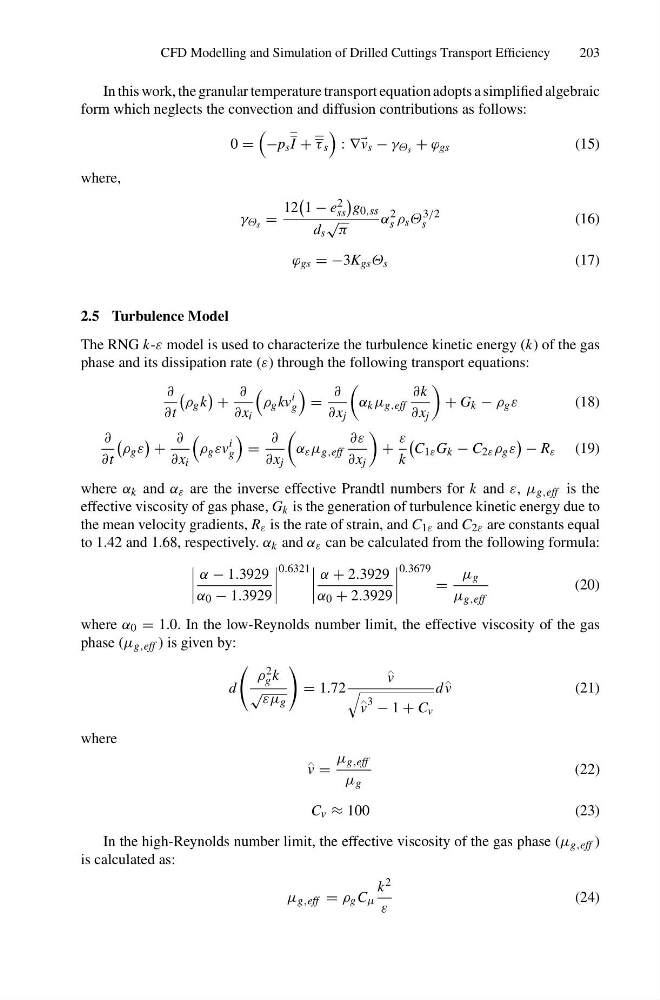
In this work, the granular temperature transport equation adopts a simplified algebraic
form which neglects the convection and diffusion contributions as follows:
0 =
−p s I + τ s
: ∇∇ v s − γ Θ s + ϕ gs
(15)
where,
γ Θ s =
12
1 − e 2
ss
g 0,ss
d s
√
π
α
2
s ρ s Θ
3/2
s
(16)
ϕ gs = −3K gs Θ s
(17)
2.5 Turbulence Model
The RNG k-ε model is used to characterize the turbulence kinetic energy (k) of the gas
phase and its dissipation rate (ε) through the following transport equations:
∂
∂t
ρ g k
+
∂
∂x i
ρ g kv
i
g
=
∂
∂x j
α k μ g,eff
∂k
∂x j
+ G k − ρ g ε
(18)
∂
∂t
ρ g ε
+
∂
∂x i
ρ g εv
i
g
=
∂
∂x j
α ε μ g,eff
∂ε
∂x j
+
ε
k
C 1ε G k − C 2ε ρ g ε
− R ε (19)
where α k and α ε are the inverse effective Prandtl numbers for k and ε, μ g,eff is the
effective viscosity of gas phase, G k is the generation of turbulence kinetic energy due to
the mean velocity gradients, R ε is the rate of strain, and C 1ε and C 2ε are constants equal
to 1.42 and 1.68, respectively. α k and α ε can be calculated from the following formula:
α − 1.3929
α 0 − 1.3929
0.6321
α + 2.3929
α 0 + 2.3929
0.3679
=
μ g
μ g,eff
(20)
where α 0 = 1.0. In the low-Reynolds number limit, the effective viscosity of the gas
phase (μ g,eff ) is given by:
d
ρ 2
g k
√
εμ g
= 1.72
v
v
3 − 1 + C v
dv
(21)
where
v
=
μ g,eff
μ g
(22)
C v ≈ 100
(23)
In the high-Reynolds number limit, the effective viscosity of the gas phase (μ g,eff )
is calculated as:
μ g,eff = ρ g C μ
k 2
ε
(24)
203
In this work, the granular temperature transport equation adopts a simplified algebraic
form which neglects the convection and diffusion contributions as follows:
0 =
−p s I + τ s
: ∇∇ v s − γ Θ s + ϕ gs
(15)
where,
γ Θ s =
12
1 − e 2
ss
g 0,ss
d s
√
π
α
2
s ρ s Θ
3/2
s
(16)
ϕ gs = −3K gs Θ s
(17)
2.5 Turbulence Model
The RNG k-ε model is used to characterize the turbulence kinetic energy (k) of the gas
phase and its dissipation rate (ε) through the following transport equations:
∂
∂t
ρ g k
+
∂
∂x i
ρ g kv
i
g
=
∂
∂x j
α k μ g,eff
∂k
∂x j
+ G k − ρ g ε
(18)
∂
∂t
ρ g ε
+
∂
∂x i
ρ g εv
i
g
=
∂
∂x j
α ε μ g,eff
∂ε
∂x j
+
ε
k
C 1ε G k − C 2ε ρ g ε
− R ε (19)
where α k and α ε are the inverse effective Prandtl numbers for k and ε, μ g,eff is the
effective viscosity of gas phase, G k is the generation of turbulence kinetic energy due to
the mean velocity gradients, R ε is the rate of strain, and C 1ε and C 2ε are constants equal
to 1.42 and 1.68, respectively. α k and α ε can be calculated from the following formula:
α − 1.3929
α 0 − 1.3929
0.6321
α + 2.3929
α 0 + 2.3929
0.3679
=
μ g
μ g,eff
(20)
where α 0 = 1.0. In the low-Reynolds number limit, the effective viscosity of the gas
phase (μ g,eff ) is given by:
d
ρ 2
g k
√
εμ g
= 1.72
v
v
3 − 1 + C v
dv
(21)
where
v
=
μ g,eff
μ g
(22)
C v ≈ 100
(23)
In the high-Reynolds number limit, the effective viscosity of the gas phase (μ g,eff )
is calculated as:
μ g,eff = ρ g C μ
k 2
ε
(24)