

Application of Functional Safety Analysis in Refined Oil Station
193
qualitative risk analysis, LOPA aims to further make quantitative description of the risks,
including the accurate description of the accident scene and the recognition of existing
independent protection layer, thus estimating whether the risk level of the system is
within the acceptable risk standard when this scenario occurs. If the risk is larger than
the allowable level, additional appropriate protection layer should be added to lower
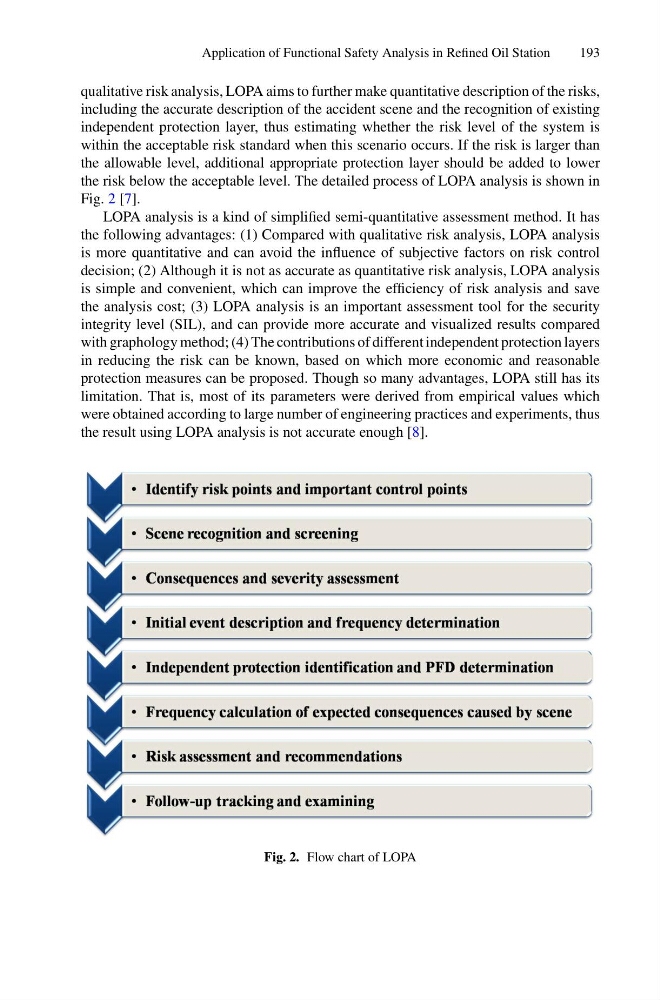
the risk below the acceptable level. The detailed process of LOPA analysis is shown in
Fig. 2 [7].
LOPA analysis is a kind of simplified semi-quantitative assessment method. It has
the following advantages: (1) Compared with qualitative risk analysis, LOPA analysis
is more quantitative and can avoid the influence of subjective factors on risk control
decision; (2) Although it is not as accurate as quantitative risk analysis, LOPA analysis
is simple and convenient, which can improve the efficiency of risk analysis and save
the analysis cost; (3) LOPA analysis is an important assessment tool for the security
integrity level (SIL), and can provide more accurate and visualized results compared
with graphology method; (4) The contributions of different independent protection layers
in reducing the risk can be known, based on which more economic and reasonable
protection measures can be proposed. Though so many advantages, LOPA still has its
limitation. That is, most of its parameters were derived from empirical values which
were obtained according to large number of engineering practices and experiments, thus
the result using LOPA analysis is not accurate enough [8].
Fig. 2. Flow chart of LOPA
193
qualitative risk analysis, LOPA aims to further make quantitative description of the risks,
including the accurate description of the accident scene and the recognition of existing
independent protection layer, thus estimating whether the risk level of the system is
within the acceptable risk standard when this scenario occurs. If the risk is larger than
the allowable level, additional appropriate protection layer should be added to lower
the risk below the acceptable level. The detailed process of LOPA analysis is shown in
Fig. 2 [7].
LOPA analysis is a kind of simplified semi-quantitative assessment method. It has
the following advantages: (1) Compared with qualitative risk analysis, LOPA analysis
is more quantitative and can avoid the influence of subjective factors on risk control
decision; (2) Although it is not as accurate as quantitative risk analysis, LOPA analysis
is simple and convenient, which can improve the efficiency of risk analysis and save
the analysis cost; (3) LOPA analysis is an important assessment tool for the security
integrity level (SIL), and can provide more accurate and visualized results compared
with graphology method; (4) The contributions of different independent protection layers
in reducing the risk can be known, based on which more economic and reasonable
protection measures can be proposed. Though so many advantages, LOPA still has its
limitation. That is, most of its parameters were derived from empirical values which
were obtained according to large number of engineering practices and experiments, thus
the result using LOPA analysis is not accurate enough [8].
Fig. 2. Flow chart of LOPA