

192
W. Li et al.
Hazard and Operability analysis is a structured and systematic analysis method [2].
In HAZOP analysis, a well-trained and experienced team leader leads members from
all fields. The “deviations” of the operating status from the normal status is analyzed
using “guide words”, identifying the potential risks to people and equipment and thus
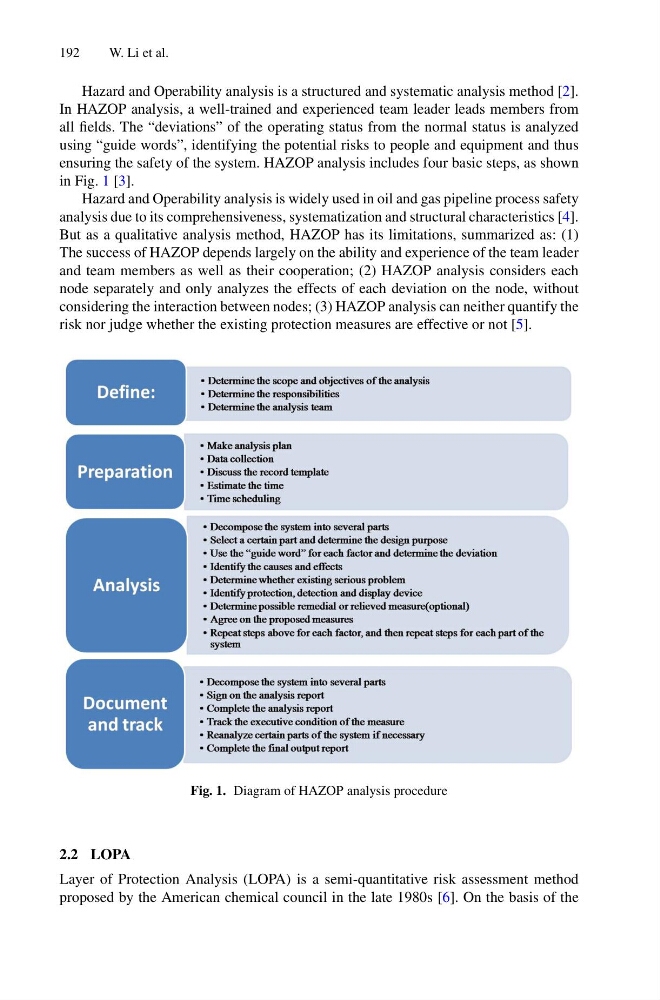
ensuring the safety of the system. HAZOP analysis includes four basic steps, as shown
in Fig. 1 [3].
Hazard and Operability analysis is widely used in oil and gas pipeline process safety
analysis due to its comprehensiveness, systematization and structural characteristics [4].
But as a qualitative analysis method, HAZOP has its limitations, summarized as: (1)
The success of HAZOP depends largely on the ability and experience of the team leader
and team members as well as their cooperation; (2) HAZOP analysis considers each
node separately and only analyzes the effects of each deviation on the node, without
considering the interaction between nodes; (3) HAZOP analysis can neither quantify the
risk nor judge whether the existing protection measures are effective or not [5].
Fig. 1. Diagram of HAZOP analysis procedure
2.2 LOPA
Layer of Protection Analysis (LOPA) is a semi-quantitative risk assessment method
proposed by the American chemical council in the late 1980s [6]. On the basis of the
W. Li et al.
Hazard and Operability analysis is a structured and systematic analysis method [2].
In HAZOP analysis, a well-trained and experienced team leader leads members from
all fields. The “deviations” of the operating status from the normal status is analyzed
using “guide words”, identifying the potential risks to people and equipment and thus
ensuring the safety of the system. HAZOP analysis includes four basic steps, as shown
in Fig. 1 [3].
Hazard and Operability analysis is widely used in oil and gas pipeline process safety
analysis due to its comprehensiveness, systematization and structural characteristics [4].
But as a qualitative analysis method, HAZOP has its limitations, summarized as: (1)
The success of HAZOP depends largely on the ability and experience of the team leader
and team members as well as their cooperation; (2) HAZOP analysis considers each
node separately and only analyzes the effects of each deviation on the node, without
considering the interaction between nodes; (3) HAZOP analysis can neither quantify the
risk nor judge whether the existing protection measures are effective or not [5].
Fig. 1. Diagram of HAZOP analysis procedure
2.2 LOPA
Layer of Protection Analysis (LOPA) is a semi-quantitative risk assessment method
proposed by the American chemical council in the late 1980s [6]. On the basis of the