

Influence of Ballast Track on Vertical Response of Multi-span SS Bridges
11
t (s)
f (Hz)
t (s)
f (Hz)
a
x
L
@ =0.5 (m/s )
2
a x
L
@ =0.5 (m/s /Hz)
2
Exp. A5
Exp. A17
Altaria Talgo VI @
km/h Track
154.8
(
#2)
Altaria Talgo VI @
km/h Track
154.8
(
#1)
Exp. A5
Exp. A17
Exp. A13
Exp. A12
Exp. A13
Exp. A12
(c)
(a)
(d)
(b)
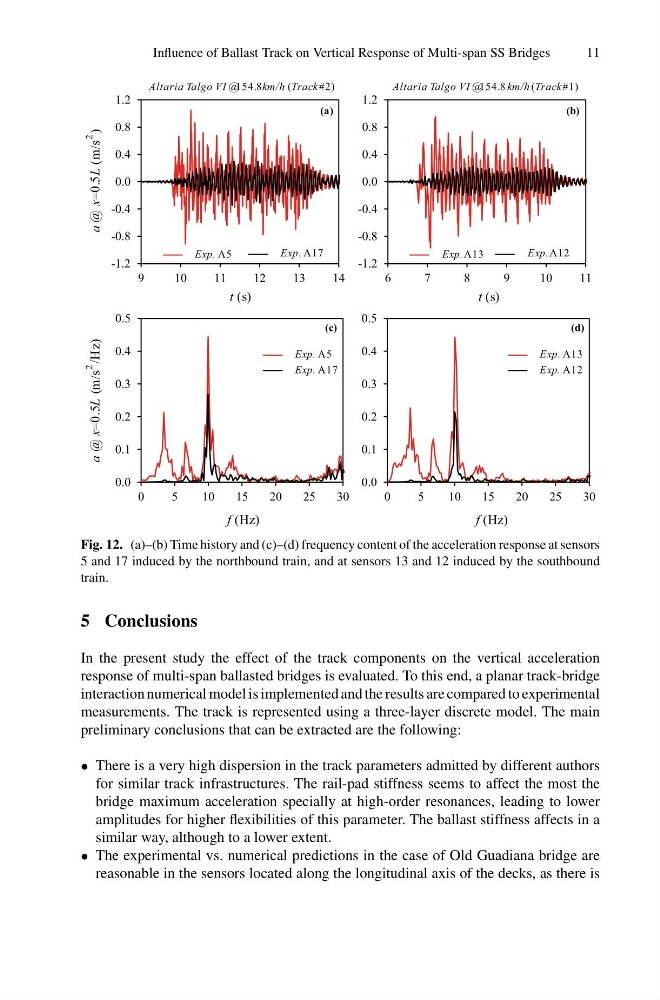
Fig. 12. (a)–(b) Time history and (c)–(d) frequency content of the acceleration response at sensors
5 and 17 induced by the northbound train, and at sensors 13 and 12 induced by the southbound
train.
5 Conclusions
In the present study the effect of the track components on the vertical acceleration
response of multi-span ballasted bridges is evaluated. To this end, a planar track-bridge
interaction numerical model is implemented and the results are compared to experimental
measurements. The track is represented using a three-layer discrete model. The main
preliminary conclusions that can be extracted are the following:
• There is a very high dispersion in the track parameters admitted by different authors
for similar track infrastructures. The rail-pad stiffness seems to affect the most the
bridge maximum acceleration specially at high-order resonances, leading to lower
amplitudes for higher flexibilities of this parameter. The ballast stiffness affects in a
similar way, although to a lower extent.
• The experimental vs. numerical predictions in the case of Old Guadiana bridge are
reasonable in the sensors located along the longitudinal axis of the decks, as there is
11
t (s)
f (Hz)
t (s)
f (Hz)
a
x
L
@ =0.5 (m/s )
2
a x
L
@ =0.5 (m/s /Hz)
2
Exp. A5
Exp. A17
Altaria Talgo VI @
km/h Track
154.8
(
#2)
Altaria Talgo VI @
km/h Track
154.8
(
#1)
Exp. A5
Exp. A17
Exp. A13
Exp. A12
Exp. A13
Exp. A12
(c)
(a)
(d)
(b)
Fig. 12. (a)–(b) Time history and (c)–(d) frequency content of the acceleration response at sensors
5 and 17 induced by the northbound train, and at sensors 13 and 12 induced by the southbound
train.
5 Conclusions
In the present study the effect of the track components on the vertical acceleration
response of multi-span ballasted bridges is evaluated. To this end, a planar track-bridge
interaction numerical model is implemented and the results are compared to experimental
measurements. The track is represented using a three-layer discrete model. The main
preliminary conclusions that can be extracted are the following:
• There is a very high dispersion in the track parameters admitted by different authors
for similar track infrastructures. The rail-pad stiffness seems to affect the most the
bridge maximum acceleration specially at high-order resonances, leading to lower
amplitudes for higher flexibilities of this parameter. The ballast stiffness affects in a
similar way, although to a lower extent.
• The experimental vs. numerical predictions in the case of Old Guadiana bridge are
reasonable in the sensors located along the longitudinal axis of the decks, as there is