

10
M. D. Martínez-Rodrigo et al.
t (s)
f (Hz)
t (s)
f (Hz)
a x
L
@ =0.5 (m/s )
2
a x
L
@ =0.5 (m/s /Hz)
2
a x
L
@ =1.5 (m/s )
2
a x
L
@ =1.5 (m/s /Hz)
2
Numerical
Experimental A13
(a)
Numerical
Experimental A17
(b)
Numerical
Experimental A13
(c)
Numerical
Experimental A17
(d)
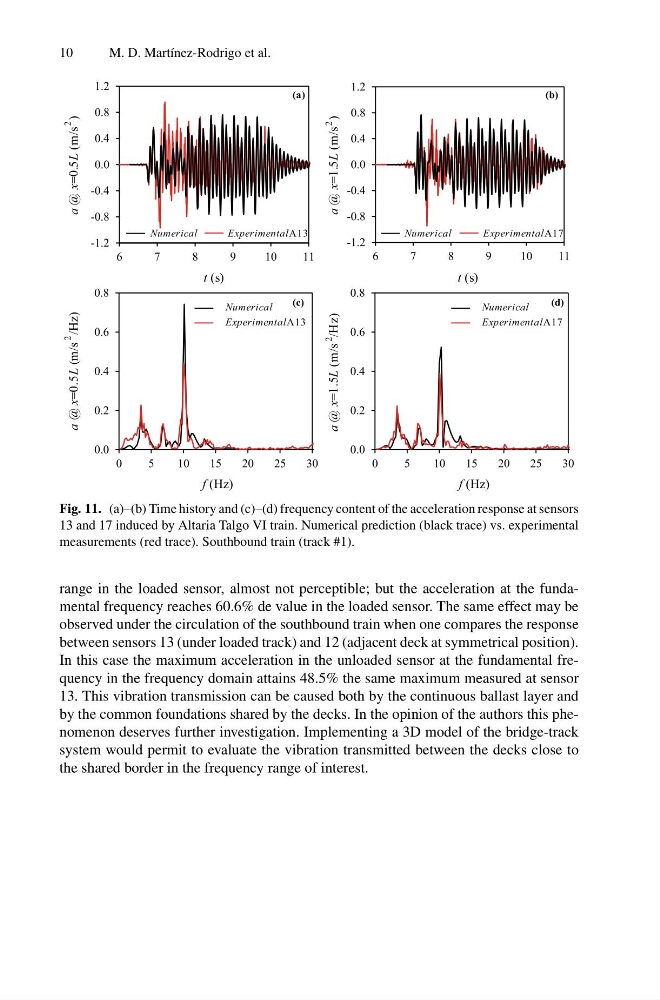
Fig. 11. (a)–(b) Time history and (c)–(d) frequency content of the acceleration response at sensors
13 and 17 induced by Altaria Talgo VI train. Numerical prediction (black trace) vs. experimental
measurements (red trace). Southbound train (track #1).
range in the loaded sensor, almost not perceptible; but the acceleration at the fundamental frequency reaches 60.6% de value in the loaded sensor. The same effect may be
observed under the circulation of the southbound train when one compares the response
between sensors 13 (under loaded track) and 12 (adjacent deck at symmetrical position).
In this case the maximum acceleration in the unloaded sensor at the fundamental frequency in the frequency domain attains 48.5% the same maximum measured at sensor
13. This vibration transmission can be caused both by the continuous ballast layer and
by the common foundations shared by the decks. In the opinion of the authors this phenomenon deserves further investigation. Implementing a 3D model of the bridge-track
system would permit to evaluate the vibration transmitted between the decks close to
the shared border in the frequency range of interest.
M. D. Martínez-Rodrigo et al.
t (s)
f (Hz)
t (s)
f (Hz)
a x
L
@ =0.5 (m/s )
2
a x
L
@ =0.5 (m/s /Hz)
2
a x
L
@ =1.5 (m/s )
2
a x
L
@ =1.5 (m/s /Hz)
2
Numerical
Experimental A13
(a)
Numerical
Experimental A17
(b)
Numerical
Experimental A13
(c)
Numerical
Experimental A17
(d)
Fig. 11. (a)–(b) Time history and (c)–(d) frequency content of the acceleration response at sensors
13 and 17 induced by Altaria Talgo VI train. Numerical prediction (black trace) vs. experimental
measurements (red trace). Southbound train (track #1).
range in the loaded sensor, almost not perceptible; but the acceleration at the fundamental frequency reaches 60.6% de value in the loaded sensor. The same effect may be
observed under the circulation of the southbound train when one compares the response
between sensors 13 (under loaded track) and 12 (adjacent deck at symmetrical position).
In this case the maximum acceleration in the unloaded sensor at the fundamental frequency in the frequency domain attains 48.5% the same maximum measured at sensor
13. This vibration transmission can be caused both by the continuous ballast layer and
by the common foundations shared by the decks. In the opinion of the authors this phenomenon deserves further investigation. Implementing a 3D model of the bridge-track
system would permit to evaluate the vibration transmitted between the decks close to
the shared border in the frequency range of interest.