

178
M. Cao et al.
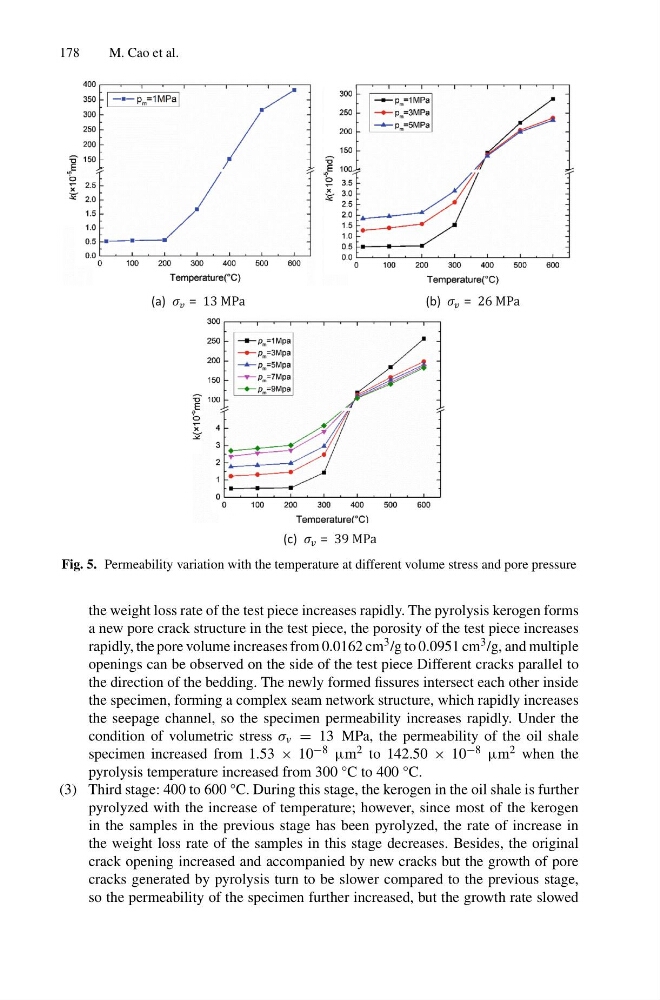
Fig. 5. Permeability variation with the temperature at different volume stress and pore pressure
the weight loss rate of the test piece increases rapidly. The pyrolysis kerogen forms
a new pore crack structure in the test piece, the porosity of the test piece increases
rapidly, the pore volume increases from 0.0162 cm 3 /g to 0.0951 cm 3 /g, and multiple
openings can be observed on the side of the test piece Different cracks parallel to
the direction of the bedding. The newly formed fissures intersect each other inside
the specimen, forming a complex seam network structure, which rapidly increases
the seepage channel, so the specimen permeability increases rapidly. Under the
condition of volumetric stress σ v = 13 MPa, the permeability of the oil shale
specimen increased from 1.53 × 10 −8 µm 2 to 142.50 × 10 −8 µm 2 when the
pyrolysis temperature increased from 300 °C to 400 °C.
(3) Third stage: 400 to 600 °C. During this stage, the kerogen in the oil shale is further
pyrolyzed with the increase of temperature; however, since most of the kerogen
in the samples in the previous stage has been pyrolyzed, the rate of increase in
the weight loss rate of the samples in this stage decreases. Besides, the original
crack opening increased and accompanied by new cracks but the growth of pore
cracks generated by pyrolysis turn to be slower compared to the previous stage,
so the permeability of the specimen further increased, but the growth rate slowed
M. Cao et al.
Fig. 5. Permeability variation with the temperature at different volume stress and pore pressure
the weight loss rate of the test piece increases rapidly. The pyrolysis kerogen forms
a new pore crack structure in the test piece, the porosity of the test piece increases
rapidly, the pore volume increases from 0.0162 cm 3 /g to 0.0951 cm 3 /g, and multiple
openings can be observed on the side of the test piece Different cracks parallel to
the direction of the bedding. The newly formed fissures intersect each other inside
the specimen, forming a complex seam network structure, which rapidly increases
the seepage channel, so the specimen permeability increases rapidly. Under the
condition of volumetric stress σ v = 13 MPa, the permeability of the oil shale
specimen increased from 1.53 × 10 −8 µm 2 to 142.50 × 10 −8 µm 2 when the
pyrolysis temperature increased from 300 °C to 400 °C.
(3) Third stage: 400 to 600 °C. During this stage, the kerogen in the oil shale is further
pyrolyzed with the increase of temperature; however, since most of the kerogen
in the samples in the previous stage has been pyrolyzed, the rate of increase in
the weight loss rate of the samples in this stage decreases. Besides, the original
crack opening increased and accompanied by new cracks but the growth of pore
cracks generated by pyrolysis turn to be slower compared to the previous stage,
so the permeability of the specimen further increased, but the growth rate slowed