

Experimental Investigation of the Evolution of Permeability and Porosity
177
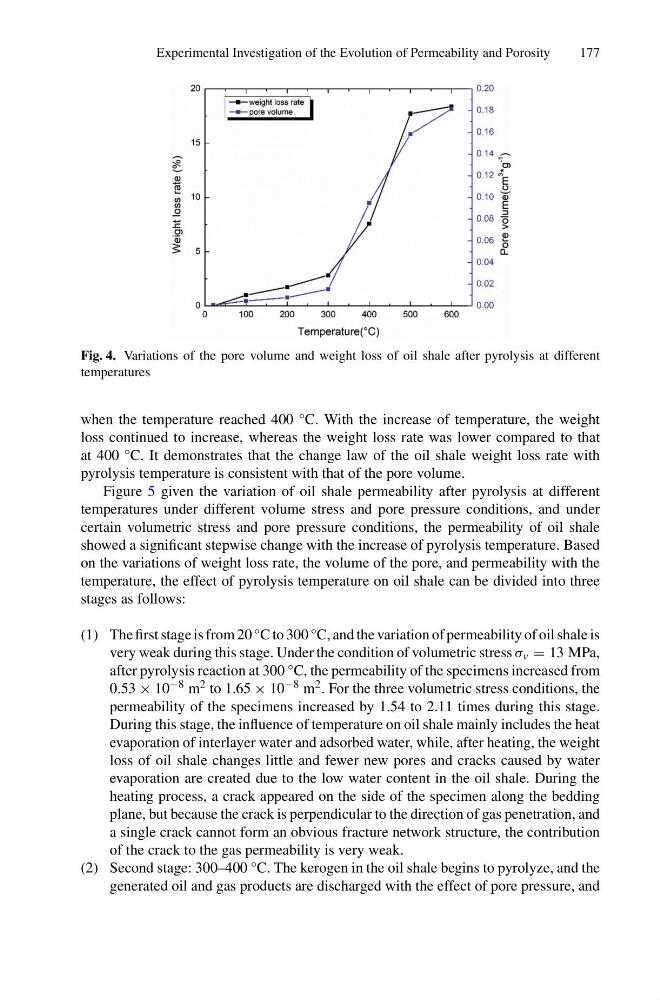
Fig. 4. Variations of the pore volume and weight loss of oil shale after pyrolysis at different
temperatures
when the temperature reached 400 °C. With the increase of temperature, the weight
loss continued to increase, whereas the weight loss rate was lower compared to that
at 400 °C. It demonstrates that the change law of the oil shale weight loss rate with
pyrolysis temperature is consistent with that of the pore volume.
Figure 5 given the variation of oil shale permeability after pyrolysis at different
temperatures under different volume stress and pore pressure conditions, and under
certain volumetric stress and pore pressure conditions, the permeability of oil shale
showed a significant stepwise change with the increase of pyrolysis temperature. Based
on the variations of weight loss rate, the volume of the pore, and permeability with the
temperature, the effect of pyrolysis temperature on oil shale can be divided into three
stages as follows:
(1) The first stage is from 20 °C to 300 °C, and the variation of permeability of oil shale is
very weak during this stage. Under the condition of volumetric stress σ v = 13 MPa,
after pyrolysis reaction at 300 °C, the permeability of the specimens increased from
0.53 × 10 −8 m 2 to 1.65 × 10 −8 m 2 . For the three volumetric stress conditions, the
permeability of the specimens increased by 1.54 to 2.11 times during this stage.
During this stage, the influence of temperature on oil shale mainly includes the heat
evaporation of interlayer water and adsorbed water, while, after heating, the weight
loss of oil shale changes little and fewer new pores and cracks caused by water
evaporation are created due to the low water content in the oil shale. During the
heating process, a crack appeared on the side of the specimen along the bedding
plane, but because the crack is perpendicular to the direction of gas penetration, and
a single crack cannot form an obvious fracture network structure, the contribution
of the crack to the gas permeability is very weak.
(2) Second stage: 300–400 °C. The kerogen in the oil shale begins to pyrolyze, and the
generated oil and gas products are discharged with the effect of pore pressure, and
177
Fig. 4. Variations of the pore volume and weight loss of oil shale after pyrolysis at different
temperatures
when the temperature reached 400 °C. With the increase of temperature, the weight
loss continued to increase, whereas the weight loss rate was lower compared to that
at 400 °C. It demonstrates that the change law of the oil shale weight loss rate with
pyrolysis temperature is consistent with that of the pore volume.
Figure 5 given the variation of oil shale permeability after pyrolysis at different
temperatures under different volume stress and pore pressure conditions, and under
certain volumetric stress and pore pressure conditions, the permeability of oil shale
showed a significant stepwise change with the increase of pyrolysis temperature. Based
on the variations of weight loss rate, the volume of the pore, and permeability with the
temperature, the effect of pyrolysis temperature on oil shale can be divided into three
stages as follows:
(1) The first stage is from 20 °C to 300 °C, and the variation of permeability of oil shale is
very weak during this stage. Under the condition of volumetric stress σ v = 13 MPa,
after pyrolysis reaction at 300 °C, the permeability of the specimens increased from
0.53 × 10 −8 m 2 to 1.65 × 10 −8 m 2 . For the three volumetric stress conditions, the
permeability of the specimens increased by 1.54 to 2.11 times during this stage.
During this stage, the influence of temperature on oil shale mainly includes the heat
evaporation of interlayer water and adsorbed water, while, after heating, the weight
loss of oil shale changes little and fewer new pores and cracks caused by water
evaporation are created due to the low water content in the oil shale. During the
heating process, a crack appeared on the side of the specimen along the bedding
plane, but because the crack is perpendicular to the direction of gas penetration, and
a single crack cannot form an obvious fracture network structure, the contribution
of the crack to the gas permeability is very weak.
(2) Second stage: 300–400 °C. The kerogen in the oil shale begins to pyrolyze, and the
generated oil and gas products are discharged with the effect of pore pressure, and