

ALOHA Anti-collision Algorithm
167
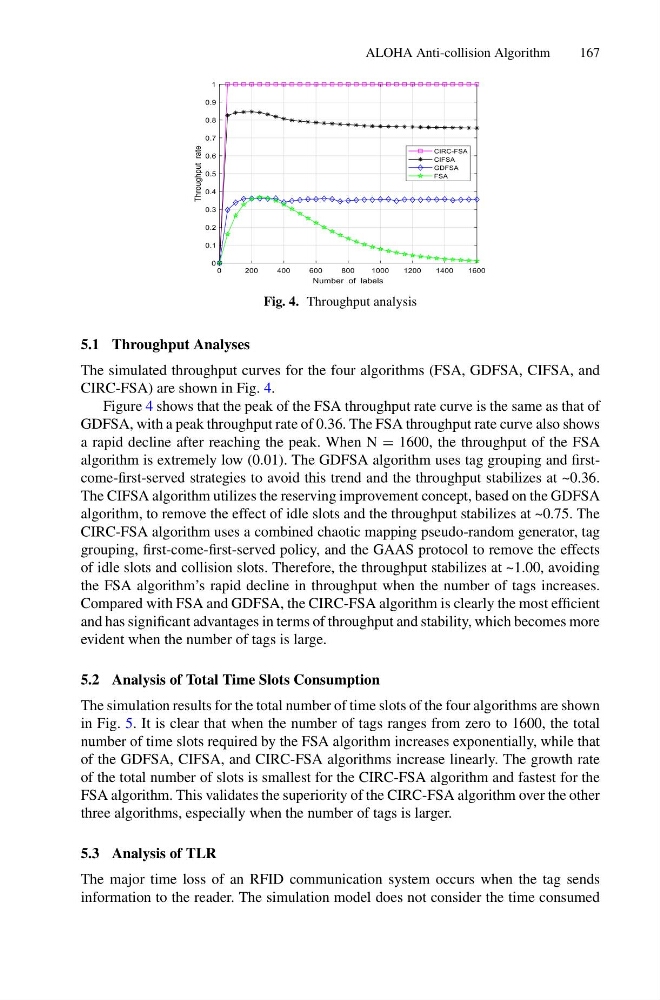
Fig. 4. Throughput analysis
5.1 Throughput Analyses
The simulated throughput curves for the four algorithms (FSA, GDFSA, CIFSA, and
CIRC-FSA) are shown in Fig. 4.
Figure 4 shows that the peak of the FSA throughput rate curve is the same as that of
GDFSA, with a peak throughput rate of 0.36. The FSA throughput rate curve also shows
a rapid decline after reaching the peak. When N = 1600, the throughput of the FSA
algorithm is extremely low (0.01). The GDFSA algorithm uses tag grouping and firstcome-first-served strategies to avoid this trend and the throughput stabilizes at ~0.36.
The CIFSA algorithm utilizes the reserving improvement concept, based on the GDFSA
algorithm, to remove the effect of idle slots and the throughput stabilizes at ~0.75. The
CIRC-FSA algorithm uses a combined chaotic mapping pseudo-random generator, tag
grouping, first-come-first-served policy, and the GAAS protocol to remove the effects
of idle slots and collision slots. Therefore, the throughput stabilizes at ~1.00, avoiding
the FSA algorithm’s rapid decline in throughput when the number of tags increases.
Compared with FSA and GDFSA, the CIRC-FSA algorithm is clearly the most efficient
and has significant advantages in terms of throughput and stability, which becomes more
evident when the number of tags is large.
5.2 Analysis of Total Time Slots Consumption
The simulation results for the total number of time slots of the four algorithms are shown
in Fig. 5. It is clear that when the number of tags ranges from zero to 1600, the total
number of time slots required by the FSA algorithm increases exponentially, while that
of the GDFSA, CIFSA, and CIRC-FSA algorithms increase linearly. The growth rate
of the total number of slots is smallest for the CIRC-FSA algorithm and fastest for the
FSA algorithm. This validates the superiority of the CIRC-FSA algorithm over the other
three algorithms, especially when the number of tags is larger.
5.3 Analysis of TLR
The major time loss of an RFID communication system occurs when the tag sends
information to the reader. The simulation model does not consider the time consumed
167
Fig. 4. Throughput analysis
5.1 Throughput Analyses
The simulated throughput curves for the four algorithms (FSA, GDFSA, CIFSA, and
CIRC-FSA) are shown in Fig. 4.
Figure 4 shows that the peak of the FSA throughput rate curve is the same as that of
GDFSA, with a peak throughput rate of 0.36. The FSA throughput rate curve also shows
a rapid decline after reaching the peak. When N = 1600, the throughput of the FSA
algorithm is extremely low (0.01). The GDFSA algorithm uses tag grouping and firstcome-first-served strategies to avoid this trend and the throughput stabilizes at ~0.36.
The CIFSA algorithm utilizes the reserving improvement concept, based on the GDFSA
algorithm, to remove the effect of idle slots and the throughput stabilizes at ~0.75. The
CIRC-FSA algorithm uses a combined chaotic mapping pseudo-random generator, tag
grouping, first-come-first-served policy, and the GAAS protocol to remove the effects
of idle slots and collision slots. Therefore, the throughput stabilizes at ~1.00, avoiding
the FSA algorithm’s rapid decline in throughput when the number of tags increases.
Compared with FSA and GDFSA, the CIRC-FSA algorithm is clearly the most efficient
and has significant advantages in terms of throughput and stability, which becomes more
evident when the number of tags is large.
5.2 Analysis of Total Time Slots Consumption
The simulation results for the total number of time slots of the four algorithms are shown
in Fig. 5. It is clear that when the number of tags ranges from zero to 1600, the total
number of time slots required by the FSA algorithm increases exponentially, while that
of the GDFSA, CIFSA, and CIRC-FSA algorithms increase linearly. The growth rate
of the total number of slots is smallest for the CIRC-FSA algorithm and fastest for the
FSA algorithm. This validates the superiority of the CIRC-FSA algorithm over the other
three algorithms, especially when the number of tags is larger.
5.3 Analysis of TLR
The major time loss of an RFID communication system occurs when the tag sends
information to the reader. The simulation model does not consider the time consumed