

166
H. Deng et al.
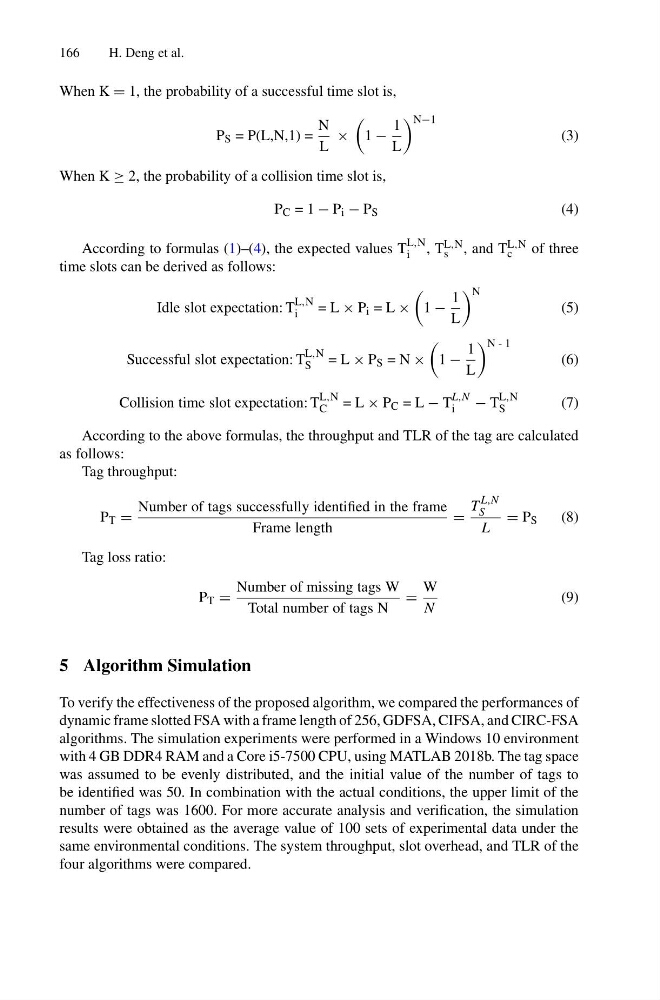
When K = 1, the probability of a successful time slot is,
P S = P(L,N,1) =
N
L
×
1 −
1
L
N−1
(3)
When K ≥ 2, the probability of a collision time slot is,
P C = 1 − P i − P S
(4)
According to formulas (1)–(4), the expected values T
L,N
i , T L,N
s , and T L,N
c
of three
time slots can be derived as follows:
Idle slot expectation: T
L,N
i
= L × P i = L ×
1 −
1
L
N
(5)
Successful slot expectation: T
L,N
S
= L × P S = N ×
1 −
1
L
N - 1
(6)
Collision time slot expectation: T
L,N
C = L × P C = L − T
L,N
i
− T
L,N
S
(7)
According to the above formulas, the throughput and TLR of the tag are calculated
as follows:
Tag throughput:
P T =
Number of tags successfully identified in the frame
Frame length
=
T
L,N
S
L
= P S
(8)
Tag loss ratio:
P T =
Number of missing tags W
Total number of tags N
=
W
N
(9)
5 Algorithm Simulation
To verify the effectiveness of the proposed algorithm, we compared the performances of
dynamic frame slotted FSA with a frame length of 256, GDFSA, CIFSA, and CIRC-FSA
algorithms. The simulation experiments were performed in a Windows 10 environment
with 4 GB DDR4 RAM and a Core i5-7500 CPU, using MATLAB 2018b. The tag space
was assumed to be evenly distributed, and the initial value of the number of tags to
be identified was 50. In combination with the actual conditions, the upper limit of the
number of tags was 1600. For more accurate analysis and verification, the simulation
results were obtained as the average value of 100 sets of experimental data under the
same environmental conditions. The system throughput, slot overhead, and TLR of the
four algorithms were compared.
H. Deng et al.
When K = 1, the probability of a successful time slot is,
P S = P(L,N,1) =
N
L
×
1 −
1
L
N−1
(3)
When K ≥ 2, the probability of a collision time slot is,
P C = 1 − P i − P S
(4)
According to formulas (1)–(4), the expected values T
L,N
i , T L,N
s , and T L,N
c
of three
time slots can be derived as follows:
Idle slot expectation: T
L,N
i
= L × P i = L ×
1 −
1
L
N
(5)
Successful slot expectation: T
L,N
S
= L × P S = N ×
1 −
1
L
N - 1
(6)
Collision time slot expectation: T
L,N
C = L × P C = L − T
L,N
i
− T
L,N
S
(7)
According to the above formulas, the throughput and TLR of the tag are calculated
as follows:
Tag throughput:
P T =
Number of tags successfully identified in the frame
Frame length
=
T
L,N
S
L
= P S
(8)
Tag loss ratio:
P T =
Number of missing tags W
Total number of tags N
=
W
N
(9)
5 Algorithm Simulation
To verify the effectiveness of the proposed algorithm, we compared the performances of
dynamic frame slotted FSA with a frame length of 256, GDFSA, CIFSA, and CIRC-FSA
algorithms. The simulation experiments were performed in a Windows 10 environment
with 4 GB DDR4 RAM and a Core i5-7500 CPU, using MATLAB 2018b. The tag space
was assumed to be evenly distributed, and the initial value of the number of tags to
be identified was 50. In combination with the actual conditions, the upper limit of the
number of tags was 1600. For more accurate analysis and verification, the simulation
results were obtained as the average value of 100 sets of experimental data under the
same environmental conditions. The system throughput, slot overhead, and TLR of the
four algorithms were compared.