

Study on the Separation Technology of HGS and Its Effect
151
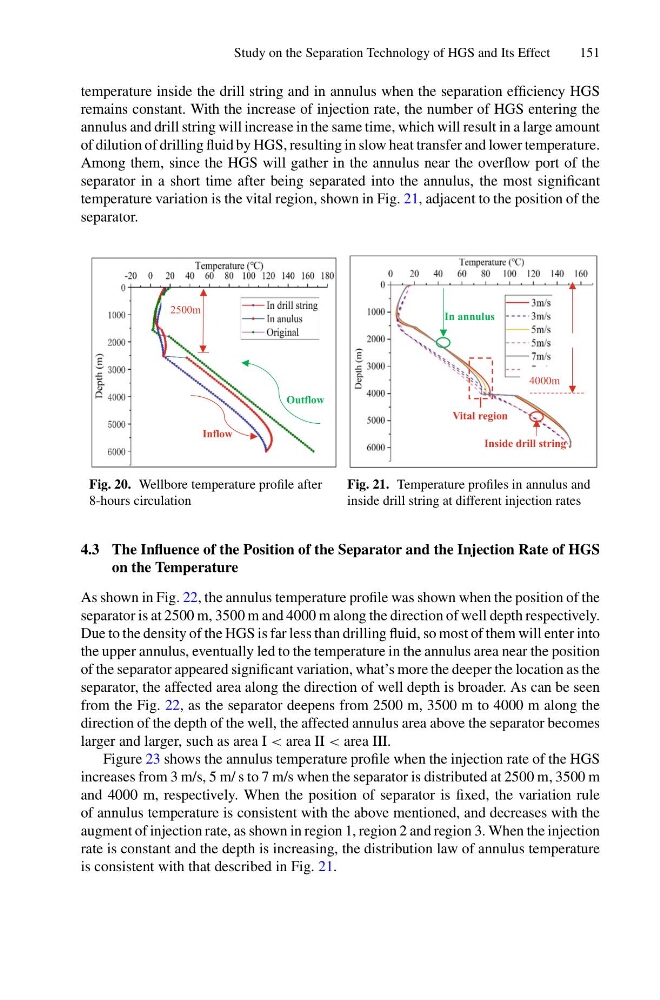
temperature inside the drill string and in annulus when the separation efficiency HGS
remains constant. With the increase of injection rate, the number of HGS entering the
annulus and drill string will increase in the same time, which will result in a large amount
of dilution of drilling fluid by HGS, resulting in slow heat transfer and lower temperature.
Among them, since the HGS will gather in the annulus near the overflow port of the
separator in a short time after being separated into the annulus, the most significant
temperature variation is the vital region, shown in Fig. 21, adjacent to the position of the
separator.
2500m
Inflow
Outflow
Fig. 20. Wellbore temperature profile after
8-hours circulation
4000m
Inside drill string
In annulus
Vital region
Fig. 21. Temperature profiles in annulus and
inside drill string at different injection rates
4.3 The Influence of the Position of the Separator and the Injection Rate of HGS
on the Temperature
As shown in Fig. 22, the annulus temperature profile was shown when the position of the
separator is at 2500 m, 3500 m and 4000 m along the direction of well depth respectively.
Due to the density of the HGS is far less than drilling fluid, so most of them will enter into
the upper annulus, eventually led to the temperature in the annulus area near the position
of the separator appeared significant variation, what’s more the deeper the location as the
separator, the affected area along the direction of well depth is broader. As can be seen
from the Fig. 22, as the separator deepens from 2500 m, 3500 m to 4000 m along the
direction of the depth of the well, the affected annulus area above the separator becomes
larger and larger, such as area I < area II < area III.
Figure 23 shows the annulus temperature profile when the injection rate of the HGS
increases from 3 m/s, 5 m/ s to 7 m/s when the separator is distributed at 2500 m, 3500 m
and 4000 m, respectively. When the position of separator is fixed, the variation rule
of annulus temperature is consistent with the above mentioned, and decreases with the
augment of injection rate, as shown in region 1, region 2 and region 3. When the injection
rate is constant and the depth is increasing, the distribution law of annulus temperature
is consistent with that described in Fig. 21.
151
temperature inside the drill string and in annulus when the separation efficiency HGS
remains constant. With the increase of injection rate, the number of HGS entering the
annulus and drill string will increase in the same time, which will result in a large amount
of dilution of drilling fluid by HGS, resulting in slow heat transfer and lower temperature.
Among them, since the HGS will gather in the annulus near the overflow port of the
separator in a short time after being separated into the annulus, the most significant
temperature variation is the vital region, shown in Fig. 21, adjacent to the position of the
separator.
2500m
Inflow
Outflow
Fig. 20. Wellbore temperature profile after
8-hours circulation
4000m
Inside drill string
In annulus
Vital region
Fig. 21. Temperature profiles in annulus and
inside drill string at different injection rates
4.3 The Influence of the Position of the Separator and the Injection Rate of HGS
on the Temperature
As shown in Fig. 22, the annulus temperature profile was shown when the position of the
separator is at 2500 m, 3500 m and 4000 m along the direction of well depth respectively.
Due to the density of the HGS is far less than drilling fluid, so most of them will enter into
the upper annulus, eventually led to the temperature in the annulus area near the position
of the separator appeared significant variation, what’s more the deeper the location as the
separator, the affected area along the direction of well depth is broader. As can be seen
from the Fig. 22, as the separator deepens from 2500 m, 3500 m to 4000 m along the
direction of the depth of the well, the affected annulus area above the separator becomes
larger and larger, such as area I < area II < area III.
Figure 23 shows the annulus temperature profile when the injection rate of the HGS
increases from 3 m/s, 5 m/ s to 7 m/s when the separator is distributed at 2500 m, 3500 m
and 4000 m, respectively. When the position of separator is fixed, the variation rule
of annulus temperature is consistent with the above mentioned, and decreases with the
augment of injection rate, as shown in region 1, region 2 and region 3. When the injection
rate is constant and the depth is increasing, the distribution law of annulus temperature
is consistent with that described in Fig. 21.