

represents the fact that the putative other polymer in the network, to which the chain
was temporarily linked, will likely move away after dissociation. Different physical
or chemical reversible bonds may be represented by different values of u 0 and r c .
Once dissociation has occurred, the rebinding timer is reset to zero and – as
described above – the bead fluctuates freely as the clock counts down to the next
transient binding event.
In molecular dynamics simulations where the entire network is simulated, rather
than only a single chain embedded in the effective medium, it is more efficient to
employ a different, explicit Monte Carlo strategy for the reversible links. A valuable
approach for this purpose has been developed for reversibly binding telechelic
polymers in [76]. We now present their original formulation while also modifying
it so that it obeys detailed balance (i.e. the binding and unbinding rates are chosen
such that the populations of bound and unbound linkers match the free energy
difference between bound and unbound states).
Monte Carlo moves that bind and unbind reversible cross-links are carried out
every N MC time steps in the MD simulation, which is at those points temporarily
paused to rearrange the transient connections. This time interval is set to be
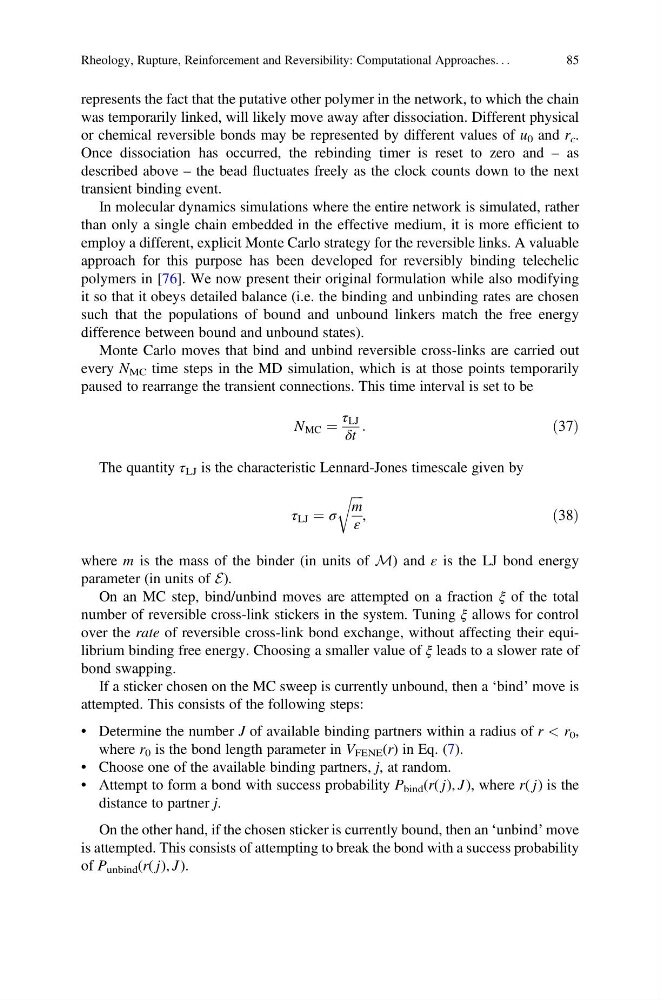
N MC ¼
τ LJ
δt
:
ð37Þ
The quantity τ LJ is the characteristic Lennard-Jones timescale given by
τ LJ ¼ σ
ffiffiffi ffi
m
ε
r
,
ð38Þ
where m is the mass of the binder (in units of M) and ε is the LJ bond energy
parameter (in units of E).
On an MC step, bind/unbind moves are attempted on a fraction ξ of the total
number of reversible cross-link stickers in the system. Tuning ξ allows for control
over the rate of reversible cross-link bond exchange, without affecting their equilibrium binding free energy. Choosing a smaller value of ξ leads to a slower rate of
bond swapping.
If a sticker chosen on the MC sweep is currently unbound, then a ‘bind’ move is
attempted. This consists of the following steps:
• Determine the number J of available binding partners within a radius of r < r 0 ,
where r 0 is the bond length parameter in V FENE (r) in Eq. (7).
• Choose one of the available binding partners, j, at random.
• Attempt to form a bond with success probability P bind (r( j), J), where r( j) is the
distance to partner j.
On the other hand, if the chosen sticker is currently bound, then an ‘unbind’ move
is attempted. This consists of attempting to break the bond with a success probability
of P unbind (r( j), J ).
Rheology, Rupture, Reinforcement and Reversibility: Computational Approaches. . .
85
was temporarily linked, will likely move away after dissociation. Different physical
or chemical reversible bonds may be represented by different values of u 0 and r c .
Once dissociation has occurred, the rebinding timer is reset to zero and – as
described above – the bead fluctuates freely as the clock counts down to the next
transient binding event.
In molecular dynamics simulations where the entire network is simulated, rather
than only a single chain embedded in the effective medium, it is more efficient to
employ a different, explicit Monte Carlo strategy for the reversible links. A valuable
approach for this purpose has been developed for reversibly binding telechelic
polymers in [76]. We now present their original formulation while also modifying
it so that it obeys detailed balance (i.e. the binding and unbinding rates are chosen
such that the populations of bound and unbound linkers match the free energy
difference between bound and unbound states).
Monte Carlo moves that bind and unbind reversible cross-links are carried out
every N MC time steps in the MD simulation, which is at those points temporarily
paused to rearrange the transient connections. This time interval is set to be
N MC ¼
τ LJ
δt
:
ð37Þ
The quantity τ LJ is the characteristic Lennard-Jones timescale given by
τ LJ ¼ σ
ffiffiffi ffi
m
ε
r
,
ð38Þ
where m is the mass of the binder (in units of M) and ε is the LJ bond energy
parameter (in units of E).
On an MC step, bind/unbind moves are attempted on a fraction ξ of the total
number of reversible cross-link stickers in the system. Tuning ξ allows for control
over the rate of reversible cross-link bond exchange, without affecting their equilibrium binding free energy. Choosing a smaller value of ξ leads to a slower rate of
bond swapping.
If a sticker chosen on the MC sweep is currently unbound, then a ‘bind’ move is
attempted. This consists of the following steps:
• Determine the number J of available binding partners within a radius of r < r 0 ,
where r 0 is the bond length parameter in V FENE (r) in Eq. (7).
• Choose one of the available binding partners, j, at random.
• Attempt to form a bond with success probability P bind (r( j), J), where r( j) is the
distance to partner j.
On the other hand, if the chosen sticker is currently bound, then an ‘unbind’ move
is attempted. This consists of attempting to break the bond with a success probability
of P unbind (r( j), J ).
Rheology, Rupture, Reinforcement and Reversibility: Computational Approaches. . .
85