

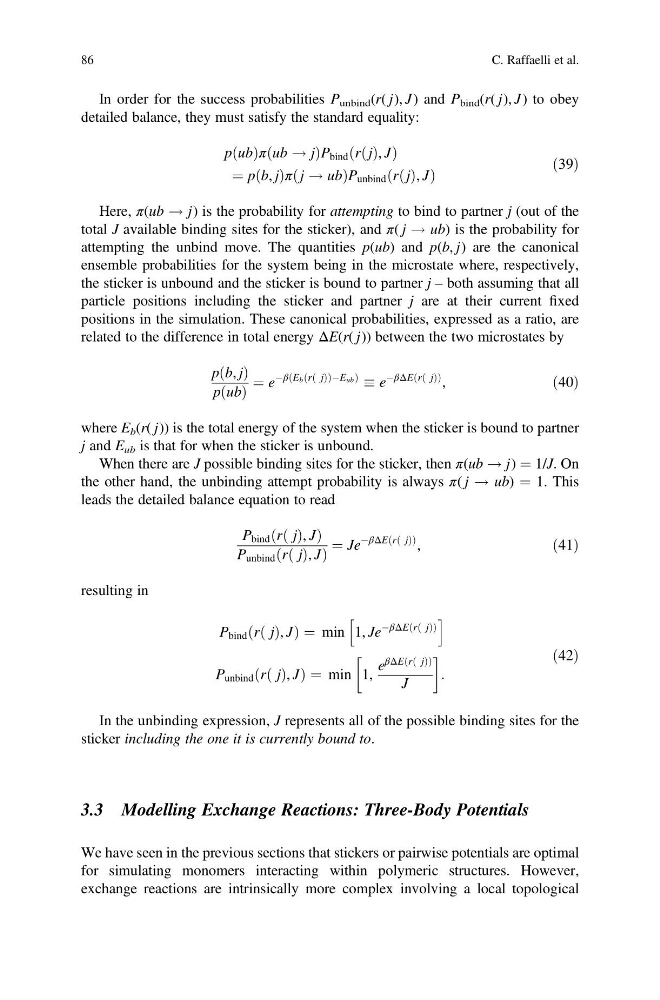
In order for the success probabilities P unbind (r( j), J) and P bind (r( j), J ) to obey
detailed balance, they must satisfy the standard equality:
p ub
ð Þπ ub ! j
ð
ÞP bind r j
ð Þ, J
ð
Þ
¼ p b, j
ð Þπ j ! ub
ð
ÞP unbind r j
ð Þ, J
ð
Þ
ð39Þ
Here, π(ub ! j) is the probability for attempting to bind to partner j (out of the
total J available binding sites for the sticker), and π( j ! ub) is the probability for
attempting the unbind move. The quantities p(ub) and p(b, j) are the canonical
ensemble probabilities for the system being in the microstate where, respectively,
the sticker is unbound and the sticker is bound to partner j – both assuming that all
particle positions including the sticker and partner j are at their current fixed
positions in the simulation. These canonical probabilities, expressed as a ratio, are
related to the difference in total energy ΔE(r( j)) between the two microstates by
p b, j
ð Þ
p ub
ð Þ
¼ e
Àβ E b r j
ð Þ
ð
ÞÀE ub
ð
Þ
e
ÀβΔE r j
ð Þ
ð
Þ ,
ð40Þ
where E b (r( j)) is the total energy of the system when the sticker is bound to partner
j and E ub is that for when the sticker is unbound.
When there are J possible binding sites for the sticker, then π(ub ! j) ¼ 1/J. On
the other hand, the unbinding attempt probability is always π( j ! ub) ¼ 1. This
leads the detailed balance equation to read
P bind r j
ð Þ, J
ð
Þ
P unbind r j
ð Þ, J
ð
Þ
¼ Je
ÀβΔE r j
ð Þ
ð
Þ ,
ð41Þ
resulting in
P bind r j
ð Þ, J
ð
Þ¼ min 1, Je
ÀβΔE r j
ð Þ
ð
Þ
h
i
P unbind r j
ð Þ, J
ð
Þ¼ min 1,
e
βΔE r j
ð Þ
ð
Þ
J
!
:
ð42Þ
In the unbinding expression, J represents all of the possible binding sites for the
sticker including the one it is currently bound to.
3.3 Modelling Exchange Reactions: Three-Body Potentials
We have seen in the previous sections that stickers or pairwise potentials are optimal
for simulating monomers interacting within polymeric structures. However,
exchange reactions are intrinsically more complex involving a local topological
86
C. Raffaelli et al.
detailed balance, they must satisfy the standard equality:
p ub
ð Þπ ub ! j
ð
ÞP bind r j
ð Þ, J
ð
Þ
¼ p b, j
ð Þπ j ! ub
ð
ÞP unbind r j
ð Þ, J
ð
Þ
ð39Þ
Here, π(ub ! j) is the probability for attempting to bind to partner j (out of the
total J available binding sites for the sticker), and π( j ! ub) is the probability for
attempting the unbind move. The quantities p(ub) and p(b, j) are the canonical
ensemble probabilities for the system being in the microstate where, respectively,
the sticker is unbound and the sticker is bound to partner j – both assuming that all
particle positions including the sticker and partner j are at their current fixed
positions in the simulation. These canonical probabilities, expressed as a ratio, are
related to the difference in total energy ΔE(r( j)) between the two microstates by
p b, j
ð Þ
p ub
ð Þ
¼ e
Àβ E b r j
ð Þ
ð
ÞÀE ub
ð
Þ
e
ÀβΔE r j
ð Þ
ð
Þ ,
ð40Þ
where E b (r( j)) is the total energy of the system when the sticker is bound to partner
j and E ub is that for when the sticker is unbound.
When there are J possible binding sites for the sticker, then π(ub ! j) ¼ 1/J. On
the other hand, the unbinding attempt probability is always π( j ! ub) ¼ 1. This
leads the detailed balance equation to read
P bind r j
ð Þ, J
ð
Þ
P unbind r j
ð Þ, J
ð
Þ
¼ Je
ÀβΔE r j
ð Þ
ð
Þ ,
ð41Þ
resulting in
P bind r j
ð Þ, J
ð
Þ¼ min 1, Je
ÀβΔE r j
ð Þ
ð
Þ
h
i
P unbind r j
ð Þ, J
ð
Þ¼ min 1,
e
βΔE r j
ð Þ
ð
Þ
J
!
:
ð42Þ
In the unbinding expression, J represents all of the possible binding sites for the
sticker including the one it is currently bound to.
3.3 Modelling Exchange Reactions: Three-Body Potentials
We have seen in the previous sections that stickers or pairwise potentials are optimal
for simulating monomers interacting within polymeric structures. However,
exchange reactions are intrinsically more complex involving a local topological
86
C. Raffaelli et al.