

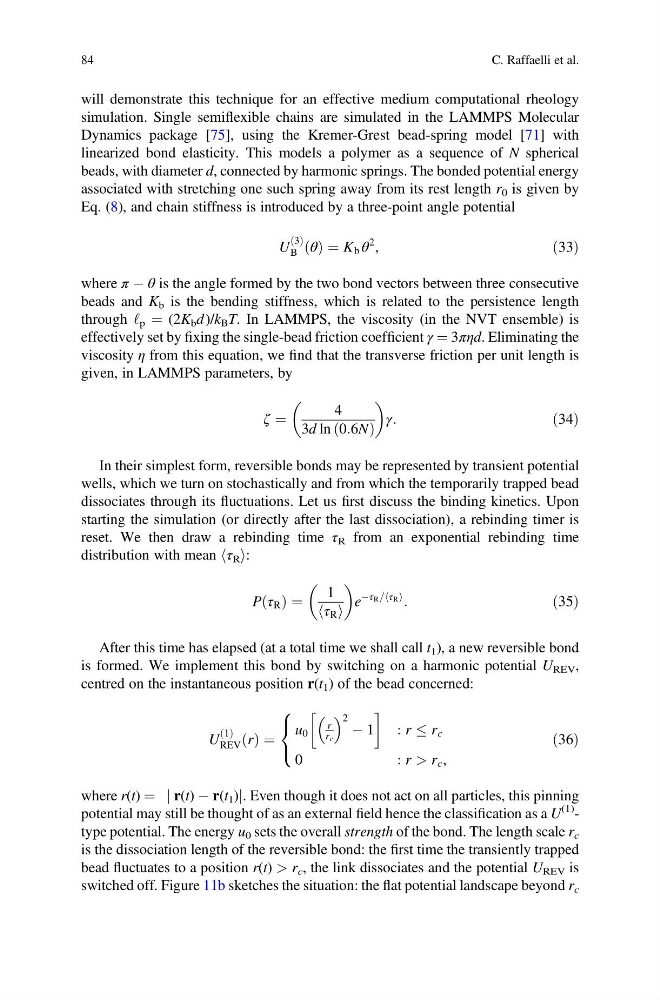
will demonstrate this technique for an effective medium computational rheology
simulation. Single semiflexible chains are simulated in the LAMMPS Molecular
Dynamics package [75], using the Kremer-Grest bead-spring model [71] with
linearized bond elasticity. This models a polymer as a sequence of N spherical
beads, with diameter d, connected by harmonic springs. The bonded potential energy
associated with stretching one such spring away from its rest length r 0 is given by
Eq. (8), and chain stiffness is introduced by a three-point angle potential
U
3
ð Þ
B θ
ð Þ ¼ K b θ
2 ,
ð33Þ
where π À θ is the angle formed by the two bond vectors between three consecutive
beads and K b is the bending stiffness, which is related to the persistence length
through ‘ p ¼ (2K b d )/k B T. In LAMMPS, the viscosity (in the NVT ensemble) is
effectively set by fixing the single-bead friction coefficient γ ¼ 3πηd. Eliminating the
viscosity η from this equation, we find that the transverse friction per unit length is
given, in LAMMPS parameters, by
ζ ¼
4
3d ln 0:6N
ð
Þ
γ:
ð34Þ
In their simplest form, reversible bonds may be represented by transient potential
wells, which we turn on stochastically and from which the temporarily trapped bead
dissociates through its fluctuations. Let us first discuss the binding kinetics. Upon
starting the simulation (or directly after the last dissociation), a rebinding timer is
reset. We then draw a rebinding time τ R from an exponential rebinding time
distribution with mean hτ R i:
P τ R
ð Þ ¼
1
τ R
h i
e
Àτ R = τ R
h i
:
ð35Þ
After this time has elapsed (at a total time we shall call t 1 ), a new reversible bond
is formed. We implement this bond by switching on a harmonic potential U REV ,
centred on the instantaneous position r(t 1 ) of the bead concerned:
U
1
ð Þ
REV r
ð Þ ¼
u 0
r
r c
2 À 1
!
: r r c
0
: r > r c ,
8
<
:
ð36Þ
where r(t) ¼ j r(t) À r(t 1 )j. Even though it does not act on all particles, this pinning
potential may still be thought of as an external field hence the classification as a U
(1) -
type potential. The energy u 0 sets the overall strength of the bond. The length scale r c
is the dissociation length of the reversible bond: the first time the transiently trapped
bead fluctuates to a position r(t) > r c , the link dissociates and the potential U REV is
switched off. Figure 11b sketches the situation: the flat potential landscape beyond r c
84
C. Raffaelli et al.
simulation. Single semiflexible chains are simulated in the LAMMPS Molecular
Dynamics package [75], using the Kremer-Grest bead-spring model [71] with
linearized bond elasticity. This models a polymer as a sequence of N spherical
beads, with diameter d, connected by harmonic springs. The bonded potential energy
associated with stretching one such spring away from its rest length r 0 is given by
Eq. (8), and chain stiffness is introduced by a three-point angle potential
U
3
ð Þ
B θ
ð Þ ¼ K b θ
2 ,
ð33Þ
where π À θ is the angle formed by the two bond vectors between three consecutive
beads and K b is the bending stiffness, which is related to the persistence length
through ‘ p ¼ (2K b d )/k B T. In LAMMPS, the viscosity (in the NVT ensemble) is
effectively set by fixing the single-bead friction coefficient γ ¼ 3πηd. Eliminating the
viscosity η from this equation, we find that the transverse friction per unit length is
given, in LAMMPS parameters, by
ζ ¼
4
3d ln 0:6N
ð
Þ
γ:
ð34Þ
In their simplest form, reversible bonds may be represented by transient potential
wells, which we turn on stochastically and from which the temporarily trapped bead
dissociates through its fluctuations. Let us first discuss the binding kinetics. Upon
starting the simulation (or directly after the last dissociation), a rebinding timer is
reset. We then draw a rebinding time τ R from an exponential rebinding time
distribution with mean hτ R i:
P τ R
ð Þ ¼
1
τ R
h i
e
Àτ R = τ R
h i
:
ð35Þ
After this time has elapsed (at a total time we shall call t 1 ), a new reversible bond
is formed. We implement this bond by switching on a harmonic potential U REV ,
centred on the instantaneous position r(t 1 ) of the bead concerned:
U
1
ð Þ
REV r
ð Þ ¼
u 0
r
r c
2 À 1
!
: r r c
0
: r > r c ,
8
<
:
ð36Þ
where r(t) ¼ j r(t) À r(t 1 )j. Even though it does not act on all particles, this pinning
potential may still be thought of as an external field hence the classification as a U
(1) -
type potential. The energy u 0 sets the overall strength of the bond. The length scale r c
is the dissociation length of the reversible bond: the first time the transiently trapped
bead fluctuates to a position r(t) > r c , the link dissociates and the potential U REV is
switched off. Figure 11b sketches the situation: the flat potential landscape beyond r c
84
C. Raffaelli et al.