

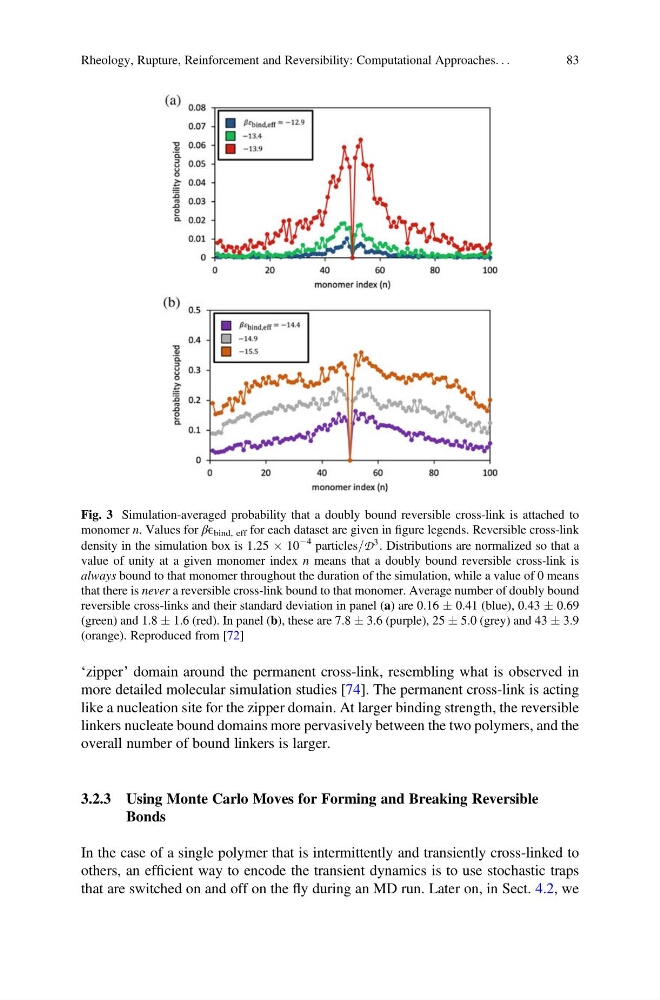
‘zipper’ domain around the permanent cross-link, resembling what is observed in
more detailed molecular simulation studies [74]. The permanent cross-link is acting
like a nucleation site for the zipper domain. At larger binding strength, the reversible
linkers nucleate bound domains more pervasively between the two polymers, and the
overall number of bound linkers is larger.
3.2.3 Using Monte Carlo Moves for Forming and Breaking Reversible
Bonds
In the case of a single polymer that is intermittently and transiently cross-linked to
others, an efficient way to encode the transient dynamics is to use stochastic traps
that are switched on and off on the fly during an MD run. Later on, in Sect. 4.2, we
Fig. 3 Simulation-averaged probability that a doubly bound reversible cross-link is attached to
monomer n. Values for βE bind, eff for each dataset are given in figure legends. Reversible cross-link
density in the simulation box is 1.25 Â 10
À4 particles=D
3 . Distributions are normalized so that a
value of unity at a given monomer index n means that a doubly bound reversible cross-link is
always bound to that monomer throughout the duration of the simulation, while a value of 0 means
that there is never a reversible cross-link bound to that monomer. Average number of doubly bound
reversible cross-links and their standard deviation in panel (a) are 0.16 Æ 0.41 (blue), 0.43 Æ 0.69
(green) and 1.8 Æ 1.6 (red). In panel (b), these are 7.8 Æ 3.6 (purple), 25 Æ 5.0 (grey) and 43 Æ 3.9
(orange). Reproduced from [72]
Rheology, Rupture, Reinforcement and Reversibility: Computational Approaches. . .
83
more detailed molecular simulation studies [74]. The permanent cross-link is acting
like a nucleation site for the zipper domain. At larger binding strength, the reversible
linkers nucleate bound domains more pervasively between the two polymers, and the
overall number of bound linkers is larger.
3.2.3 Using Monte Carlo Moves for Forming and Breaking Reversible
Bonds
In the case of a single polymer that is intermittently and transiently cross-linked to
others, an efficient way to encode the transient dynamics is to use stochastic traps
that are switched on and off on the fly during an MD run. Later on, in Sect. 4.2, we
Fig. 3 Simulation-averaged probability that a doubly bound reversible cross-link is attached to
monomer n. Values for βE bind, eff for each dataset are given in figure legends. Reversible cross-link
density in the simulation box is 1.25 Â 10
À4 particles=D
3 . Distributions are normalized so that a
value of unity at a given monomer index n means that a doubly bound reversible cross-link is
always bound to that monomer throughout the duration of the simulation, while a value of 0 means
that there is never a reversible cross-link bound to that monomer. Average number of doubly bound
reversible cross-links and their standard deviation in panel (a) are 0.16 Æ 0.41 (blue), 0.43 Æ 0.69
(green) and 1.8 Æ 1.6 (red). In panel (b), these are 7.8 Æ 3.6 (purple), 25 Æ 5.0 (grey) and 43 Æ 3.9
(orange). Reproduced from [72]
Rheology, Rupture, Reinforcement and Reversibility: Computational Approaches. . .
83