

site(s) on a reversible cross-link or a polymer segment. They are also practical for
implementing directional interactions in coarse-grained molecular simulation.
Stickers are readily implemented in molecular dynamics as beads attached to their
host reversible cross-link or polymer segment. An example of an implementation is
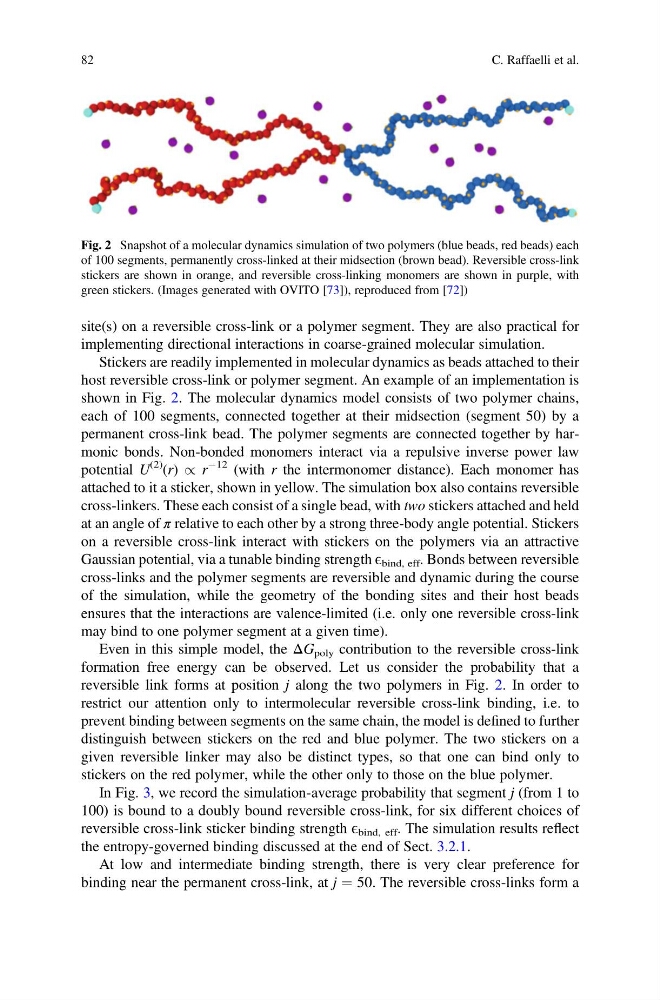
shown in Fig. 2. The molecular dynamics model consists of two polymer chains,
each of 100 segments, connected together at their midsection (segment 50) by a
permanent cross-link bead. The polymer segments are connected together by harmonic bonds. Non-bonded monomers interact via a repulsive inverse power law
potential U
(2) (r) / r
À12 (with r the intermonomer distance). Each monomer has
attached to it a sticker, shown in yellow. The simulation box also contains reversible
cross-linkers. These each consist of a single bead, with two stickers attached and held
at an angle of π relative to each other by a strong three-body angle potential. Stickers
on a reversible cross-link interact with stickers on the polymers via an attractive
Gaussian potential, via a tunable binding strength E bind, eff . Bonds between reversible
cross-links and the polymer segments are reversible and dynamic during the course
of the simulation, while the geometry of the bonding sites and their host beads
ensures that the interactions are valence-limited (i.e. only one reversible cross-link
may bind to one polymer segment at a given time).
Even in this simple model, the ΔG poly contribution to the reversible cross-link
formation free energy can be observed. Let us consider the probability that a
reversible link forms at position j along the two polymers in Fig. 2. In order to
restrict our attention only to intermolecular reversible cross-link binding, i.e. to
prevent binding between segments on the same chain, the model is defined to further
distinguish between stickers on the red and blue polymer. The two stickers on a
given reversible linker may also be distinct types, so that one can bind only to
stickers on the red polymer, while the other only to those on the blue polymer.
In Fig. 3, we record the simulation-average probability that segment j (from 1 to
100) is bound to a doubly bound reversible cross-link, for six different choices of
reversible cross-link sticker binding strength E bind, eff . The simulation results reflect
the entropy-governed binding discussed at the end of Sect. 3.2.1.
At low and intermediate binding strength, there is very clear preference for
binding near the permanent cross-link, at j ¼ 50. The reversible cross-links form a
Fig. 2 Snapshot of a molecular dynamics simulation of two polymers (blue beads, red beads) each
of 100 segments, permanently cross-linked at their midsection (brown bead). Reversible cross-link
stickers are shown in orange, and reversible cross-linking monomers are shown in purple, with
green stickers. (Images generated with OVITO [73]), reproduced from [72])
82
C. Raffaelli et al.
implementing directional interactions in coarse-grained molecular simulation.
Stickers are readily implemented in molecular dynamics as beads attached to their
host reversible cross-link or polymer segment. An example of an implementation is
shown in Fig. 2. The molecular dynamics model consists of two polymer chains,
each of 100 segments, connected together at their midsection (segment 50) by a
permanent cross-link bead. The polymer segments are connected together by harmonic bonds. Non-bonded monomers interact via a repulsive inverse power law
potential U
(2) (r) / r
À12 (with r the intermonomer distance). Each monomer has
attached to it a sticker, shown in yellow. The simulation box also contains reversible
cross-linkers. These each consist of a single bead, with two stickers attached and held
at an angle of π relative to each other by a strong three-body angle potential. Stickers
on a reversible cross-link interact with stickers on the polymers via an attractive
Gaussian potential, via a tunable binding strength E bind, eff . Bonds between reversible
cross-links and the polymer segments are reversible and dynamic during the course
of the simulation, while the geometry of the bonding sites and their host beads
ensures that the interactions are valence-limited (i.e. only one reversible cross-link
may bind to one polymer segment at a given time).
Even in this simple model, the ΔG poly contribution to the reversible cross-link
formation free energy can be observed. Let us consider the probability that a
reversible link forms at position j along the two polymers in Fig. 2. In order to
restrict our attention only to intermolecular reversible cross-link binding, i.e. to
prevent binding between segments on the same chain, the model is defined to further
distinguish between stickers on the red and blue polymer. The two stickers on a
given reversible linker may also be distinct types, so that one can bind only to
stickers on the red polymer, while the other only to those on the blue polymer.
In Fig. 3, we record the simulation-average probability that segment j (from 1 to
100) is bound to a doubly bound reversible cross-link, for six different choices of
reversible cross-link sticker binding strength E bind, eff . The simulation results reflect
the entropy-governed binding discussed at the end of Sect. 3.2.1.
At low and intermediate binding strength, there is very clear preference for
binding near the permanent cross-link, at j ¼ 50. The reversible cross-links form a
Fig. 2 Snapshot of a molecular dynamics simulation of two polymers (blue beads, red beads) each
of 100 segments, permanently cross-linked at their midsection (brown bead). Reversible cross-link
stickers are shown in orange, and reversible cross-linking monomers are shown in purple, with
green stickers. (Images generated with OVITO [73]), reproduced from [72])
82
C. Raffaelli et al.