

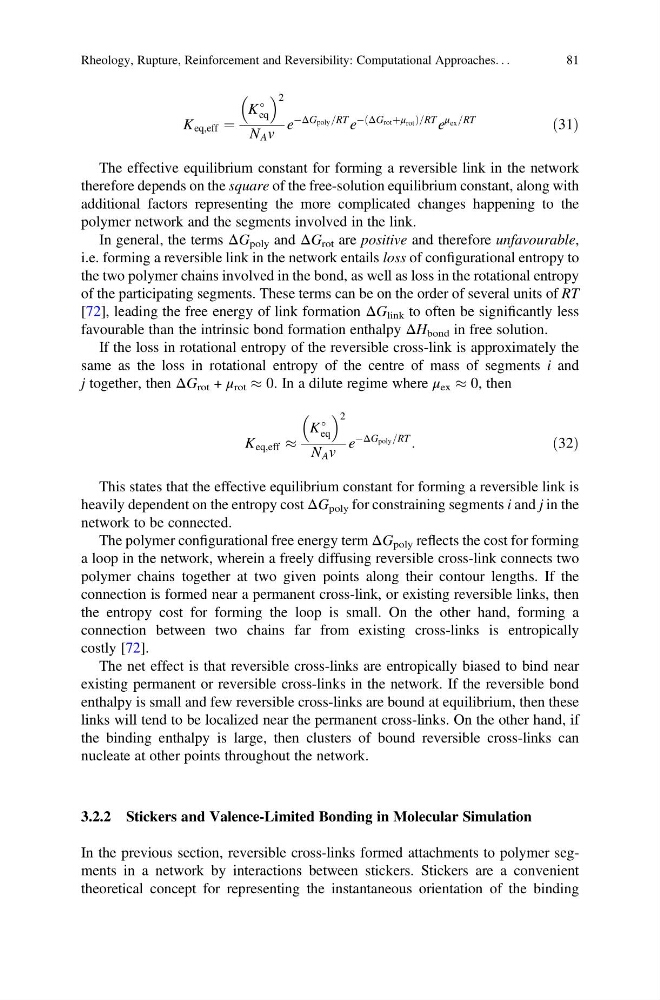
K eq,eff ¼
K
∘
eq
2
N A v
e
ÀΔG poly =RT e
À ΔG rot þμ rot
ð
Þ =RT e
μ ex =RT
ð31Þ
The effective equilibrium constant for forming a reversible link in the network
therefore depends on the square of the free-solution equilibrium constant, along with
additional factors representing the more complicated changes happening to the
polymer network and the segments involved in the link.
In general, the terms ΔG poly and ΔG rot are positive and therefore unfavourable,
i.e. forming a reversible link in the network entails loss of configurational entropy to
the two polymer chains involved in the bond, as well as loss in the rotational entropy
of the participating segments. These terms can be on the order of several units of RT
[72], leading the free energy of link formation ΔG link to often be significantly less
favourable than the intrinsic bond formation enthalpy ΔH bond in free solution.
If the loss in rotational entropy of the reversible cross-link is approximately the
same as the loss in rotational entropy of the centre of mass of segments i and
j together, then ΔG rot + μ rot % 0. In a dilute regime where μ ex % 0, then
K eq,eff %
K
∘
eq
2
N A v
e
ÀΔG poly =RT
:
ð32Þ
This states that the effective equilibrium constant for forming a reversible link is
heavily dependent on the entropy cost ΔG poly for constraining segments i and j in the
network to be connected.
The polymer configurational free energy term ΔG poly reflects the cost for forming
a loop in the network, wherein a freely diffusing reversible cross-link connects two
polymer chains together at two given points along their contour lengths. If the
connection is formed near a permanent cross-link, or existing reversible links, then
the entropy cost for forming the loop is small. On the other hand, forming a
connection between two chains far from existing cross-links is entropically
costly [72].
The net effect is that reversible cross-links are entropically biased to bind near
existing permanent or reversible cross-links in the network. If the reversible bond
enthalpy is small and few reversible cross-links are bound at equilibrium, then these
links will tend to be localized near the permanent cross-links. On the other hand, if
the binding enthalpy is large, then clusters of bound reversible cross-links can
nucleate at other points throughout the network.
3.2.2 Stickers and Valence-Limited Bonding in Molecular Simulation
In the previous section, reversible cross-links formed attachments to polymer segments in a network by interactions between stickers. Stickers are a convenient
theoretical concept for representing the instantaneous orientation of the binding
Rheology, Rupture, Reinforcement and Reversibility: Computational Approaches. . .
81
K
∘
eq
2
N A v
e
ÀΔG poly =RT e
À ΔG rot þμ rot
ð
Þ =RT e
μ ex =RT
ð31Þ
The effective equilibrium constant for forming a reversible link in the network
therefore depends on the square of the free-solution equilibrium constant, along with
additional factors representing the more complicated changes happening to the
polymer network and the segments involved in the link.
In general, the terms ΔG poly and ΔG rot are positive and therefore unfavourable,
i.e. forming a reversible link in the network entails loss of configurational entropy to
the two polymer chains involved in the bond, as well as loss in the rotational entropy
of the participating segments. These terms can be on the order of several units of RT
[72], leading the free energy of link formation ΔG link to often be significantly less
favourable than the intrinsic bond formation enthalpy ΔH bond in free solution.
If the loss in rotational entropy of the reversible cross-link is approximately the
same as the loss in rotational entropy of the centre of mass of segments i and
j together, then ΔG rot + μ rot % 0. In a dilute regime where μ ex % 0, then
K eq,eff %
K
∘
eq
2
N A v
e
ÀΔG poly =RT
:
ð32Þ
This states that the effective equilibrium constant for forming a reversible link is
heavily dependent on the entropy cost ΔG poly for constraining segments i and j in the
network to be connected.
The polymer configurational free energy term ΔG poly reflects the cost for forming
a loop in the network, wherein a freely diffusing reversible cross-link connects two
polymer chains together at two given points along their contour lengths. If the
connection is formed near a permanent cross-link, or existing reversible links, then
the entropy cost for forming the loop is small. On the other hand, forming a
connection between two chains far from existing cross-links is entropically
costly [72].
The net effect is that reversible cross-links are entropically biased to bind near
existing permanent or reversible cross-links in the network. If the reversible bond
enthalpy is small and few reversible cross-links are bound at equilibrium, then these
links will tend to be localized near the permanent cross-links. On the other hand, if
the binding enthalpy is large, then clusters of bound reversible cross-links can
nucleate at other points throughout the network.
3.2.2 Stickers and Valence-Limited Bonding in Molecular Simulation
In the previous section, reversible cross-links formed attachments to polymer segments in a network by interactions between stickers. Stickers are a convenient
theoretical concept for representing the instantaneous orientation of the binding
Rheology, Rupture, Reinforcement and Reversibility: Computational Approaches. . .
81