

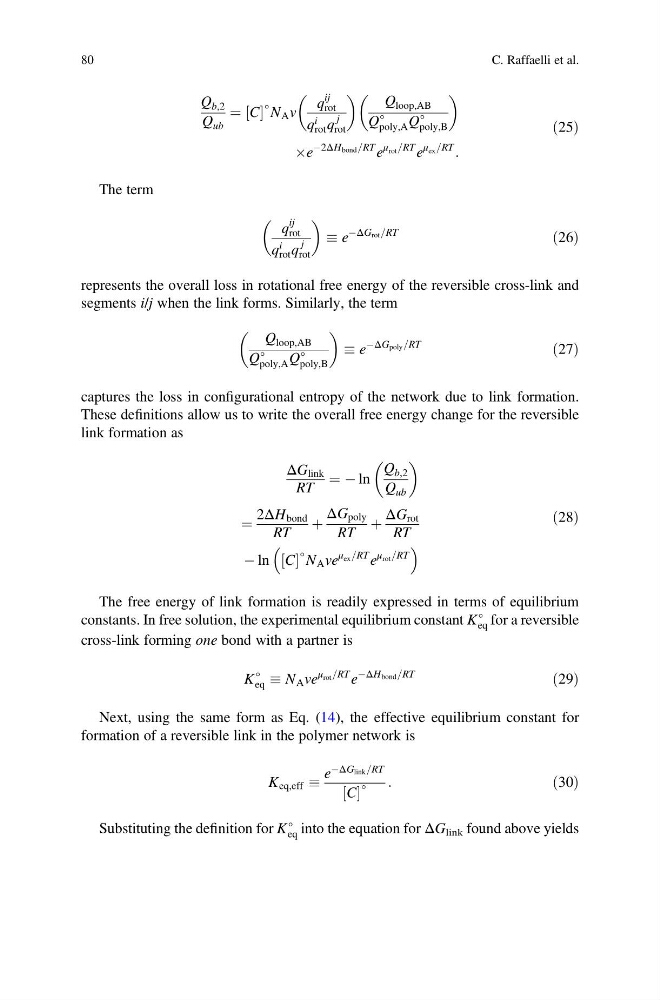
Q b,2
Q ub
¼ C
½
∘ N A v
q
ij
rot
q
i
rot q
j
rot
Q loop,AB
Q
∘
poly,A Q
∘
poly,B
Âe
À2ΔH bond =RT e
μ rot =RT e
μ ex =RT
:
ð25Þ
The term
q
ij
rot
q
i
rot q
j
rot
e
ÀΔG rot =RT
ð26Þ
represents the overall loss in rotational free energy of the reversible cross-link and
segments i/j when the link forms. Similarly, the term
Q loop,AB
Q
∘
poly,A Q
∘
poly,B
e
ÀΔG poly =RT
ð27Þ
captures the loss in configurational entropy of the network due to link formation.
These definitions allow us to write the overall free energy change for the reversible
link formation as
ΔG link
RT
¼ À ln
Q b,2
Q ub
¼
2ΔH bond
RT
þ
ΔG poly
RT
þ
ΔG rot
RT
À ln C
½
∘ N A ve
μ ex =RT e
μ rot =RT
ð28Þ
The free energy of link formation is readily expressed in terms of equilibrium
constants. In free solution, the experimental equilibrium constant K
∘
eq for a reversible
cross-link forming one bond with a partner is
K
∘
eq N A ve
μ rot =RT e
ÀΔH bond =RT
ð29Þ
Next, using the same form as Eq. (14), the effective equilibrium constant for
formation of a reversible link in the polymer network is
K eq,eff
e
ÀΔG link =RT
C
½
∘
:
ð30Þ
Substituting the definition for K
∘
eq into the equation for ΔG link found above yields
80
C. Raffaelli et al.
Q ub
¼ C
½
∘ N A v
q
ij
rot
q
i
rot q
j
rot
Q loop,AB
Q
∘
poly,A Q
∘
poly,B
Âe
À2ΔH bond =RT e
μ rot =RT e
μ ex =RT
:
ð25Þ
The term
q
ij
rot
q
i
rot q
j
rot
e
ÀΔG rot =RT
ð26Þ
represents the overall loss in rotational free energy of the reversible cross-link and
segments i/j when the link forms. Similarly, the term
Q loop,AB
Q
∘
poly,A Q
∘
poly,B
e
ÀΔG poly =RT
ð27Þ
captures the loss in configurational entropy of the network due to link formation.
These definitions allow us to write the overall free energy change for the reversible
link formation as
ΔG link
RT
¼ À ln
Q b,2
Q ub
¼
2ΔH bond
RT
þ
ΔG poly
RT
þ
ΔG rot
RT
À ln C
½
∘ N A ve
μ ex =RT e
μ rot =RT
ð28Þ
The free energy of link formation is readily expressed in terms of equilibrium
constants. In free solution, the experimental equilibrium constant K
∘
eq for a reversible
cross-link forming one bond with a partner is
K
∘
eq N A ve
μ rot =RT e
ÀΔH bond =RT
ð29Þ
Next, using the same form as Eq. (14), the effective equilibrium constant for
formation of a reversible link in the polymer network is
K eq,eff
e
ÀΔG link =RT
C
½
∘
:
ð30Þ
Substituting the definition for K
∘
eq into the equation for ΔG link found above yields
80
C. Raffaelli et al.