

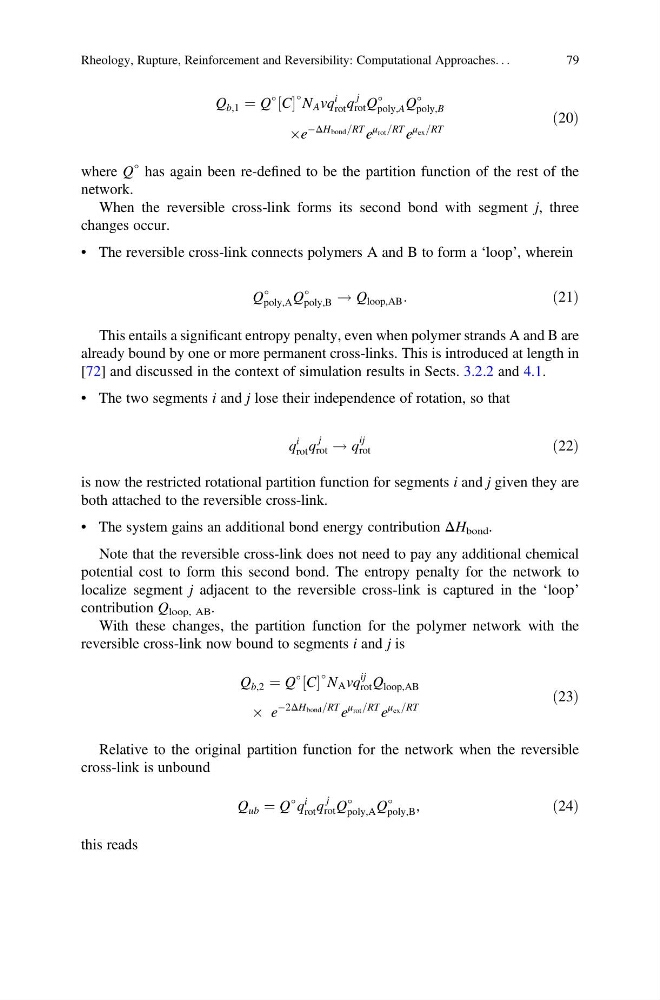
Q b,1 ¼ Q
∘ C
½
∘ N A vq
i
rot q
j
rot Q
∘
poly,A Q
∘
poly,B
Âe
ÀΔH bond =RT e
μ rot =RT e
μ ex =RT
ð20Þ
where Q
∘ has again been re-defined to be the partition function of the rest of the
network.
When the reversible cross-link forms its second bond with segment j, three
changes occur.
• The reversible cross-link connects polymers A and B to form a ‘loop’, wherein
Q
∘
poly,A Q
∘
poly,B ! Q loop,AB :
ð21Þ
This entails a significant entropy penalty, even when polymer strands A and B are
already bound by one or more permanent cross-links. This is introduced at length in
[72] and discussed in the context of simulation results in Sects. 3.2.2 and 4.1.
• The two segments i and j lose their independence of rotation, so that
q
i
rot q
j
rot ! q
ij
rot
ð22Þ
is now the restricted rotational partition function for segments i and j given they are
both attached to the reversible cross-link.
• The system gains an additional bond energy contribution ΔH bond .
Note that the reversible cross-link does not need to pay any additional chemical
potential cost to form this second bond. The entropy penalty for the network to
localize segment j adjacent to the reversible cross-link is captured in the ‘loop’
contribution Q loop, AB .
With these changes, the partition function for the polymer network with the
reversible cross-link now bound to segments i and j is
Q b,2 ¼ Q
∘ C
½
∘ N A vq
ij
rot Q loop,AB
 e
À2ΔH bond =RT e
μ rot =RT e
μ ex =RT
ð23Þ
Relative to the original partition function for the network when the reversible
cross-link is unbound
Q ub ¼ Q
∘ q
i
rot q
j
rot Q
∘
poly,A Q
∘
poly,B ,
ð24Þ
this reads
Rheology, Rupture, Reinforcement and Reversibility: Computational Approaches. . .
79
∘ C
½
∘ N A vq
i
rot q
j
rot Q
∘
poly,A Q
∘
poly,B
Âe
ÀΔH bond =RT e
μ rot =RT e
μ ex =RT
ð20Þ
where Q
∘ has again been re-defined to be the partition function of the rest of the
network.
When the reversible cross-link forms its second bond with segment j, three
changes occur.
• The reversible cross-link connects polymers A and B to form a ‘loop’, wherein
Q
∘
poly,A Q
∘
poly,B ! Q loop,AB :
ð21Þ
This entails a significant entropy penalty, even when polymer strands A and B are
already bound by one or more permanent cross-links. This is introduced at length in
[72] and discussed in the context of simulation results in Sects. 3.2.2 and 4.1.
• The two segments i and j lose their independence of rotation, so that
q
i
rot q
j
rot ! q
ij
rot
ð22Þ
is now the restricted rotational partition function for segments i and j given they are
both attached to the reversible cross-link.
• The system gains an additional bond energy contribution ΔH bond .
Note that the reversible cross-link does not need to pay any additional chemical
potential cost to form this second bond. The entropy penalty for the network to
localize segment j adjacent to the reversible cross-link is captured in the ‘loop’
contribution Q loop, AB .
With these changes, the partition function for the polymer network with the
reversible cross-link now bound to segments i and j is
Q b,2 ¼ Q
∘ C
½
∘ N A vq
ij
rot Q loop,AB
 e
À2ΔH bond =RT e
μ rot =RT e
μ ex =RT
ð23Þ
Relative to the original partition function for the network when the reversible
cross-link is unbound
Q ub ¼ Q
∘ q
i
rot q
j
rot Q
∘
poly,A Q
∘
poly,B ,
ð24Þ
this reads
Rheology, Rupture, Reinforcement and Reversibility: Computational Approaches. . .
79