

Suppose now that an unbound reversible cross-link forms one of its two bonds
with the sticker on segment i. First, the system thermodynamically gains the energy
associated with the bond formation. Let this be defined as ΔH bond . Second, the
reversible cross-link must pay the price of the chemical potential μ for localizing
next to segment i in order to form the bond.
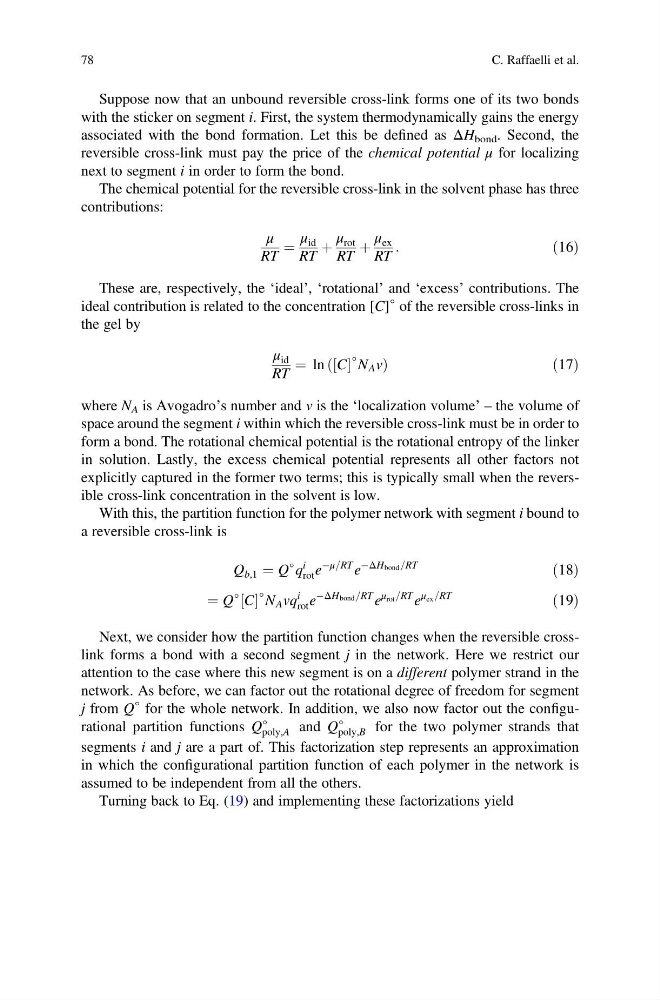
The chemical potential for the reversible cross-link in the solvent phase has three
contributions:
μ
RT
¼
μ id
RT
þ
μ rot
RT
þ
μ ex
RT
:
ð16Þ
These are, respectively, the ‘ideal’, ‘rotational’ and ‘excess’ contributions. The
ideal contribution is related to the concentration [C]
∘ of the reversible cross-links in
the gel by
μ id
RT
¼ ln C
½
∘ N A v
ð
Þ
ð 17Þ
where N A is Avogadro’s number and v is the ‘localization volume’ – the volume of
space around the segment i within which the reversible cross-link must be in order to
form a bond. The rotational chemical potential is the rotational entropy of the linker
in solution. Lastly, the excess chemical potential represents all other factors not
explicitly captured in the former two terms; this is typically small when the reversible cross-link concentration in the solvent is low.
With this, the partition function for the polymer network with segment i bound to
a reversible cross-link is
Q b,1 ¼ Q
∘ q
i
rot e
Àμ=RT e
ÀΔH bond =RT
ð18Þ
¼ Q
∘ C
½
∘ N A vq
i
rot e
ÀΔH bond =RT e
μ rot =RT e
μ ex =RT
ð19Þ
Next, we consider how the partition function changes when the reversible crosslink forms a bond with a second segment j in the network. Here we restrict our
attention to the case where this new segment is on a different polymer strand in the
network. As before, we can factor out the rotational degree of freedom for segment
j from Q
∘ for the whole network. In addition, we also now factor out the configurational partition functions Q
∘
poly,A and Q
∘
poly,B for the two polymer strands that
segments i and j are a part of. This factorization step represents an approximation
in which the configurational partition function of each polymer in the network is
assumed to be independent from all the others.
Turning back to Eq. (19) and implementing these factorizations yield
78
C. Raffaelli et al.
with the sticker on segment i. First, the system thermodynamically gains the energy
associated with the bond formation. Let this be defined as ΔH bond . Second, the
reversible cross-link must pay the price of the chemical potential μ for localizing
next to segment i in order to form the bond.
The chemical potential for the reversible cross-link in the solvent phase has three
contributions:
μ
RT
¼
μ id
RT
þ
μ rot
RT
þ
μ ex
RT
:
ð16Þ
These are, respectively, the ‘ideal’, ‘rotational’ and ‘excess’ contributions. The
ideal contribution is related to the concentration [C]
∘ of the reversible cross-links in
the gel by
μ id
RT
¼ ln C
½
∘ N A v
ð
Þ
ð 17Þ
where N A is Avogadro’s number and v is the ‘localization volume’ – the volume of
space around the segment i within which the reversible cross-link must be in order to
form a bond. The rotational chemical potential is the rotational entropy of the linker
in solution. Lastly, the excess chemical potential represents all other factors not
explicitly captured in the former two terms; this is typically small when the reversible cross-link concentration in the solvent is low.
With this, the partition function for the polymer network with segment i bound to
a reversible cross-link is
Q b,1 ¼ Q
∘ q
i
rot e
Àμ=RT e
ÀΔH bond =RT
ð18Þ
¼ Q
∘ C
½
∘ N A vq
i
rot e
ÀΔH bond =RT e
μ rot =RT e
μ ex =RT
ð19Þ
Next, we consider how the partition function changes when the reversible crosslink forms a bond with a second segment j in the network. Here we restrict our
attention to the case where this new segment is on a different polymer strand in the
network. As before, we can factor out the rotational degree of freedom for segment
j from Q
∘ for the whole network. In addition, we also now factor out the configurational partition functions Q
∘
poly,A and Q
∘
poly,B for the two polymer strands that
segments i and j are a part of. This factorization step represents an approximation
in which the configurational partition function of each polymer in the network is
assumed to be independent from all the others.
Turning back to Eq. (19) and implementing these factorizations yield
78
C. Raffaelli et al.