

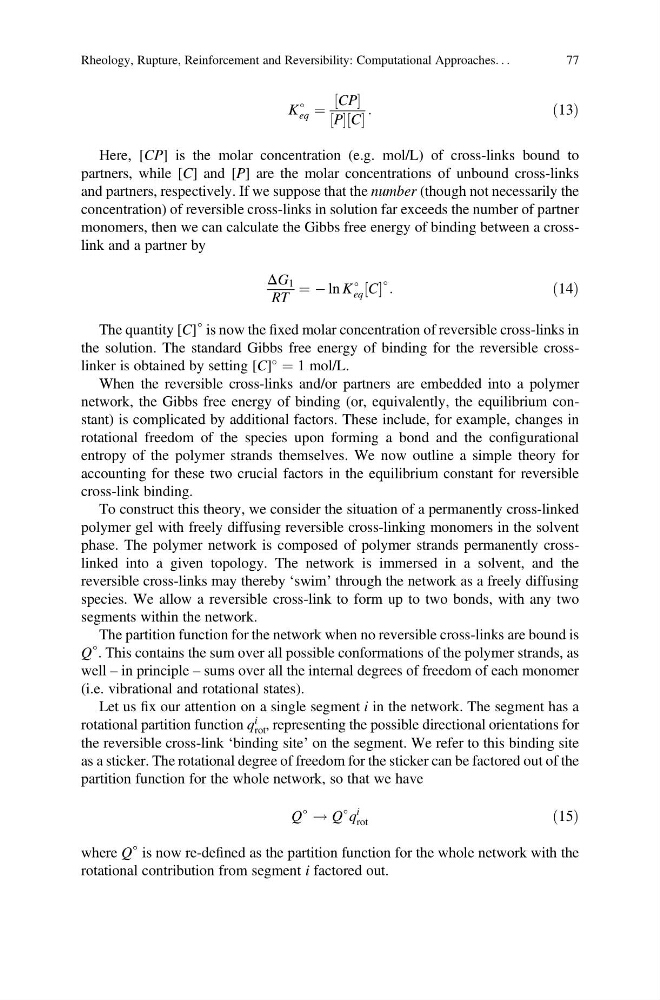
K
∘
eq ¼
CP
½
P
½ C
½
:
ð13Þ
Here, [CP] is the molar concentration (e.g. mol/L) of cross-links bound to
partners, while [C] and [P] are the molar concentrations of unbound cross-links
and partners, respectively. If we suppose that the number (though not necessarily the
concentration) of reversible cross-links in solution far exceeds the number of partner
monomers, then we can calculate the Gibbs free energy of binding between a crosslink and a partner by
ΔG 1
RT
¼ À ln K
∘
eq C
½
∘ :
ð14Þ
The quantity [C]
∘ is now the fixed molar concentration of reversible cross-links in
the solution. The standard Gibbs free energy of binding for the reversible crosslinker is obtained by setting [C]
¼ 1 mol/L.
When the reversible cross-links and/or partners are embedded into a polymer
network, the Gibbs free energy of binding (or, equivalently, the equilibrium constant) is complicated by additional factors. These include, for example, changes in
rotational freedom of the species upon forming a bond and the configurational
entropy of the polymer strands themselves. We now outline a simple theory for
accounting for these two crucial factors in the equilibrium constant for reversible
cross-link binding.
To construct this theory, we consider the situation of a permanently cross-linked
polymer gel with freely diffusing reversible cross-linking monomers in the solvent
phase. The polymer network is composed of polymer strands permanently crosslinked into a given topology. The network is immersed in a solvent, and the
reversible cross-links may thereby ‘swim’ through the network as a freely diffusing
species. We allow a reversible cross-link to form up to two bonds, with any two
segments within the network.
The partition function for the network when no reversible cross-links are bound is
Q
∘
. This contains the sum over all possible conformations of the polymer strands, as
well – in principle – sums over all the internal degrees of freedom of each monomer
(i.e. vibrational and rotational states).
Let us fix our attention on a single segment i in the network. The segment has a
rotational partition function q
i
rot , representing the possible directional orientations for
the reversible cross-link ‘binding site’ on the segment. We refer to this binding site
as a sticker. The rotational degree of freedom for the sticker can be factored out of the
partition function for the whole network, so that we have
Q
∘
! Q
∘ q
i
rot
ð15Þ
where Q
∘ is now re-defined as the partition function for the whole network with the
rotational contribution from segment i factored out.
Rheology, Rupture, Reinforcement and Reversibility: Computational Approaches. . .
77
∘
eq ¼
CP
½
P
½ C
½
:
ð13Þ
Here, [CP] is the molar concentration (e.g. mol/L) of cross-links bound to
partners, while [C] and [P] are the molar concentrations of unbound cross-links
and partners, respectively. If we suppose that the number (though not necessarily the
concentration) of reversible cross-links in solution far exceeds the number of partner
monomers, then we can calculate the Gibbs free energy of binding between a crosslink and a partner by
ΔG 1
RT
¼ À ln K
∘
eq C
½
∘ :
ð14Þ
The quantity [C]
∘ is now the fixed molar concentration of reversible cross-links in
the solution. The standard Gibbs free energy of binding for the reversible crosslinker is obtained by setting [C]
¼ 1 mol/L.
When the reversible cross-links and/or partners are embedded into a polymer
network, the Gibbs free energy of binding (or, equivalently, the equilibrium constant) is complicated by additional factors. These include, for example, changes in
rotational freedom of the species upon forming a bond and the configurational
entropy of the polymer strands themselves. We now outline a simple theory for
accounting for these two crucial factors in the equilibrium constant for reversible
cross-link binding.
To construct this theory, we consider the situation of a permanently cross-linked
polymer gel with freely diffusing reversible cross-linking monomers in the solvent
phase. The polymer network is composed of polymer strands permanently crosslinked into a given topology. The network is immersed in a solvent, and the
reversible cross-links may thereby ‘swim’ through the network as a freely diffusing
species. We allow a reversible cross-link to form up to two bonds, with any two
segments within the network.
The partition function for the network when no reversible cross-links are bound is
Q
∘
. This contains the sum over all possible conformations of the polymer strands, as
well – in principle – sums over all the internal degrees of freedom of each monomer
(i.e. vibrational and rotational states).
Let us fix our attention on a single segment i in the network. The segment has a
rotational partition function q
i
rot , representing the possible directional orientations for
the reversible cross-link ‘binding site’ on the segment. We refer to this binding site
as a sticker. The rotational degree of freedom for the sticker can be factored out of the
partition function for the whole network, so that we have
Q
∘
! Q
∘ q
i
rot
ð15Þ
where Q
∘ is now re-defined as the partition function for the whole network with the
rotational contribution from segment i factored out.
Rheology, Rupture, Reinforcement and Reversibility: Computational Approaches. . .
77