

cases, the van der Waals attraction may be neglected altogether, and a smooth
potential capable of effecting short-range steric repulsion is required. For such
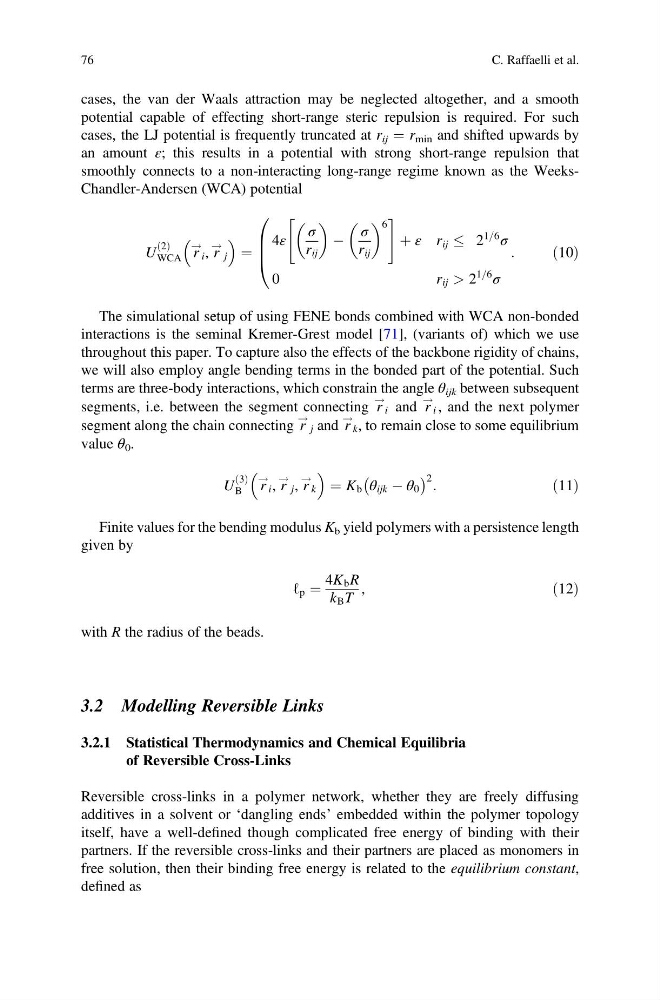
cases, the LJ potential is frequently truncated at r ij ¼ r min and shifted upwards by
an amount ε; this results in a potential with strong short-range repulsion that
smoothly connects to a non-interacting long-range regime known as the WeeksChandler-Andersen (WCA) potential
U
2
ð Þ
WCA r
!
i , r
!
j
¼
4ε
σ
r ij
À
σ
r ij
6
"
#
þ ε r ij
2
1=6
σ
0
r ij > 2
1=6
σ
0
B
B
@
:
ð10Þ
The simulational setup of using FENE bonds combined with WCA non-bonded
interactions is the seminal Kremer-Grest model [71], (variants of) which we use
throughout this paper. To capture also the effects of the backbone rigidity of chains,
we will also employ angle bending terms in the bonded part of the potential. Such
terms are three-body interactions, which constrain the angle θ ijk between subsequent
segments, i.e. between the segment connecting r
!
i and r
!
i , and the next polymer
segment along the chain connecting r
!
j and r
!
k , to remain close to some equilibrium
value θ 0 .
U
3
ð Þ
B
r
!
i , r
!
j , r
!
k
¼ K b θ ijk À θ 0
À
Á 2 :
ð11Þ
Finite values for the bending modulus K b yield polymers with a persistence length
given by
ℓ p ¼
4K b R
k B T
,
ð12Þ
with R the radius of the beads.
3.2 Modelling Reversible Links
3.2.1 Statistical Thermodynamics and Chemical Equilibria
of Reversible Cross-Links
Reversible cross-links in a polymer network, whether they are freely diffusing
additives in a solvent or ‘dangling ends’ embedded within the polymer topology
itself, have a well-defined though complicated free energy of binding with their
partners. If the reversible cross-links and their partners are placed as monomers in
free solution, then their binding free energy is related to the equilibrium constant,
defined as
76
C. Raffaelli et al.
potential capable of effecting short-range steric repulsion is required. For such
cases, the LJ potential is frequently truncated at r ij ¼ r min and shifted upwards by
an amount ε; this results in a potential with strong short-range repulsion that
smoothly connects to a non-interacting long-range regime known as the WeeksChandler-Andersen (WCA) potential
U
2
ð Þ
WCA r
!
i , r
!
j
¼
4ε
σ
r ij
À
σ
r ij
6
"
#
þ ε r ij
2
1=6
σ
0
r ij > 2
1=6
σ
0
B
B
@
:
ð10Þ
The simulational setup of using FENE bonds combined with WCA non-bonded
interactions is the seminal Kremer-Grest model [71], (variants of) which we use
throughout this paper. To capture also the effects of the backbone rigidity of chains,
we will also employ angle bending terms in the bonded part of the potential. Such
terms are three-body interactions, which constrain the angle θ ijk between subsequent
segments, i.e. between the segment connecting r
!
i and r
!
i , and the next polymer
segment along the chain connecting r
!
j and r
!
k , to remain close to some equilibrium
value θ 0 .
U
3
ð Þ
B
r
!
i , r
!
j , r
!
k
¼ K b θ ijk À θ 0
À
Á 2 :
ð11Þ
Finite values for the bending modulus K b yield polymers with a persistence length
given by
ℓ p ¼
4K b R
k B T
,
ð12Þ
with R the radius of the beads.
3.2 Modelling Reversible Links
3.2.1 Statistical Thermodynamics and Chemical Equilibria
of Reversible Cross-Links
Reversible cross-links in a polymer network, whether they are freely diffusing
additives in a solvent or ‘dangling ends’ embedded within the polymer topology
itself, have a well-defined though complicated free energy of binding with their
partners. If the reversible cross-links and their partners are placed as monomers in
free solution, then their binding free energy is related to the equilibrium constant,
defined as
76
C. Raffaelli et al.