

multiples) that are actually bonded; the MD configuration should therefore contain
also a table of the particles between which such bonds exist. General physical
interactions like electrostatic (Coulomb) forces, excluded volume effects or hydrodynamic interactions feature regardless of the existence of an explicit bond between
particles and therefore are present between all pairs of particles in the simulation
box; the potentials that represent them in MD are termed non-bonded.
While the random and frictional parts of the total force F tot, i (t) are fairly generic,
the conservative part is where the specifics of a simulation are important. In this
manuscript, we encounter several widely used examples of both bonded and
non-bonded interactions. All of the MD simulations in this paper will concern
so-called bead-spring models, which represent the polymer by a chain of spherical
beads connected (bonded) by springs. These beads each experience the generic
frictional and random forces detailed above. In one often used approach, the springs
between the beads are modelled as finitely extensible nonlinear elastic (for short,
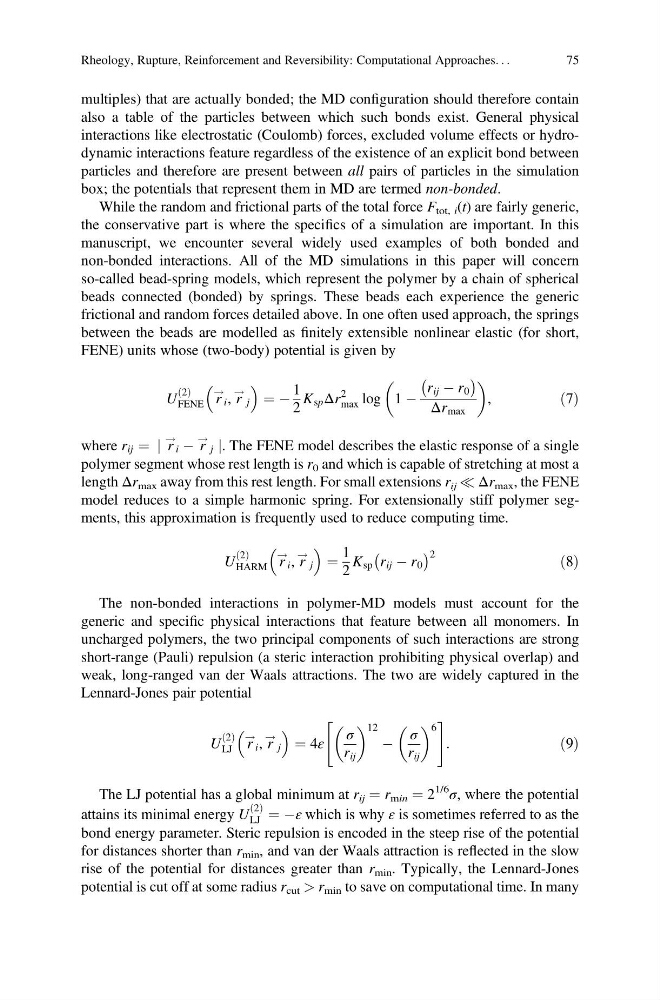
FENE) units whose (two-body) potential is given by
U
2
ð Þ
FENE r
!
i , r
!
j
¼ À
1
2
K sp Δr
2
max log 1 À
r ij À r 0
À
Á
Δr max
,
ð7Þ
where r ij ¼ j r
!
i À r
!
j j. The FENE model describes the elastic response of a single
polymer segment whose rest length is r 0 and which is capable of stretching at most a
length Δr max away from this rest length. For small extensions r ij ( Δr max , the FENE
model reduces to a simple harmonic spring. For extensionally stiff polymer segments, this approximation is frequently used to reduce computing time.
U
2
ð Þ
HARM r
!
i , r
!
j
¼
1
2
K sp r ij À r 0
À
Á 2
ð8Þ
The non-bonded interactions in polymer-MD models must account for the
generic and specific physical interactions that feature between all monomers. In
uncharged polymers, the two principal components of such interactions are strong
short-range (Pauli) repulsion (a steric interaction prohibiting physical overlap) and
weak, long-ranged van der Waals attractions. The two are widely captured in the
Lennard-Jones pair potential
U
2
ð Þ
LJ r
!
i , r
!
j
¼ 4ε
σ
r ij
12
À
σ
r ij
6
"
#
:
ð9Þ
The LJ potential has a global minimum at r ij ¼ r min ¼ 2
1/6
σ, where the potential
attains its minimal energy U
2
ð Þ
LJ ¼ Àε which is why ε is sometimes referred to as the
bond energy parameter. Steric repulsion is encoded in the steep rise of the potential
for distances shorter than r min , and van der Waals attraction is reflected in the slow
rise of the potential for distances greater than r min . Typically, the Lennard-Jones
potential is cut off at some radius r cut > r min to save on computational time. In many
Rheology, Rupture, Reinforcement and Reversibility: Computational Approaches. . .
75
also a table of the particles between which such bonds exist. General physical
interactions like electrostatic (Coulomb) forces, excluded volume effects or hydrodynamic interactions feature regardless of the existence of an explicit bond between
particles and therefore are present between all pairs of particles in the simulation
box; the potentials that represent them in MD are termed non-bonded.
While the random and frictional parts of the total force F tot, i (t) are fairly generic,
the conservative part is where the specifics of a simulation are important. In this
manuscript, we encounter several widely used examples of both bonded and
non-bonded interactions. All of the MD simulations in this paper will concern
so-called bead-spring models, which represent the polymer by a chain of spherical
beads connected (bonded) by springs. These beads each experience the generic
frictional and random forces detailed above. In one often used approach, the springs
between the beads are modelled as finitely extensible nonlinear elastic (for short,
FENE) units whose (two-body) potential is given by
U
2
ð Þ
FENE r
!
i , r
!
j
¼ À
1
2
K sp Δr
2
max log 1 À
r ij À r 0
À
Á
Δr max
,
ð7Þ
where r ij ¼ j r
!
i À r
!
j j. The FENE model describes the elastic response of a single
polymer segment whose rest length is r 0 and which is capable of stretching at most a
length Δr max away from this rest length. For small extensions r ij ( Δr max , the FENE
model reduces to a simple harmonic spring. For extensionally stiff polymer segments, this approximation is frequently used to reduce computing time.
U
2
ð Þ
HARM r
!
i , r
!
j
¼
1
2
K sp r ij À r 0
À
Á 2
ð8Þ
The non-bonded interactions in polymer-MD models must account for the
generic and specific physical interactions that feature between all monomers. In
uncharged polymers, the two principal components of such interactions are strong
short-range (Pauli) repulsion (a steric interaction prohibiting physical overlap) and
weak, long-ranged van der Waals attractions. The two are widely captured in the
Lennard-Jones pair potential
U
2
ð Þ
LJ r
!
i , r
!
j
¼ 4ε
σ
r ij
12
À
σ
r ij
6
"
#
:
ð9Þ
The LJ potential has a global minimum at r ij ¼ r min ¼ 2
1/6
σ, where the potential
attains its minimal energy U
2
ð Þ
LJ ¼ Àε which is why ε is sometimes referred to as the
bond energy parameter. Steric repulsion is encoded in the steep rise of the potential
for distances shorter than r min , and van der Waals attraction is reflected in the slow
rise of the potential for distances greater than r min . Typically, the Lennard-Jones
potential is cut off at some radius r cut > r min to save on computational time. In many
Rheology, Rupture, Reinforcement and Reversibility: Computational Approaches. . .
75