

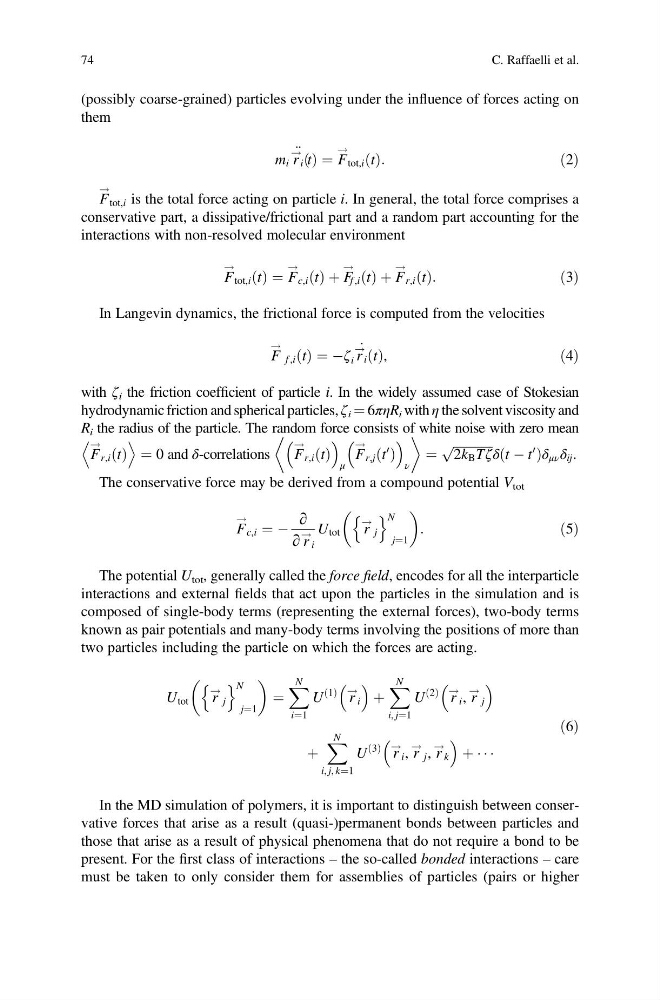
(possibly coarse-grained) particles evolving under the influence of forces acting on
them
m i
€
r
!
i t
ð Þ ¼ F
!
tot,i t
ð Þ:
ð2Þ
F
!
tot,i is the total force acting on particle i. In general, the total force comprises a
conservative part, a dissipative/frictional part and a random part accounting for the
interactions with non-resolved molecular environment
F
!
tot,i t
ð Þ ¼ F
!
c,i t
ð Þ þ F
!
f ,i t
ð Þ þ F
!
r,i t
ð Þ:
ð3Þ
In Langevin dynamics, the frictional force is computed from the velocities
F
!
f ,i t
ð Þ ¼ Àζ i
_
r
!
i t
ð Þ,
ð4Þ
with ζ i the friction coefficient of particle i. In the widely assumed case of Stokesian
hydrodynamic friction and spherical particles, ζ i ¼ 6πηR i with η the solvent viscosity and
R i the radius of the particle. The random force consists of white noise with zero mean
F
!
r,i t
ð Þ
D
E
¼ 0 and δ-correlations
F
!
r,i t
ð Þ
μ
F
!
r,j t
0
ð Þ
ν
(
)
¼
ffiffiffiffiffiffiffiffiffiffiffiffiffi
2k B Tζ
p
δ t À t
0
ð
Þδ μν δ ij .
The conservative force may be derived from a compound potential V tot
F
!
c,i ¼ À
∂
∂ r
!
i
U tot
r
!
j
n o N
j¼1
:
ð5Þ
The potential U tot , generally called the force field, encodes for all the interparticle
interactions and external fields that act upon the particles in the simulation and is
composed of single-body terms (representing the external forces), two-body terms
known as pair potentials and many-body terms involving the positions of more than
two particles including the particle on which the forces are acting.
U tot
r
!
j
n o N
j¼1
¼
X N
i¼1
U
1
ð Þ r
!
i
þ
X N
i, j¼1
U
2
ð Þ r
!
i , r
!
j
þ
X N
i, j, k¼1
U
3
ð Þ r
!
i , r
!
j , r
!
k
þ Á Á Á
ð6Þ
In the MD simulation of polymers, it is important to distinguish between conservative forces that arise as a result (quasi-)permanent bonds between particles and
those that arise as a result of physical phenomena that do not require a bond to be
present. For the first class of interactions – the so-called bonded interactions – care
must be taken to only consider them for assemblies of particles (pairs or higher
74
C. Raffaelli et al.
them
m i
€
r
!
i t
ð Þ ¼ F
!
tot,i t
ð Þ:
ð2Þ
F
!
tot,i is the total force acting on particle i. In general, the total force comprises a
conservative part, a dissipative/frictional part and a random part accounting for the
interactions with non-resolved molecular environment
F
!
tot,i t
ð Þ ¼ F
!
c,i t
ð Þ þ F
!
f ,i t
ð Þ þ F
!
r,i t
ð Þ:
ð3Þ
In Langevin dynamics, the frictional force is computed from the velocities
F
!
f ,i t
ð Þ ¼ Àζ i
_
r
!
i t
ð Þ,
ð4Þ
with ζ i the friction coefficient of particle i. In the widely assumed case of Stokesian
hydrodynamic friction and spherical particles, ζ i ¼ 6πηR i with η the solvent viscosity and
R i the radius of the particle. The random force consists of white noise with zero mean
F
!
r,i t
ð Þ
D
E
¼ 0 and δ-correlations
F
!
r,i t
ð Þ
μ
F
!
r,j t
0
ð Þ
ν
(
)
¼
ffiffiffiffiffiffiffiffiffiffiffiffiffi
2k B Tζ
p
δ t À t
0
ð
Þδ μν δ ij .
The conservative force may be derived from a compound potential V tot
F
!
c,i ¼ À
∂
∂ r
!
i
U tot
r
!
j
n o N
j¼1
:
ð5Þ
The potential U tot , generally called the force field, encodes for all the interparticle
interactions and external fields that act upon the particles in the simulation and is
composed of single-body terms (representing the external forces), two-body terms
known as pair potentials and many-body terms involving the positions of more than
two particles including the particle on which the forces are acting.
U tot
r
!
j
n o N
j¼1
¼
X N
i¼1
U
1
ð Þ r
!
i
þ
X N
i, j¼1
U
2
ð Þ r
!
i , r
!
j
þ
X N
i, j, k¼1
U
3
ð Þ r
!
i , r
!
j , r
!
k
þ Á Á Á
ð6Þ
In the MD simulation of polymers, it is important to distinguish between conservative forces that arise as a result (quasi-)permanent bonds between particles and
those that arise as a result of physical phenomena that do not require a bond to be
present. For the first class of interactions – the so-called bonded interactions – care
must be taken to only consider them for assemblies of particles (pairs or higher
74
C. Raffaelli et al.