

localized damages. In vitrimers, covalent bond swapping across the cut elegantly
takes care of healing any damage that the material sustains, so effectively that swaps
can also act as a welding strategy to naturally merge two equilibrated surfaces into a
single piece of material. If the vitrimer is engineered such that the stress is relaxed
much later than the swap time [67], the material can effectively heal autonomously
while still being a solid. Lastly, vitrimers behave as super-strong glass formers [57]
exhibiting a very slow growth of the viscosity approaching their glass transition.
This grants them vast (re)processing power because they keep flowing as slow
viscous liquids in a wide temperature range. Interestingly we have been able to
model their fragility [68] and unravel that the topology becomes important also close
to the glass transition.
3 Computational Approaches
3.1 Coarse-Grained Strategies for Polymer Networks
in Molecular Dynamics
Molecular simulation presents the opportunity to systematically study the static and
dynamic properties of a polymer network. Detailed molecular properties may be
harvested from the simulation trajectories, and parameters systematically varied.
There are two general approaches to polymer simulations: ‘atomistic’ and
‘coarse-grained’ [69]. In an atomistic approach, atoms or small groups of atoms
are represented explicitly, and interactions between the entities are defined by
empirical force fields. The advantage of this approach is that specific polymeric
chemistries can be studied. However, given the level of detail present in the model, it
becomes computationally challenging to study large systems or long timescales. For
polymer networks where overall structural relaxation times grow large, this limitation of the atomistic approach can become prohibitive.
In a coarse-grained approach [69, 70], simplified models of the polymers are used
in order to reduce computational complexity while still retaining essential physical
interactions between the monomers. The approach is useful for exploring more
general features of polymer behaviour in a network, without specificity towards
particular chemistries or monomer functional groups. For example, the bead-spring
model of polymers represents monomers as spheres and bonds as harmonic potentials between the monomers. The monomers interact via a Lennard-Jones
intermolecular potential. Three-body angle potentials and four-body dihedral potentials can be added in order to study semiflexible polymers. The coarse-grained
approach allows one to study larger systems, and longer timescales, compared to
the atomistic approach.
In practice, a molecular dynamics (MD) simulation amounts to solving Newton’s
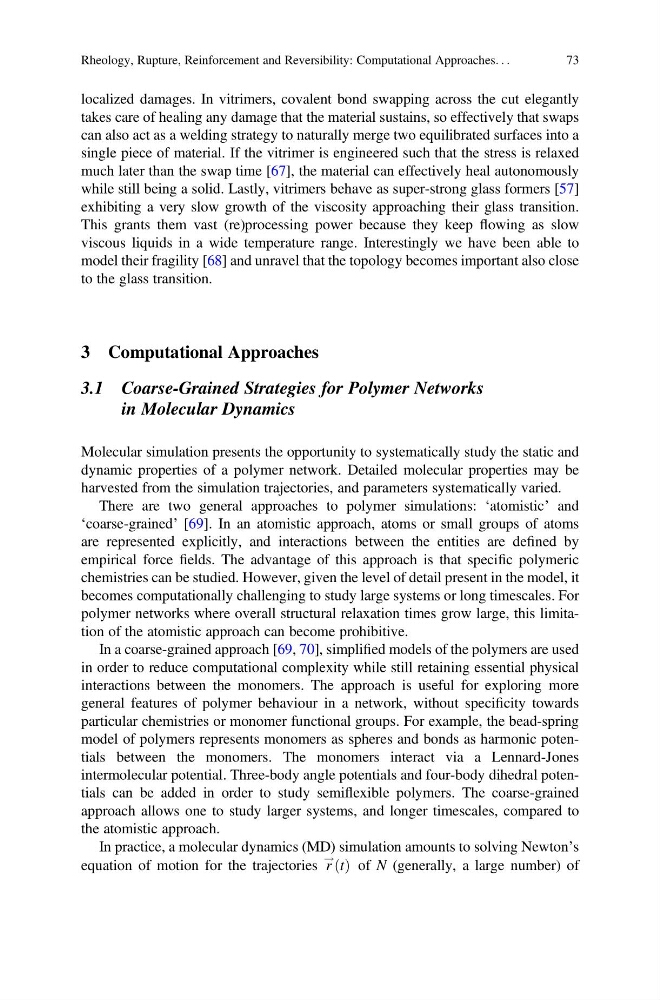
equation of motion for the trajectories r
! t
ð Þ of N (generally, a large number) of
Rheology, Rupture, Reinforcement and Reversibility: Computational Approaches. . .
73
takes care of healing any damage that the material sustains, so effectively that swaps
can also act as a welding strategy to naturally merge two equilibrated surfaces into a
single piece of material. If the vitrimer is engineered such that the stress is relaxed
much later than the swap time [67], the material can effectively heal autonomously
while still being a solid. Lastly, vitrimers behave as super-strong glass formers [57]
exhibiting a very slow growth of the viscosity approaching their glass transition.
This grants them vast (re)processing power because they keep flowing as slow
viscous liquids in a wide temperature range. Interestingly we have been able to
model their fragility [68] and unravel that the topology becomes important also close
to the glass transition.
3 Computational Approaches
3.1 Coarse-Grained Strategies for Polymer Networks
in Molecular Dynamics
Molecular simulation presents the opportunity to systematically study the static and
dynamic properties of a polymer network. Detailed molecular properties may be
harvested from the simulation trajectories, and parameters systematically varied.
There are two general approaches to polymer simulations: ‘atomistic’ and
‘coarse-grained’ [69]. In an atomistic approach, atoms or small groups of atoms
are represented explicitly, and interactions between the entities are defined by
empirical force fields. The advantage of this approach is that specific polymeric
chemistries can be studied. However, given the level of detail present in the model, it
becomes computationally challenging to study large systems or long timescales. For
polymer networks where overall structural relaxation times grow large, this limitation of the atomistic approach can become prohibitive.
In a coarse-grained approach [69, 70], simplified models of the polymers are used
in order to reduce computational complexity while still retaining essential physical
interactions between the monomers. The approach is useful for exploring more
general features of polymer behaviour in a network, without specificity towards
particular chemistries or monomer functional groups. For example, the bead-spring
model of polymers represents monomers as spheres and bonds as harmonic potentials between the monomers. The monomers interact via a Lennard-Jones
intermolecular potential. Three-body angle potentials and four-body dihedral potentials can be added in order to study semiflexible polymers. The coarse-grained
approach allows one to study larger systems, and longer timescales, compared to
the atomistic approach.
In practice, a molecular dynamics (MD) simulation amounts to solving Newton’s
equation of motion for the trajectories r
! t
ð Þ of N (generally, a large number) of
Rheology, Rupture, Reinforcement and Reversibility: Computational Approaches. . .
73