

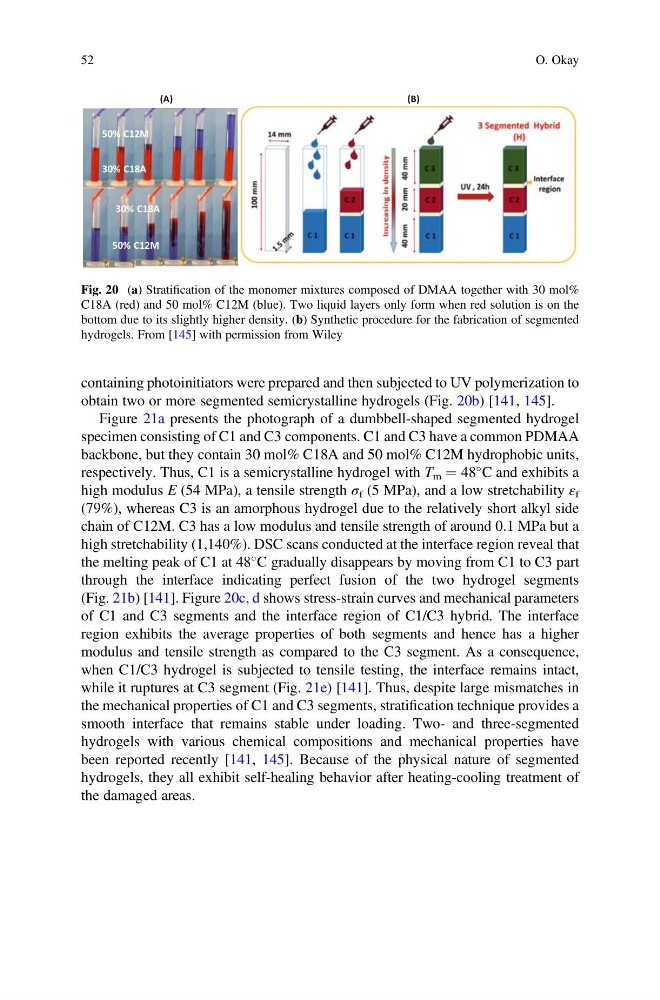
containing photoinitiators were prepared and then subjected to UV polymerization to
obtain two or more segmented semicrystalline hydrogels (Fig. 20b) [141, 145].
Figure 21a presents the photograph of a dumbbell-shaped segmented hydrogel
specimen consisting of C1 and C3 components. C1 and C3 have a common PDMAA
backbone, but they contain 30 mol% C18A and 50 mol% C12M hydrophobic units,
respectively. Thus, C1 is a semicrystalline hydrogel with T m ¼ 48
C and exhibits a
high modulus E (54 MPa), a tensile strength σ f (5 MPa), and a low stretchability ε f
(79%), whereas C3 is an amorphous hydrogel due to the relatively short alkyl side
chain of C12M. C3 has a low modulus and tensile strength of around 0.1 MPa but a
high stretchability (1,140%). DSC scans conducted at the interface region reveal that
the melting peak of C1 at 48
C gradually disappears by moving from C1 to C3 part
through the interface indicating perfect fusion of the two hydrogel segments
(Fig. 21b) [141]. Figure 20c, d shows stress-strain curves and mechanical parameters
of C1 and C3 segments and the interface region of C1/C3 hybrid. The interface
region exhibits the average properties of both segments and hence has a higher
modulus and tensile strength as compared to the C3 segment. As a consequence,
when C1/C3 hydrogel is subjected to tensile testing, the interface remains intact,
while it ruptures at C3 segment (Fig. 21e) [141]. Thus, despite large mismatches in
the mechanical properties of C1 and C3 segments, stratification technique provides a
smooth interface that remains stable under loading. Two- and three-segmented
hydrogels with various chemical compositions and mechanical properties have
been reported recently [141, 145]. Because of the physical nature of segmented
hydrogels, they all exhibit self-healing behavior after heating-cooling treatment of
the damaged areas.
30% C18A
50% C12M
30% C18A
50% C12M
(A)
(B)
Fig. 20 (a) Stratification of the monomer mixtures composed of DMAA together with 30 mol%
C18A (red) and 50 mol% C12M (blue). Two liquid layers only form when red solution is on the
bottom due to its slightly higher density. (b) Synthetic procedure for the fabrication of segmented
hydrogels. From [145] with permission from Wiley
52
O. Okay
obtain two or more segmented semicrystalline hydrogels (Fig. 20b) [141, 145].
Figure 21a presents the photograph of a dumbbell-shaped segmented hydrogel
specimen consisting of C1 and C3 components. C1 and C3 have a common PDMAA
backbone, but they contain 30 mol% C18A and 50 mol% C12M hydrophobic units,
respectively. Thus, C1 is a semicrystalline hydrogel with T m ¼ 48
C and exhibits a
high modulus E (54 MPa), a tensile strength σ f (5 MPa), and a low stretchability ε f
(79%), whereas C3 is an amorphous hydrogel due to the relatively short alkyl side
chain of C12M. C3 has a low modulus and tensile strength of around 0.1 MPa but a
high stretchability (1,140%). DSC scans conducted at the interface region reveal that
the melting peak of C1 at 48
C gradually disappears by moving from C1 to C3 part
through the interface indicating perfect fusion of the two hydrogel segments
(Fig. 21b) [141]. Figure 20c, d shows stress-strain curves and mechanical parameters
of C1 and C3 segments and the interface region of C1/C3 hybrid. The interface
region exhibits the average properties of both segments and hence has a higher
modulus and tensile strength as compared to the C3 segment. As a consequence,
when C1/C3 hydrogel is subjected to tensile testing, the interface remains intact,
while it ruptures at C3 segment (Fig. 21e) [141]. Thus, despite large mismatches in
the mechanical properties of C1 and C3 segments, stratification technique provides a
smooth interface that remains stable under loading. Two- and three-segmented
hydrogels with various chemical compositions and mechanical properties have
been reported recently [141, 145]. Because of the physical nature of segmented
hydrogels, they all exhibit self-healing behavior after heating-cooling treatment of
the damaged areas.
30% C18A
50% C12M
30% C18A
50% C12M
(A)
(B)
Fig. 20 (a) Stratification of the monomer mixtures composed of DMAA together with 30 mol%
C18A (red) and 50 mol% C12M (blue). Two liquid layers only form when red solution is on the
bottom due to its slightly higher density. (b) Synthetic procedure for the fabrication of segmented
hydrogels. From [145] with permission from Wiley
52
O. Okay