

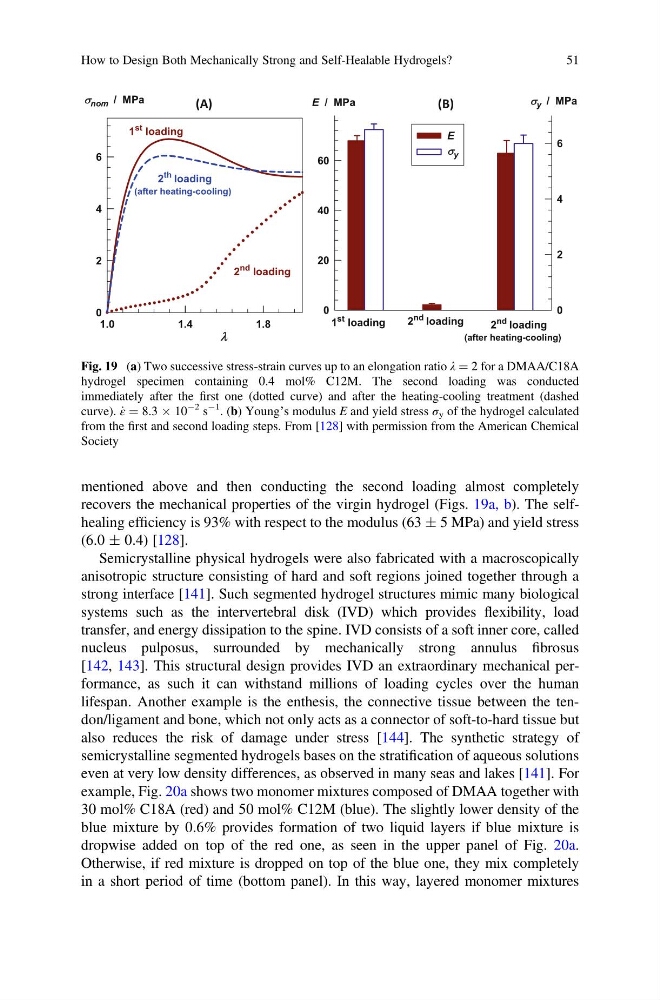
mentioned above and then conducting the second loading almost completely
recovers the mechanical properties of the virgin hydrogel (Figs. 19a, b). The selfhealing efficiency is 93% with respect to the modulus (63 Æ 5 MPa) and yield stress
(6.0 Æ 0.4) [128].
Semicrystalline physical hydrogels were also fabricated with a macroscopically
anisotropic structure consisting of hard and soft regions joined together through a
strong interface [141]. Such segmented hydrogel structures mimic many biological
systems such as the intervertebral disk (IVD) which provides flexibility, load
transfer, and energy dissipation to the spine. IVD consists of a soft inner core, called
nucleus pulposus, surrounded by mechanically strong annulus fibrosus
[142, 143]. This structural design provides IVD an extraordinary mechanical performance, as such it can withstand millions of loading cycles over the human
lifespan. Another example is the enthesis, the connective tissue between the tendon/ligament and bone, which not only acts as a connector of soft-to-hard tissue but
also reduces the risk of damage under stress [144]. The synthetic strategy of
semicrystalline segmented hydrogels bases on the stratification of aqueous solutions
even at very low density differences, as observed in many seas and lakes [141]. For
example, Fig. 20a shows two monomer mixtures composed of DMAA together with
30 mol% C18A (red) and 50 mol% C12M (blue). The slightly lower density of the
blue mixture by 0.6% provides formation of two liquid layers if blue mixture is
dropwise added on top of the red one, as seen in the upper panel of Fig. 20a.
Otherwise, if red mixture is dropped on top of the blue one, they mix completely
in a short period of time (bottom panel). In this way, layered monomer mixtures
λ λ
1.0
1.4
1.8
σ nom / MPa
0
2
4
6
1
st loading
2
nd loading
2
th loading
(after heating-cooling)
E / MPa
0
20
40
60
σ y / MPa
0
2
4
6
E
σ y
1
st loading
2
nd loading
2
nd loading
(after heating-cooling)
(B)
(A)
Fig. 19 (a) Two successive stress-strain curves up to an elongation ratio λ ¼ 2 for a DMAA/C18A
hydrogel specimen containing 0.4 mol% C12M. The second loading was conducted
immediately after the first one (dotted curve) and after the heating-cooling treatment (dashed
curve). _
ε ¼ 8.3 Â 10
À2 s
À1
. (b) Young’s modulus E and yield stress σ y of the hydrogel calculated
from the first and second loading steps. From [128] with permission from the American Chemical
Society
How to Design Both Mechanically Strong and Self-Healable Hydrogels?
51
recovers the mechanical properties of the virgin hydrogel (Figs. 19a, b). The selfhealing efficiency is 93% with respect to the modulus (63 Æ 5 MPa) and yield stress
(6.0 Æ 0.4) [128].
Semicrystalline physical hydrogels were also fabricated with a macroscopically
anisotropic structure consisting of hard and soft regions joined together through a
strong interface [141]. Such segmented hydrogel structures mimic many biological
systems such as the intervertebral disk (IVD) which provides flexibility, load
transfer, and energy dissipation to the spine. IVD consists of a soft inner core, called
nucleus pulposus, surrounded by mechanically strong annulus fibrosus
[142, 143]. This structural design provides IVD an extraordinary mechanical performance, as such it can withstand millions of loading cycles over the human
lifespan. Another example is the enthesis, the connective tissue between the tendon/ligament and bone, which not only acts as a connector of soft-to-hard tissue but
also reduces the risk of damage under stress [144]. The synthetic strategy of
semicrystalline segmented hydrogels bases on the stratification of aqueous solutions
even at very low density differences, as observed in many seas and lakes [141]. For
example, Fig. 20a shows two monomer mixtures composed of DMAA together with
30 mol% C18A (red) and 50 mol% C12M (blue). The slightly lower density of the
blue mixture by 0.6% provides formation of two liquid layers if blue mixture is
dropwise added on top of the red one, as seen in the upper panel of Fig. 20a.
Otherwise, if red mixture is dropped on top of the blue one, they mix completely
in a short period of time (bottom panel). In this way, layered monomer mixtures
λ λ
1.0
1.4
1.8
σ nom / MPa
0
2
4
6
1
st loading
2
nd loading
2
th loading
(after heating-cooling)
E / MPa
0
20
40
60
σ y / MPa
0
2
4
6
E
σ y
1
st loading
2
nd loading
2
nd loading
(after heating-cooling)
(B)
(A)
Fig. 19 (a) Two successive stress-strain curves up to an elongation ratio λ ¼ 2 for a DMAA/C18A
hydrogel specimen containing 0.4 mol% C12M. The second loading was conducted
immediately after the first one (dotted curve) and after the heating-cooling treatment (dashed
curve). _
ε ¼ 8.3 Â 10
À2 s
À1
. (b) Young’s modulus E and yield stress σ y of the hydrogel calculated
from the first and second loading steps. From [128] with permission from the American Chemical
Society
How to Design Both Mechanically Strong and Self-Healable Hydrogels?
51