

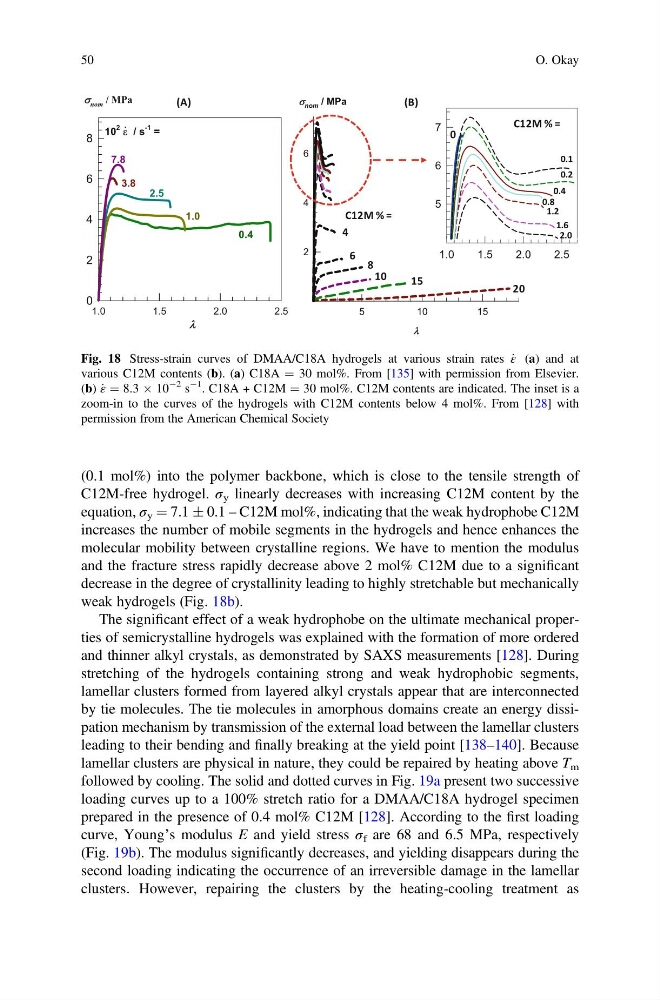
(0.1 mol%) into the polymer backbone, which is close to the tensile strength of
C12M-free hydrogel. σ y linearly decreases with increasing C12M content by the
equation, σ y ¼ 7.1 Æ 0.1 – C12M mol%, indicating that the weak hydrophobe C12M
increases the number of mobile segments in the hydrogels and hence enhances the
molecular mobility between crystalline regions. We have to mention the modulus
and the fracture stress rapidly decrease above 2 mol% C12M due to a significant
decrease in the degree of crystallinity leading to highly stretchable but mechanically
weak hydrogels (Fig. 18b).
The significant effect of a weak hydrophobe on the ultimate mechanical properties of semicrystalline hydrogels was explained with the formation of more ordered
and thinner alkyl crystals, as demonstrated by SAXS measurements [128]. During
stretching of the hydrogels containing strong and weak hydrophobic segments,
lamellar clusters formed from layered alkyl crystals appear that are interconnected
by tie molecules. The tie molecules in amorphous domains create an energy dissipation mechanism by transmission of the external load between the lamellar clusters
leading to their bending and finally breaking at the yield point [138–140]. Because
lamellar clusters are physical in nature, they could be repaired by heating above T m
followed by cooling. The solid and dotted curves in Fig. 19a present two successive
loading curves up to a 100% stretch ratio for a DMAA/C18A hydrogel specimen
prepared in the presence of 0.4 mol% C12M [128]. According to the first loading
curve, Young’s modulus E and yield stress σ f are 68 and 6.5 MPa, respectively
(Fig. 19b). The modulus significantly decreases, and yielding disappears during the
second loading indicating the occurrence of an irreversible damage in the lamellar
clusters. However, repairing the clusters by the heating-cooling treatment as
λ
σ σ nom / MPa
0
2
4
6
8
7.8
10
2 ε / s
-1 =
3.8
2.5
0.4
1.0
.
λ
1.0
1.5
2.0
2.5
5
1 0
1 5
σ nom / MPa
2
4
6
1.0
1.5
2.0
2.5
5
6
7
(A)
(B)
4
8
10
6
15
20
C12M % =
0
0.1
0.2
0.4
0.8
1.2
1.6
2.0
C12M % =
Fig. 18 Stress-strain curves of DMAA/C18A hydrogels at various strain rates _
ε (a) and at
various C12M contents (b). (a) C18A ¼ 30 mol%. From [135] with permission from Elsevier.
(b) _
ε ¼ 8.3 Â 10
À2 s
À1
. C18A + C12M ¼ 30 mol%. C12M contents are indicated. The inset is a
zoom-in to the curves of the hydrogels with C12M contents below 4 mol%. From [128] with
permission from the American Chemical Society
50
O. Okay
C12M-free hydrogel. σ y linearly decreases with increasing C12M content by the
equation, σ y ¼ 7.1 Æ 0.1 – C12M mol%, indicating that the weak hydrophobe C12M
increases the number of mobile segments in the hydrogels and hence enhances the
molecular mobility between crystalline regions. We have to mention the modulus
and the fracture stress rapidly decrease above 2 mol% C12M due to a significant
decrease in the degree of crystallinity leading to highly stretchable but mechanically
weak hydrogels (Fig. 18b).
The significant effect of a weak hydrophobe on the ultimate mechanical properties of semicrystalline hydrogels was explained with the formation of more ordered
and thinner alkyl crystals, as demonstrated by SAXS measurements [128]. During
stretching of the hydrogels containing strong and weak hydrophobic segments,
lamellar clusters formed from layered alkyl crystals appear that are interconnected
by tie molecules. The tie molecules in amorphous domains create an energy dissipation mechanism by transmission of the external load between the lamellar clusters
leading to their bending and finally breaking at the yield point [138–140]. Because
lamellar clusters are physical in nature, they could be repaired by heating above T m
followed by cooling. The solid and dotted curves in Fig. 19a present two successive
loading curves up to a 100% stretch ratio for a DMAA/C18A hydrogel specimen
prepared in the presence of 0.4 mol% C12M [128]. According to the first loading
curve, Young’s modulus E and yield stress σ f are 68 and 6.5 MPa, respectively
(Fig. 19b). The modulus significantly decreases, and yielding disappears during the
second loading indicating the occurrence of an irreversible damage in the lamellar
clusters. However, repairing the clusters by the heating-cooling treatment as
λ
σ σ nom / MPa
0
2
4
6
8
7.8
10
2 ε / s
-1 =
3.8
2.5
0.4
1.0
.
λ
1.0
1.5
2.0
2.5
5
1 0
1 5
σ nom / MPa
2
4
6
1.0
1.5
2.0
2.5
5
6
7
(A)
(B)
4
8
10
6
15
20
C12M % =
0
0.1
0.2
0.4
0.8
1.2
1.6
2.0
C12M % =
Fig. 18 Stress-strain curves of DMAA/C18A hydrogels at various strain rates _
ε (a) and at
various C12M contents (b). (a) C18A ¼ 30 mol%. From [135] with permission from Elsevier.
(b) _
ε ¼ 8.3 Â 10
À2 s
À1
. C18A + C12M ¼ 30 mol%. C12M contents are indicated. The inset is a
zoom-in to the curves of the hydrogels with C12M contents below 4 mol%. From [128] with
permission from the American Chemical Society
50
O. Okay