

4 Conclusions and Outlook
Recent developments in the field of hydrogels enable to enhance their mechanical
strength to MPa level at a water content between 60 and 75 wt%, which is similar to
the load-bearing tissues. Another challenge immersing in the last years is to generate
self-healing function in such hydrogels without affecting their good mechanical
properties. Because self-healing and mechanical strength are inversely related,
autonomic self-healing in high-strength hydrogels formed by long-lived crosslinks could not been created. However, a significant hard-to-soft or first-order
transition induced by an external trigger creates self-healing in such high-strength
hydrogels and hence combines the two antagonistic features in a single hydrogel
material. In this review, I mainly focused on hydrogels formed via H-bonding and
hydrophobic interactions, which are generally highly stretchable and exhibit
Young’s modulus and tensile strength in the range of MPa.
The strategies developed so far for the fabrication of H-bonded hydrogels are
based on forming self-complementary dual or multiple H-bonding interactions
between polymer chains. In addition, hydrophobic segments have been incorporated
into the hydrophilic chains to amplify these interactions. Polymer chains consisting
C3
C1
C3
C1
C3
(A)
ε %
0 300 600 900 1200
σ
nom / MPa
10 -2
10 -1
10 0
10 1
Interface
C1
C3
E / MPa
10 -1
10 0
10 1
σ
f / MPa
10 -1
10 0
ε
f %
10 2
10 3
C1
Interface C3
(C)
Temperature / o C
20
30
40
50
60
Heat flow / a.u.
C3
C1
1
2
3
4
5
6
Endo
(B)
(D)
6
Interface
C1
C3
1 2 3 4 5
E = 54 Mpa, σ f = 5 MPa
E, σ f = ~ 0.1 MPa
(E)
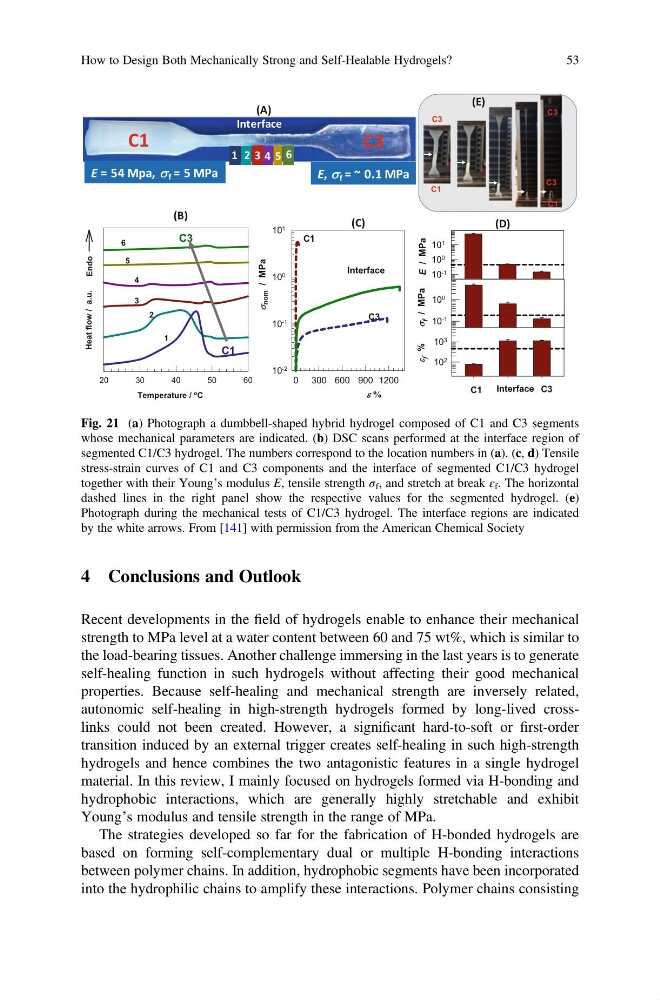
Fig. 21 (a) Photograph a dumbbell-shaped hybrid hydrogel composed of C1 and C3 segments
whose mechanical parameters are indicated. (b) DSC scans performed at the interface region of
segmented C1/C3 hydrogel. The numbers correspond to the location numbers in (a). (c, d) Tensile
stress-strain curves of C1 and C3 components and the interface of segmented C1/C3 hydrogel
together with their Young’s modulus E, tensile strength σ f , and stretch at break ε f . The horizontal
dashed lines in the right panel show the respective values for the segmented hydrogel. (e)
Photograph during the mechanical tests of C1/C3 hydrogel. The interface regions are indicated
by the white arrows. From [141] with permission from the American Chemical Society
How to Design Both Mechanically Strong and Self-Healable Hydrogels?
53
Recent developments in the field of hydrogels enable to enhance their mechanical
strength to MPa level at a water content between 60 and 75 wt%, which is similar to
the load-bearing tissues. Another challenge immersing in the last years is to generate
self-healing function in such hydrogels without affecting their good mechanical
properties. Because self-healing and mechanical strength are inversely related,
autonomic self-healing in high-strength hydrogels formed by long-lived crosslinks could not been created. However, a significant hard-to-soft or first-order
transition induced by an external trigger creates self-healing in such high-strength
hydrogels and hence combines the two antagonistic features in a single hydrogel
material. In this review, I mainly focused on hydrogels formed via H-bonding and
hydrophobic interactions, which are generally highly stretchable and exhibit
Young’s modulus and tensile strength in the range of MPa.
The strategies developed so far for the fabrication of H-bonded hydrogels are
based on forming self-complementary dual or multiple H-bonding interactions
between polymer chains. In addition, hydrophobic segments have been incorporated
into the hydrophilic chains to amplify these interactions. Polymer chains consisting
C3
C1
C3
C1
C3
(A)
ε %
0 300 600 900 1200
σ
nom / MPa
10 -2
10 -1
10 0
10 1
Interface
C1
C3
E / MPa
10 -1
10 0
10 1
σ
f / MPa
10 -1
10 0
ε
f %
10 2
10 3
C1
Interface C3
(C)
Temperature / o C
20
30
40
50
60
Heat flow / a.u.
C3
C1
1
2
3
4
5
6
Endo
(B)
(D)
6
Interface
C1
C3
1 2 3 4 5
E = 54 Mpa, σ f = 5 MPa
E, σ f = ~ 0.1 MPa
(E)
Fig. 21 (a) Photograph a dumbbell-shaped hybrid hydrogel composed of C1 and C3 segments
whose mechanical parameters are indicated. (b) DSC scans performed at the interface region of
segmented C1/C3 hydrogel. The numbers correspond to the location numbers in (a). (c, d) Tensile
stress-strain curves of C1 and C3 components and the interface of segmented C1/C3 hydrogel
together with their Young’s modulus E, tensile strength σ f , and stretch at break ε f . The horizontal
dashed lines in the right panel show the respective values for the segmented hydrogel. (e)
Photograph during the mechanical tests of C1/C3 hydrogel. The interface regions are indicated
by the white arrows. From [141] with permission from the American Chemical Society
How to Design Both Mechanically Strong and Self-Healable Hydrogels?
53