

cross-links appear due to the formation of aggregates composed of oppositely
charged AAc and CTA ions and alkyl side chains of C17.3 segments. These second
cross-links lead to a dramatic increase in the mechanical properties of water-swollen
PAAc hydrogels during which their viscous, energy-dissipating properties do not
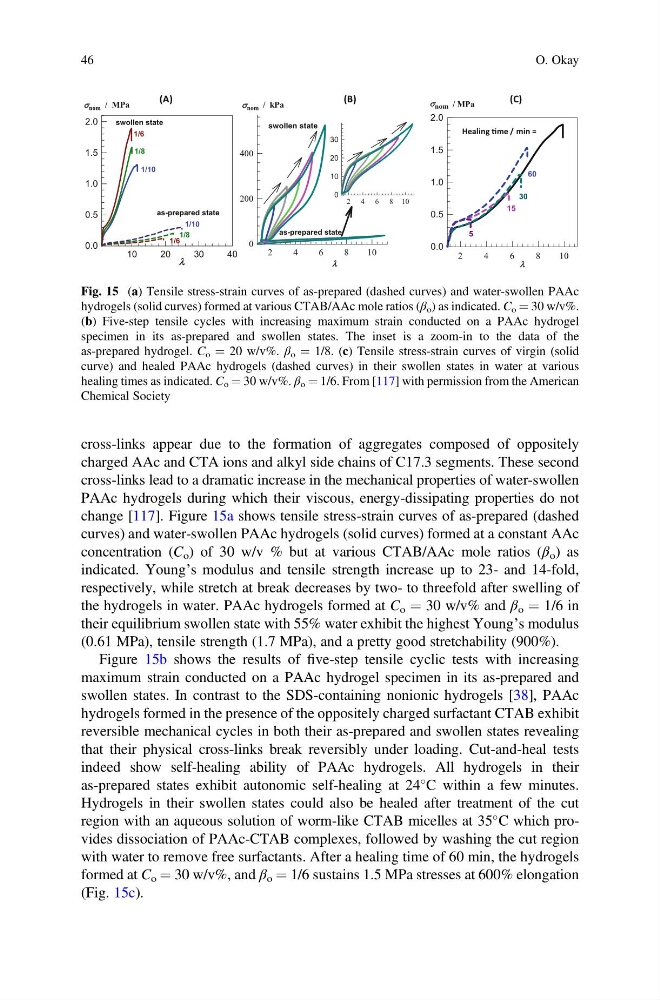
change [117]. Figure 15a shows tensile stress-strain curves of as-prepared (dashed
curves) and water-swollen PAAc hydrogels (solid curves) formed at a constant AAc
concentration (C o ) of 30 w/v % but at various CTAB/AAc mole ratios (β o ) as
indicated. Young’s modulus and tensile strength increase up to 23- and 14-fold,
respectively, while stretch at break decreases by two- to threefold after swelling of
the hydrogels in water. PAAc hydrogels formed at C o ¼ 30 w/v% and β o ¼ 1/6 in
their equilibrium swollen state with 55% water exhibit the highest Young’s modulus
(0.61 MPa), tensile strength (1.7 MPa), and a pretty good stretchability (900%).
Figure 15b shows the results of five-step tensile cyclic tests with increasing
maximum strain conducted on a PAAc hydrogel specimen in its as-prepared and
swollen states. In contrast to the SDS-containing nonionic hydrogels [38], PAAc
hydrogels formed in the presence of the oppositely charged surfactant CTAB exhibit
reversible mechanical cycles in both their as-prepared and swollen states revealing
that their physical cross-links break reversibly under loading. Cut-and-heal tests
indeed show self-healing ability of PAAc hydrogels. All hydrogels in their
as-prepared states exhibit autonomic self-healing at 24
C within a few minutes.
Hydrogels in their swollen states could also be healed after treatment of the cut
region with an aqueous solution of worm-like CTAB micelles at 35
C which provides dissociation of PAAc-CTAB complexes, followed by washing the cut region
with water to remove free surfactants. After a healing time of 60 min, the hydrogels
formed at C o ¼ 30 w/v%, and β o ¼ 1/6 sustains 1.5 MPa stresses at 600% elongation
(Fig. 15c).
λ
2
4
6
8
1 0
σ nom / kPa
0
200
400
as-prepared state
swollen state
2 4 6 8 10
0
10
20
30
λ
10
20
30
40
σ nom / MPa
0.0
0.5
1.0
1.5
2.0
1/10
1/6
1/8
1/10
1/6
1/8
as-prepared state
swollen state
λ
2
4
6
8
1 0
σ nom / MPa
0.0
0.5
1.0
1.5
2.0
60
30
5
15
Healing Ɵme / min =
(A)
(B)
(C)
Fig. 15 (a) Tensile stress-strain curves of as-prepared (dashed curves) and water-swollen PAAc
hydrogels (solid curves) formed at various CTAB/AAc mole ratios (β o ) as indicated. C o ¼ 30 w/v%.
(b) Five-step tensile cycles with increasing maximum strain conducted on a PAAc hydrogel
specimen in its as-prepared and swollen states. The inset is a zoom-in to the data of the
as-prepared hydrogel. C o ¼ 20 w/v%. β o ¼ 1/8. (c) Tensile stress-strain curves of virgin (solid
curve) and healed PAAc hydrogels (dashed curves) in their swollen states in water at various
healing times as indicated. C o ¼ 30 w/v%. β o ¼ 1/6. From [117] with permission from the American
Chemical Society
46
O. Okay
charged AAc and CTA ions and alkyl side chains of C17.3 segments. These second
cross-links lead to a dramatic increase in the mechanical properties of water-swollen
PAAc hydrogels during which their viscous, energy-dissipating properties do not
change [117]. Figure 15a shows tensile stress-strain curves of as-prepared (dashed
curves) and water-swollen PAAc hydrogels (solid curves) formed at a constant AAc
concentration (C o ) of 30 w/v % but at various CTAB/AAc mole ratios (β o ) as
indicated. Young’s modulus and tensile strength increase up to 23- and 14-fold,
respectively, while stretch at break decreases by two- to threefold after swelling of
the hydrogels in water. PAAc hydrogels formed at C o ¼ 30 w/v% and β o ¼ 1/6 in
their equilibrium swollen state with 55% water exhibit the highest Young’s modulus
(0.61 MPa), tensile strength (1.7 MPa), and a pretty good stretchability (900%).
Figure 15b shows the results of five-step tensile cyclic tests with increasing
maximum strain conducted on a PAAc hydrogel specimen in its as-prepared and
swollen states. In contrast to the SDS-containing nonionic hydrogels [38], PAAc
hydrogels formed in the presence of the oppositely charged surfactant CTAB exhibit
reversible mechanical cycles in both their as-prepared and swollen states revealing
that their physical cross-links break reversibly under loading. Cut-and-heal tests
indeed show self-healing ability of PAAc hydrogels. All hydrogels in their
as-prepared states exhibit autonomic self-healing at 24
C within a few minutes.
Hydrogels in their swollen states could also be healed after treatment of the cut
region with an aqueous solution of worm-like CTAB micelles at 35
C which provides dissociation of PAAc-CTAB complexes, followed by washing the cut region
with water to remove free surfactants. After a healing time of 60 min, the hydrogels
formed at C o ¼ 30 w/v%, and β o ¼ 1/6 sustains 1.5 MPa stresses at 600% elongation
(Fig. 15c).
λ
2
4
6
8
1 0
σ nom / kPa
0
200
400
as-prepared state
swollen state
2 4 6 8 10
0
10
20
30
λ
10
20
30
40
σ nom / MPa
0.0
0.5
1.0
1.5
2.0
1/10
1/6
1/8
1/10
1/6
1/8
as-prepared state
swollen state
λ
2
4
6
8
1 0
σ nom / MPa
0.0
0.5
1.0
1.5
2.0
60
30
5
15
Healing Ɵme / min =
(A)
(B)
(C)
Fig. 15 (a) Tensile stress-strain curves of as-prepared (dashed curves) and water-swollen PAAc
hydrogels (solid curves) formed at various CTAB/AAc mole ratios (β o ) as indicated. C o ¼ 30 w/v%.
(b) Five-step tensile cycles with increasing maximum strain conducted on a PAAc hydrogel
specimen in its as-prepared and swollen states. The inset is a zoom-in to the data of the
as-prepared hydrogel. C o ¼ 20 w/v%. β o ¼ 1/8. (c) Tensile stress-strain curves of virgin (solid
curve) and healed PAAc hydrogels (dashed curves) in their swollen states in water at various
healing times as indicated. C o ¼ 30 w/v%. β o ¼ 1/6. From [117] with permission from the American
Chemical Society
46
O. Okay