

3.2.2 Hydrogels Containing Crystalline Domains
Another attempt to fabricate mechanically strong hydrophobically modified
hydrogels with self-healing ability was to create alkyl crystal cross-links in the gel
network providing temperature-induced hard-to-soft transitions and thereby selfhealing [27, 128]. Thus, when the local temperature of the damaged area of a
semicrystalline physical hydrogel is increased above the crystalline melting temperature, the crystalline order is lost along with the strength of the crystal cross-links
providing a rapid healing due to the increased chain mobility in that area. Preparation
of semicrystalline chemically cross-linked hydrogels and the observation of an
order-to-disorder transition in the gel network were first reported 25 years ago by
Osada et al. [129–132]. They fabricated hybrid hydrogels containing both chemical
and alkyl crystal cross-links by free-radical copolymerization of AAc and C18A in
the presence of the chemical cross-linker BAAm in ethanol, a common solvent for
both monomers. The amorphous hydrophilic region of the hydrogels provides water
absorption, while the crystalline region is responsible for their high modulus. The
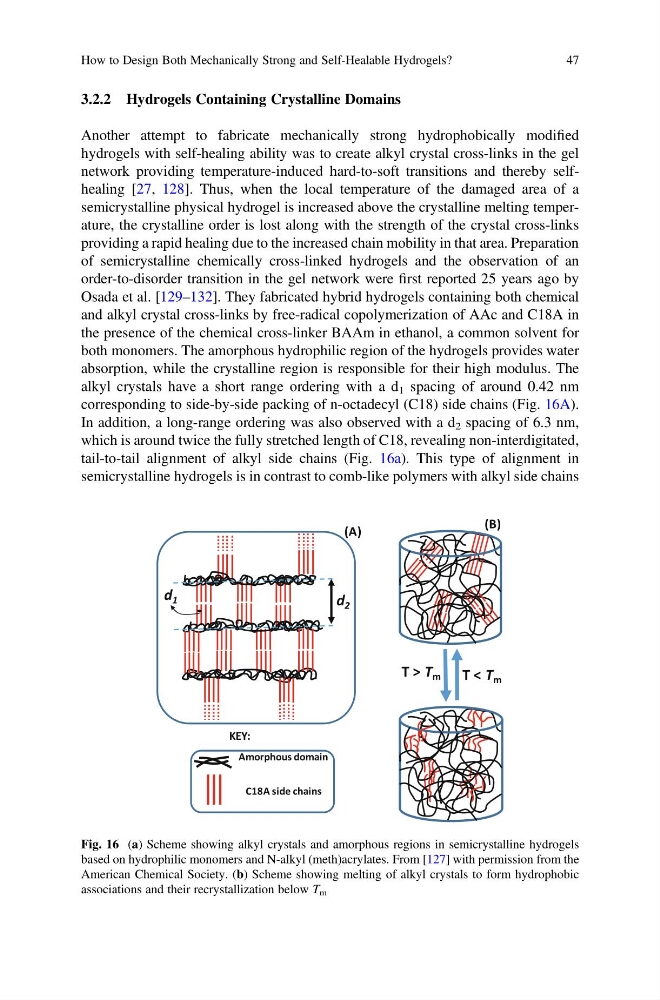
alkyl crystals have a short range ordering with a d 1 spacing of around 0.42 nm
corresponding to side-by-side packing of n-octadecyl (C18) side chains (Fig. 16A).
In addition, a long-range ordering was also observed with a d 2 spacing of 6.3 nm,
which is around twice the fully stretched length of C18, revealing non-interdigitated,
tail-to-tail alignment of alkyl side chains (Fig. 16a). This type of alignment in
semicrystalline hydrogels is in contrast to comb-like polymers with alkyl side chains
(A)
(B)
d 2
d 1
KEY:
Amorphous domain
C18A side chains
T < T m
T > T m
Fig. 16 (a) Scheme showing alkyl crystals and amorphous regions in semicrystalline hydrogels
based on hydrophilic monomers and N-alkyl (meth)acrylates. From [127] with permission from the
American Chemical Society. (b) Scheme showing melting of alkyl crystals to form hydrophobic
associations and their recrystallization below T m
How to Design Both Mechanically Strong and Self-Healable Hydrogels?
47
Another attempt to fabricate mechanically strong hydrophobically modified
hydrogels with self-healing ability was to create alkyl crystal cross-links in the gel
network providing temperature-induced hard-to-soft transitions and thereby selfhealing [27, 128]. Thus, when the local temperature of the damaged area of a
semicrystalline physical hydrogel is increased above the crystalline melting temperature, the crystalline order is lost along with the strength of the crystal cross-links
providing a rapid healing due to the increased chain mobility in that area. Preparation
of semicrystalline chemically cross-linked hydrogels and the observation of an
order-to-disorder transition in the gel network were first reported 25 years ago by
Osada et al. [129–132]. They fabricated hybrid hydrogels containing both chemical
and alkyl crystal cross-links by free-radical copolymerization of AAc and C18A in
the presence of the chemical cross-linker BAAm in ethanol, a common solvent for
both monomers. The amorphous hydrophilic region of the hydrogels provides water
absorption, while the crystalline region is responsible for their high modulus. The
alkyl crystals have a short range ordering with a d 1 spacing of around 0.42 nm
corresponding to side-by-side packing of n-octadecyl (C18) side chains (Fig. 16A).
In addition, a long-range ordering was also observed with a d 2 spacing of 6.3 nm,
which is around twice the fully stretched length of C18, revealing non-interdigitated,
tail-to-tail alignment of alkyl side chains (Fig. 16a). This type of alignment in
semicrystalline hydrogels is in contrast to comb-like polymers with alkyl side chains
(A)
(B)
d 2
d 1
KEY:
Amorphous domain
C18A side chains
T < T m
T > T m
Fig. 16 (a) Scheme showing alkyl crystals and amorphous regions in semicrystalline hydrogels
based on hydrophilic monomers and N-alkyl (meth)acrylates. From [127] with permission from the
American Chemical Society. (b) Scheme showing melting of alkyl crystals to form hydrophobic
associations and their recrystallization below T m
How to Design Both Mechanically Strong and Self-Healable Hydrogels?
47