

polymerization [117]. The interactions between polyelectrolytes and oppositely
charged surfactants in an aqueous solution such as poly(acrylic acid) (PAAc) and
cetyltrimethylammonium bromide (CTAB) have been investigated in detail during
the past two decades [118–125]. It was shown that, at a high ionization degree of
PAAc, electrostatic interactions determine the complex formation between PAAc
and CTAB, whereas hydrophobic interactions start to dominate when the ionization
is suppressed by decreasing the pH of the solution [118, 121]. Moreover, PAAcCTAB interactions become stronger when a small amount of a hydrophobic segment
carrying alkyl side chain is incorporated into the PAAc backbone because of the
formation of mixed micelles composed of CTAB and alkyl side chains of
hydrophobically modified PAAc [126, 127].
High-strength self-healing PAAc hydrogels were recently fabricated by micellar
copolymerization of AAc and 2 mol% C17.3M in aqueous solutions of worm-like
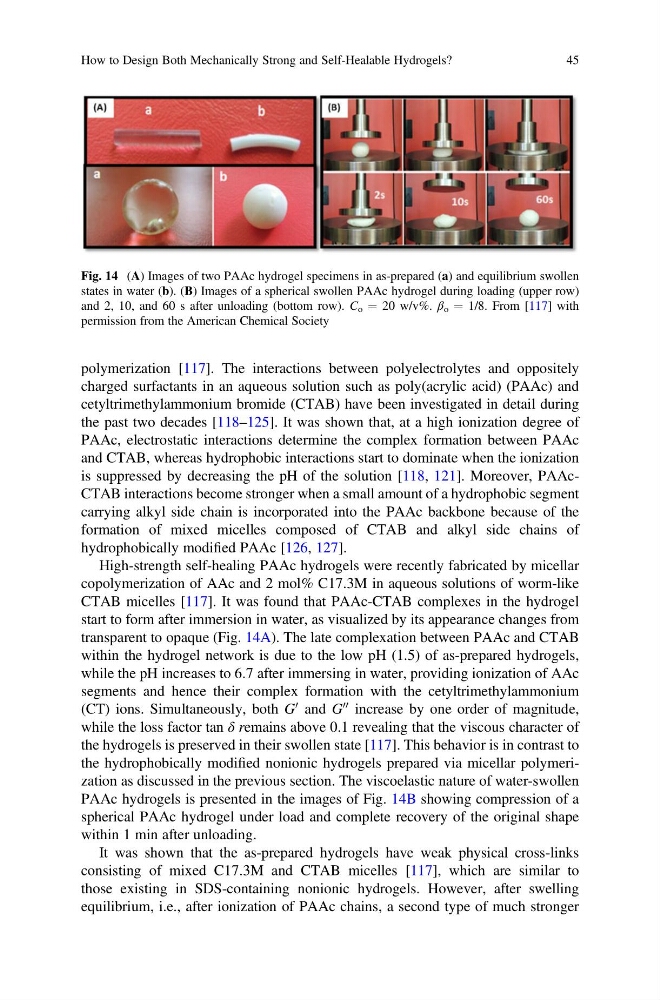
CTAB micelles [117]. It was found that PAAc-CTAB complexes in the hydrogel
start to form after immersion in water, as visualized by its appearance changes from
transparent to opaque (Fig. 14A). The late complexation between PAAc and CTAB
within the hydrogel network is due to the low pH (1.5) of as-prepared hydrogels,
while the pH increases to 6.7 after immersing in water, providing ionization of AAc
segments and hence their complex formation with the cetyltrimethylammonium
(CT) ions. Simultaneously, both G
0 and G
00 increase by one order of magnitude,
while the loss factor tan δ remains above 0.1 revealing that the viscous character of
the hydrogels is preserved in their swollen state [117]. This behavior is in contrast to
the hydrophobically modified nonionic hydrogels prepared via micellar polymerization as discussed in the previous section. The viscoelastic nature of water-swollen
PAAc hydrogels is presented in the images of Fig. 14B showing compression of a
spherical PAAc hydrogel under load and complete recovery of the original shape
within 1 min after unloading.
It was shown that the as-prepared hydrogels have weak physical cross-links
consisting of mixed C17.3M and CTAB micelles [117], which are similar to
those existing in SDS-containing nonionic hydrogels. However, after swelling
equilibrium, i.e., after ionization of PAAc chains, a second type of much stronger
Fig. 14 (A) Images of two PAAc hydrogel specimens in as-prepared (a) and equilibrium swollen
states in water (b). (B) Images of a spherical swollen PAAc hydrogel during loading (upper row)
and 2, 10, and 60 s after unloading (bottom row). C o ¼ 20 w/v%. β o ¼ 1/8. From [117] with
permission from the American Chemical Society
How to Design Both Mechanically Strong and Self-Healable Hydrogels?
45
charged surfactants in an aqueous solution such as poly(acrylic acid) (PAAc) and
cetyltrimethylammonium bromide (CTAB) have been investigated in detail during
the past two decades [118–125]. It was shown that, at a high ionization degree of
PAAc, electrostatic interactions determine the complex formation between PAAc
and CTAB, whereas hydrophobic interactions start to dominate when the ionization
is suppressed by decreasing the pH of the solution [118, 121]. Moreover, PAAcCTAB interactions become stronger when a small amount of a hydrophobic segment
carrying alkyl side chain is incorporated into the PAAc backbone because of the
formation of mixed micelles composed of CTAB and alkyl side chains of
hydrophobically modified PAAc [126, 127].
High-strength self-healing PAAc hydrogels were recently fabricated by micellar
copolymerization of AAc and 2 mol% C17.3M in aqueous solutions of worm-like
CTAB micelles [117]. It was found that PAAc-CTAB complexes in the hydrogel
start to form after immersion in water, as visualized by its appearance changes from
transparent to opaque (Fig. 14A). The late complexation between PAAc and CTAB
within the hydrogel network is due to the low pH (1.5) of as-prepared hydrogels,
while the pH increases to 6.7 after immersing in water, providing ionization of AAc
segments and hence their complex formation with the cetyltrimethylammonium
(CT) ions. Simultaneously, both G
0 and G
00 increase by one order of magnitude,
while the loss factor tan δ remains above 0.1 revealing that the viscous character of
the hydrogels is preserved in their swollen state [117]. This behavior is in contrast to
the hydrophobically modified nonionic hydrogels prepared via micellar polymerization as discussed in the previous section. The viscoelastic nature of water-swollen
PAAc hydrogels is presented in the images of Fig. 14B showing compression of a
spherical PAAc hydrogel under load and complete recovery of the original shape
within 1 min after unloading.
It was shown that the as-prepared hydrogels have weak physical cross-links
consisting of mixed C17.3M and CTAB micelles [117], which are similar to
those existing in SDS-containing nonionic hydrogels. However, after swelling
equilibrium, i.e., after ionization of PAAc chains, a second type of much stronger
Fig. 14 (A) Images of two PAAc hydrogel specimens in as-prepared (a) and equilibrium swollen
states in water (b). (B) Images of a spherical swollen PAAc hydrogel during loading (upper row)
and 2, 10, and 60 s after unloading (bottom row). C o ¼ 20 w/v%. β o ¼ 1/8. From [117] with
permission from the American Chemical Society
How to Design Both Mechanically Strong and Self-Healable Hydrogels?
45