

supramolecular bonds [106, 107]. However, increasing SDS concentration in the
hydrogel results in a gel-to-sol transition due to the dissolution of the mixed
micelles.
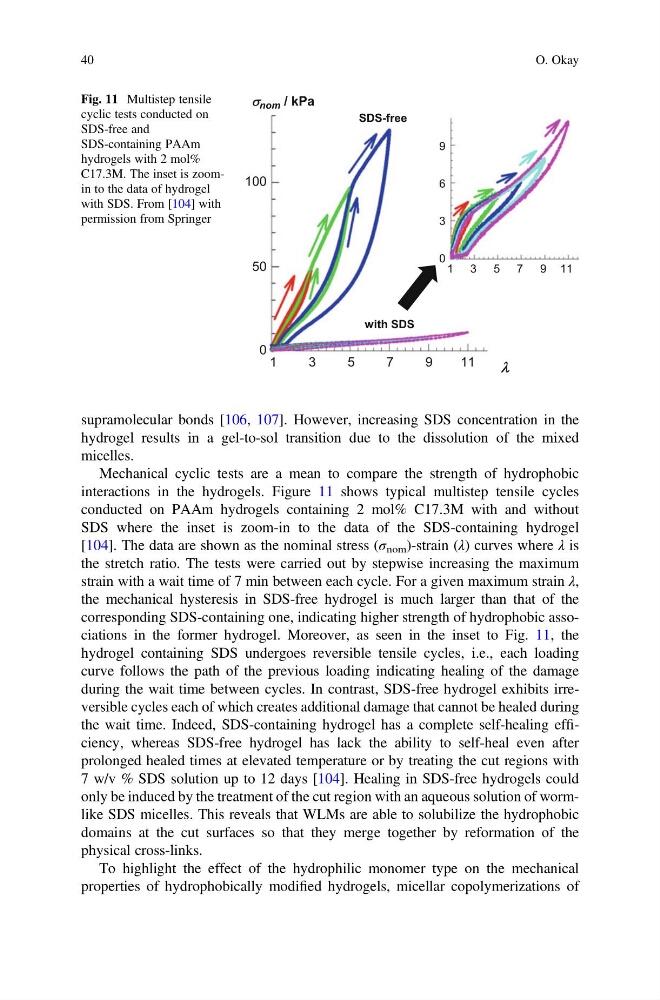
Mechanical cyclic tests are a mean to compare the strength of hydrophobic
interactions in the hydrogels. Figure 11 shows typical multistep tensile cycles
conducted on PAAm hydrogels containing 2 mol% C17.3M with and without
SDS where the inset is zoom-in to the data of the SDS-containing hydrogel
[104]. The data are shown as the nominal stress (σ nom )-strain (λ) curves where λ is
the stretch ratio. The tests were carried out by stepwise increasing the maximum
strain with a wait time of 7 min between each cycle. For a given maximum strain λ,
the mechanical hysteresis in SDS-free hydrogel is much larger than that of the
corresponding SDS-containing one, indicating higher strength of hydrophobic associations in the former hydrogel. Moreover, as seen in the inset to Fig. 11, the
hydrogel containing SDS undergoes reversible tensile cycles, i.e., each loading
curve follows the path of the previous loading indicating healing of the damage
during the wait time between cycles. In contrast, SDS-free hydrogel exhibits irreversible cycles each of which creates additional damage that cannot be healed during
the wait time. Indeed, SDS-containing hydrogel has a complete self-healing efficiency, whereas SDS-free hydrogel has lack the ability to self-heal even after
prolonged healed times at elevated temperature or by treating the cut regions with
7 w/v % SDS solution up to 12 days [104]. Healing in SDS-free hydrogels could
only be induced by the treatment of the cut region with an aqueous solution of wormlike SDS micelles. This reveals that WLMs are able to solubilize the hydrophobic
domains at the cut surfaces so that they merge together by reformation of the
physical cross-links.
To highlight the effect of the hydrophilic monomer type on the mechanical
properties of hydrophobically modified hydrogels, micellar copolymerizations of
λ λ
1
3
5
7
9
11
σ nom / kPa
0
50
100
1 3 5 7 9 11
0
3
6
9
with SDS
SDS-free
Fig. 11 Multistep tensile
cyclic tests conducted on
SDS-free and
SDS-containing PAAm
hydrogels with 2 mol%
C17.3M. The inset is zoomin to the data of hydrogel
with SDS. From [104] with
permission from Springer
40
O. Okay
hydrogel results in a gel-to-sol transition due to the dissolution of the mixed
micelles.
Mechanical cyclic tests are a mean to compare the strength of hydrophobic
interactions in the hydrogels. Figure 11 shows typical multistep tensile cycles
conducted on PAAm hydrogels containing 2 mol% C17.3M with and without
SDS where the inset is zoom-in to the data of the SDS-containing hydrogel
[104]. The data are shown as the nominal stress (σ nom )-strain (λ) curves where λ is
the stretch ratio. The tests were carried out by stepwise increasing the maximum
strain with a wait time of 7 min between each cycle. For a given maximum strain λ,
the mechanical hysteresis in SDS-free hydrogel is much larger than that of the
corresponding SDS-containing one, indicating higher strength of hydrophobic associations in the former hydrogel. Moreover, as seen in the inset to Fig. 11, the
hydrogel containing SDS undergoes reversible tensile cycles, i.e., each loading
curve follows the path of the previous loading indicating healing of the damage
during the wait time between cycles. In contrast, SDS-free hydrogel exhibits irreversible cycles each of which creates additional damage that cannot be healed during
the wait time. Indeed, SDS-containing hydrogel has a complete self-healing efficiency, whereas SDS-free hydrogel has lack the ability to self-heal even after
prolonged healed times at elevated temperature or by treating the cut regions with
7 w/v % SDS solution up to 12 days [104]. Healing in SDS-free hydrogels could
only be induced by the treatment of the cut region with an aqueous solution of wormlike SDS micelles. This reveals that WLMs are able to solubilize the hydrophobic
domains at the cut surfaces so that they merge together by reformation of the
physical cross-links.
To highlight the effect of the hydrophilic monomer type on the mechanical
properties of hydrophobically modified hydrogels, micellar copolymerizations of
λ λ
1
3
5
7
9
11
σ nom / kPa
0
50
100
1 3 5 7 9 11
0
3
6
9
with SDS
SDS-free
Fig. 11 Multistep tensile
cyclic tests conducted on
SDS-free and
SDS-containing PAAm
hydrogels with 2 mol%
C17.3M. The inset is zoomin to the data of hydrogel
with SDS. From [104] with
permission from Springer
40
O. Okay