

hydrophilic AAm, NIPAM, and DMAA monomers were conducted with 2 mol%
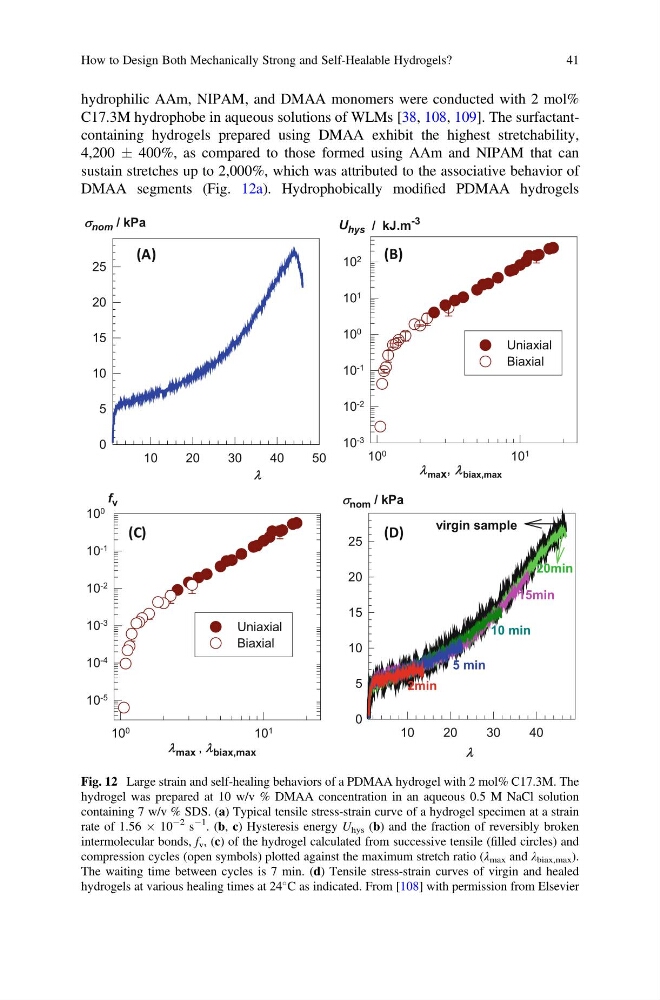
C17.3M hydrophobe in aqueous solutions of WLMs [38, 108, 109]. The surfactantcontaining hydrogels prepared using DMAA exhibit the highest stretchability,
4,200 Æ 400%, as compared to those formed using AAm and NIPAM that can
sustain stretches up to 2,000%, which was attributed to the associative behavior of
DMAA segments (Fig. 12a). Hydrophobically modified PDMAA hydrogels
λ max , λ biax,max
10
0
10
1
U hys / kJ.m
-3
10
-3
10
-2
10
-1
10
0
10
1
10
2
Uniaxial
Biaxial
λ max , λ biax,max
10
0
10
1
f v
10 -5
10
-4
10
-3
10
-2
10
-1
10
0
Uniaxial
Biaxial
λ
10
20
30
40
50
σ nom / kPa
0
5
10
15
20
25
λ
10
20
30
40
σ nom / kPa
0
5
10
15
20
25
virgin sample
20min
15min
10 min
5 min
2min
(A)
(B)
(C)
(D)
Fig. 12 Large strain and self-healing behaviors of a PDMAA hydrogel with 2 mol% C17.3M. The
hydrogel was prepared at 10 w/v % DMAA concentration in an aqueous 0.5 M NaCl solution
containing 7 w/v % SDS. (a) Typical tensile stress-strain curve of a hydrogel specimen at a strain
rate of 1.56 Â 10
À2 s
À1
. (b, c) Hysteresis energy U hys (b) and the fraction of reversibly broken
intermolecular bonds, f v , (c) of the hydrogel calculated from successive tensile (filled circles) and
compression cycles (open symbols) plotted against the maximum stretch ratio (λ max and λ biax,max ).
The waiting time between cycles is 7 min. (d) Tensile stress-strain curves of virgin and healed
hydrogels at various healing times at 24
C as indicated. From [108] with permission from Elsevier
How to Design Both Mechanically Strong and Self-Healable Hydrogels?
41
C17.3M hydrophobe in aqueous solutions of WLMs [38, 108, 109]. The surfactantcontaining hydrogels prepared using DMAA exhibit the highest stretchability,
4,200 Æ 400%, as compared to those formed using AAm and NIPAM that can
sustain stretches up to 2,000%, which was attributed to the associative behavior of
DMAA segments (Fig. 12a). Hydrophobically modified PDMAA hydrogels
λ max , λ biax,max
10
0
10
1
U hys / kJ.m
-3
10
-3
10
-2
10
-1
10
0
10
1
10
2
Uniaxial
Biaxial
λ max , λ biax,max
10
0
10
1
f v
10 -5
10
-4
10
-3
10
-2
10
-1
10
0
Uniaxial
Biaxial
λ
10
20
30
40
50
σ nom / kPa
0
5
10
15
20
25
λ
10
20
30
40
σ nom / kPa
0
5
10
15
20
25
virgin sample
20min
15min
10 min
5 min
2min
(A)
(B)
(C)
(D)
Fig. 12 Large strain and self-healing behaviors of a PDMAA hydrogel with 2 mol% C17.3M. The
hydrogel was prepared at 10 w/v % DMAA concentration in an aqueous 0.5 M NaCl solution
containing 7 w/v % SDS. (a) Typical tensile stress-strain curve of a hydrogel specimen at a strain
rate of 1.56 Â 10
À2 s
À1
. (b, c) Hysteresis energy U hys (b) and the fraction of reversibly broken
intermolecular bonds, f v , (c) of the hydrogel calculated from successive tensile (filled circles) and
compression cycles (open symbols) plotted against the maximum stretch ratio (λ max and λ biax,max ).
The waiting time between cycles is 7 min. (d) Tensile stress-strain curves of virgin and healed
hydrogels at various healing times at 24
C as indicated. From [108] with permission from Elsevier
How to Design Both Mechanically Strong and Self-Healable Hydrogels?
41