

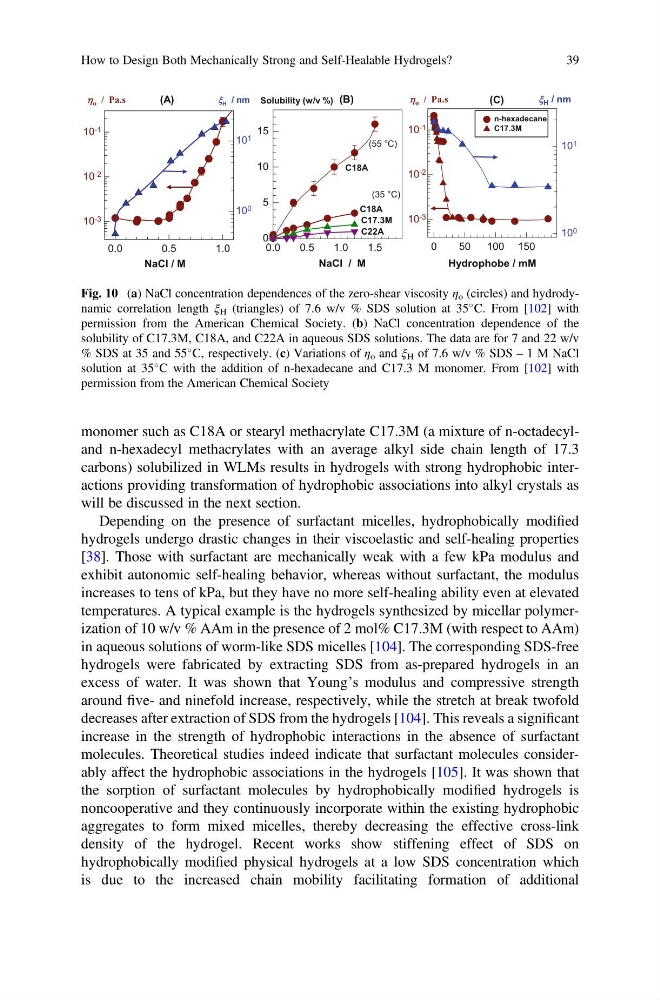
monomer such as C18A or stearyl methacrylate C17.3M (a mixture of n-octadecyland n-hexadecyl methacrylates with an average alkyl side chain length of 17.3
carbons) solubilized in WLMs results in hydrogels with strong hydrophobic interactions providing transformation of hydrophobic associations into alkyl crystals as
will be discussed in the next section.
Depending on the presence of surfactant micelles, hydrophobically modified
hydrogels undergo drastic changes in their viscoelastic and self-healing properties
[38]. Those with surfactant are mechanically weak with a few kPa modulus and
exhibit autonomic self-healing behavior, whereas without surfactant, the modulus
increases to tens of kPa, but they have no more self-healing ability even at elevated
temperatures. A typical example is the hydrogels synthesized by micellar polymerization of 10 w/v % AAm in the presence of 2 mol% C17.3M (with respect to AAm)
in aqueous solutions of worm-like SDS micelles [104]. The corresponding SDS-free
hydrogels were fabricated by extracting SDS from as-prepared hydrogels in an
excess of water. It was shown that Young’s modulus and compressive strength
around five- and ninefold increase, respectively, while the stretch at break twofold
decreases after extraction of SDS from the hydrogels [104]. This reveals a significant
increase in the strength of hydrophobic interactions in the absence of surfactant
molecules. Theoretical studies indeed indicate that surfactant molecules considerably affect the hydrophobic associations in the hydrogels [105]. It was shown that
the sorption of surfactant molecules by hydrophobically modified hydrogels is
noncooperative and they continuously incorporate within the existing hydrophobic
aggregates to form mixed micelles, thereby decreasing the effective cross-link
density of the hydrogel. Recent works show stiffening effect of SDS on
hydrophobically modified physical hydrogels at a low SDS concentration which
is due to the increased chain mobility facilitating formation of additional
NaCl / M
0.0
0.5
1.0
η o / Pa.s
10 -3
10 -2
10 -1
ξ H / nm
10 0
10 1
Hydrophobe / mM
0
50
100 150
η o / Pa.s
10 -3
10 -2
10 -1
ξ H / nm
10 0
10 1
n-hexadecane
C17.3M
(A)
(B)
NaCl / M
0.0
0.5
1.0
1.5
Solubility (w/v %)
0
5
10
15
C18A
C22A
C17.3M
C18A
(55 °C)
(35 °C)
(C)
Fig. 10 (a) NaCl concentration dependences of the zero-shear viscosity η o (circles) and hydrodynamic correlation length ξ H (triangles) of 7.6 w/v % SDS solution at 35
C. From [102] with
permission from the American Chemical Society. (b) NaCl concentration dependence of the
solubility of C17.3M, C18A, and C22A in aqueous SDS solutions. The data are for 7 and 22 w/v
% SDS at 35 and 55
C, respectively. (c) Variations of η o and ξ H of 7.6 w/v % SDS – 1 M NaCl
solution at 35
C with the addition of n-hexadecane and C17.3 M monomer. From [102] with
permission from the American Chemical Society
How to Design Both Mechanically Strong and Self-Healable Hydrogels?
39
carbons) solubilized in WLMs results in hydrogels with strong hydrophobic interactions providing transformation of hydrophobic associations into alkyl crystals as
will be discussed in the next section.
Depending on the presence of surfactant micelles, hydrophobically modified
hydrogels undergo drastic changes in their viscoelastic and self-healing properties
[38]. Those with surfactant are mechanically weak with a few kPa modulus and
exhibit autonomic self-healing behavior, whereas without surfactant, the modulus
increases to tens of kPa, but they have no more self-healing ability even at elevated
temperatures. A typical example is the hydrogels synthesized by micellar polymerization of 10 w/v % AAm in the presence of 2 mol% C17.3M (with respect to AAm)
in aqueous solutions of worm-like SDS micelles [104]. The corresponding SDS-free
hydrogels were fabricated by extracting SDS from as-prepared hydrogels in an
excess of water. It was shown that Young’s modulus and compressive strength
around five- and ninefold increase, respectively, while the stretch at break twofold
decreases after extraction of SDS from the hydrogels [104]. This reveals a significant
increase in the strength of hydrophobic interactions in the absence of surfactant
molecules. Theoretical studies indeed indicate that surfactant molecules considerably affect the hydrophobic associations in the hydrogels [105]. It was shown that
the sorption of surfactant molecules by hydrophobically modified hydrogels is
noncooperative and they continuously incorporate within the existing hydrophobic
aggregates to form mixed micelles, thereby decreasing the effective cross-link
density of the hydrogel. Recent works show stiffening effect of SDS on
hydrophobically modified physical hydrogels at a low SDS concentration which
is due to the increased chain mobility facilitating formation of additional
NaCl / M
0.0
0.5
1.0
η o / Pa.s
10 -3
10 -2
10 -1
ξ H / nm
10 0
10 1
Hydrophobe / mM
0
50
100 150
η o / Pa.s
10 -3
10 -2
10 -1
ξ H / nm
10 0
10 1
n-hexadecane
C17.3M
(A)
(B)
NaCl / M
0.0
0.5
1.0
1.5
Solubility (w/v %)
0
5
10
15
C18A
C22A
C17.3M
C18A
(55 °C)
(35 °C)
(C)
Fig. 10 (a) NaCl concentration dependences of the zero-shear viscosity η o (circles) and hydrodynamic correlation length ξ H (triangles) of 7.6 w/v % SDS solution at 35
C. From [102] with
permission from the American Chemical Society. (b) NaCl concentration dependence of the
solubility of C17.3M, C18A, and C22A in aqueous SDS solutions. The data are for 7 and 22 w/v
% SDS at 35 and 55
C, respectively. (c) Variations of η o and ξ H of 7.6 w/v % SDS – 1 M NaCl
solution at 35
C with the addition of n-hexadecane and C17.3 M monomer. From [102] with
permission from the American Chemical Society
How to Design Both Mechanically Strong and Self-Healable Hydrogels?
39