

to the preexisting PVP, in situ formed PVP produces much weaker H-bonds with the
in situ formed PAAm chains. This finding was explained with the higher molecular
weight of preexisting PVP than the in situ formed one, creating stronger
cooperativity in H-bonding interactions due to the so-called proximity effect
[45, 46]. Thus, once H-bonds are formed between two polymer molecules, their
conformational freedom is restricted, facilitating formation of subsequent H-bonds,
the extent of which increases with increasing number of segments in a polymer
molecule. In addition, trapping effect of H-bonds may also increase the lifetime of
chain entanglements leading to entanglement cross-links.
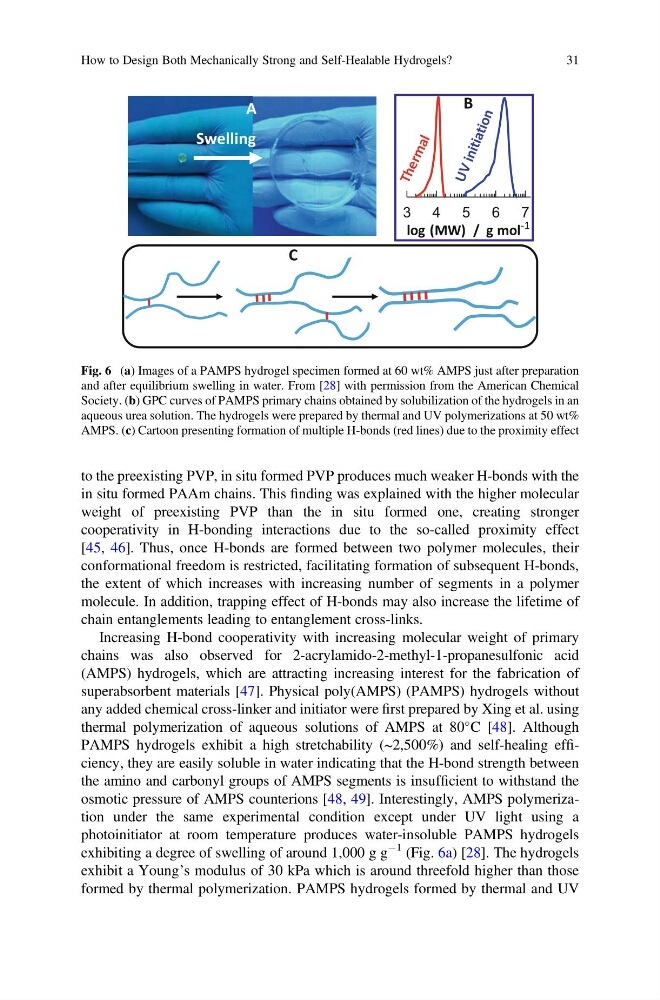
Increasing H-bond cooperativity with increasing molecular weight of primary
chains was also observed for 2-acrylamido-2-methyl-1-propanesulfonic acid
(AMPS) hydrogels, which are attracting increasing interest for the fabrication of
superabsorbent materials [47]. Physical poly(AMPS) (PAMPS) hydrogels without
any added chemical cross-linker and initiator were first prepared by Xing et al. using
thermal polymerization of aqueous solutions of AMPS at 80
C [48]. Although
PAMPS hydrogels exhibit a high stretchability (~2,500%) and self-healing efficiency, they are easily soluble in water indicating that the H-bond strength between
the amino and carbonyl groups of AMPS segments is insufficient to withstand the
osmotic pressure of AMPS counterions [48, 49]. Interestingly, AMPS polymerization under the same experimental condition except under UV light using a
photoinitiator at room temperature produces water-insoluble PAMPS hydrogels
exhibiting a degree of swelling of around 1,000 g g
À1 (Fig. 6a) [28]. The hydrogels
exhibit a Young’s modulus of 30 kPa which is around threefold higher than those
formed by thermal polymerization. PAMPS hydrogels formed by thermal and UV
3 4 5 6 7
log (MW) / g mol
-1
Swelling
B
C
A
Fig. 6 (a) Images of a PAMPS hydrogel specimen formed at 60 wt% AMPS just after preparation
and after equilibrium swelling in water. From [28] with permission from the American Chemical
Society. (b) GPC curves of PAMPS primary chains obtained by solubilization of the hydrogels in an
aqueous urea solution. The hydrogels were prepared by thermal and UV polymerizations at 50 wt%
AMPS. (c) Cartoon presenting formation of multiple H-bonds (red lines) due to the proximity effect
How to Design Both Mechanically Strong and Self-Healable Hydrogels?
31
in situ formed PAAm chains. This finding was explained with the higher molecular
weight of preexisting PVP than the in situ formed one, creating stronger
cooperativity in H-bonding interactions due to the so-called proximity effect
[45, 46]. Thus, once H-bonds are formed between two polymer molecules, their
conformational freedom is restricted, facilitating formation of subsequent H-bonds,
the extent of which increases with increasing number of segments in a polymer
molecule. In addition, trapping effect of H-bonds may also increase the lifetime of
chain entanglements leading to entanglement cross-links.
Increasing H-bond cooperativity with increasing molecular weight of primary
chains was also observed for 2-acrylamido-2-methyl-1-propanesulfonic acid
(AMPS) hydrogels, which are attracting increasing interest for the fabrication of
superabsorbent materials [47]. Physical poly(AMPS) (PAMPS) hydrogels without
any added chemical cross-linker and initiator were first prepared by Xing et al. using
thermal polymerization of aqueous solutions of AMPS at 80
C [48]. Although
PAMPS hydrogels exhibit a high stretchability (~2,500%) and self-healing efficiency, they are easily soluble in water indicating that the H-bond strength between
the amino and carbonyl groups of AMPS segments is insufficient to withstand the
osmotic pressure of AMPS counterions [48, 49]. Interestingly, AMPS polymerization under the same experimental condition except under UV light using a
photoinitiator at room temperature produces water-insoluble PAMPS hydrogels
exhibiting a degree of swelling of around 1,000 g g
À1 (Fig. 6a) [28]. The hydrogels
exhibit a Young’s modulus of 30 kPa which is around threefold higher than those
formed by thermal polymerization. PAMPS hydrogels formed by thermal and UV
3 4 5 6 7
log (MW) / g mol
-1
Swelling
B
C
A
Fig. 6 (a) Images of a PAMPS hydrogel specimen formed at 60 wt% AMPS just after preparation
and after equilibrium swelling in water. From [28] with permission from the American Chemical
Society. (b) GPC curves of PAMPS primary chains obtained by solubilization of the hydrogels in an
aqueous urea solution. The hydrogels were prepared by thermal and UV polymerizations at 50 wt%
AMPS. (c) Cartoon presenting formation of multiple H-bonds (red lines) due to the proximity effect
How to Design Both Mechanically Strong and Self-Healable Hydrogels?
31