

polymerizations are easily soluble in aqueous solutions of urea indicating that they
both form by H-bonding interactions. The main difference between two hydrogels
was the molecular weight of the primary chains, i.e., 8.3 Â 10
3 vs 7.5 Â 10
5 g mol
À1
for those formed via thermal and UV polymerization, respectively (Fig. 6b)
[28]. This finding also highlights the importance of the proximity effect in the
H-bond connectivity [45, 46]. As schematically illustrated in Fig. 6c, formation of
a H-bond between two polymer chains facilitates formation of additional H-bonds in
the vicinity because of the restricted conformation of chain segments in this volume
element. As a consequence, increasing chain length also increases the number of
H-bonds between polymers in H-bonded hydrogels.
Poly(DMAA) (PDMAA) is a versatile hydrophilic biocompatible polymer
exhibiting associativity due to its dimethyl groups [50–54]. Although the segments
of PDMAA with their dimethyl amino groups cannot form H-bonds between each
other, they have an enhanced H-bond acceptor capability through their carbonyl
groups via σ-donation effect of the methyl groups. Therefore, DMAA increases the
H-bonding cooperativity in hydrogels when it is copolymerized with H-donor
monomers. For example, UV polymerization of aqueous solutions of AMPS and
DMAA in the absence of a chemical cross-linker leads to high-strength physical
hydrogels with water contents between 30 and 40% [28]. Quantum mechanical
calculations indeed reveal that the H-bond strength between AMPS/DMAA copolymers is much stronger than that between AMPS polymers [28]. AMPS/DMAA
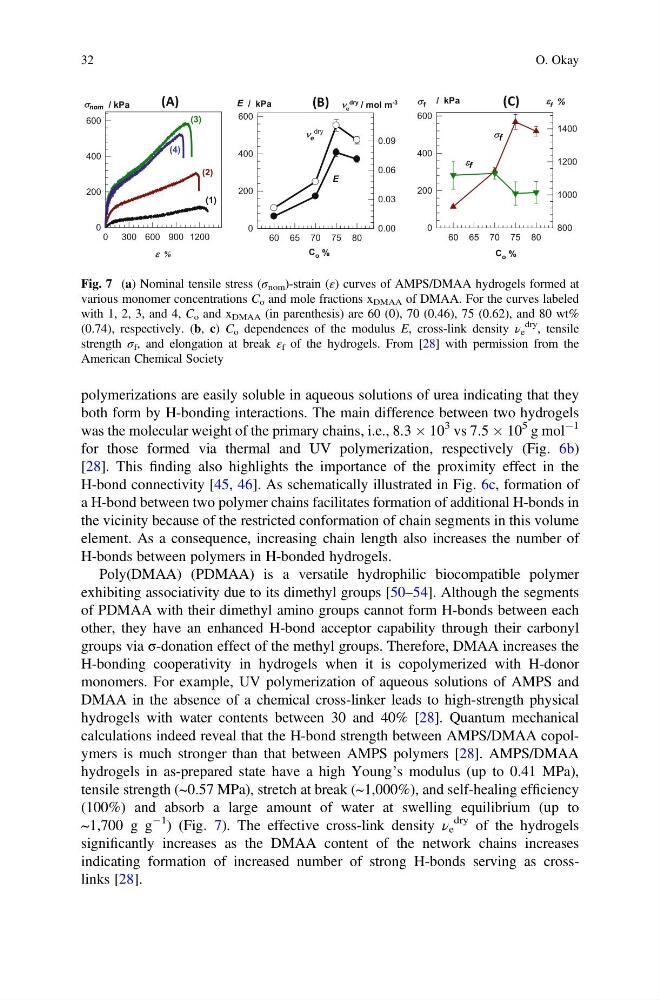
hydrogels in as-prepared state have a high Young’s modulus (up to 0.41 MPa),
tensile strength (~0.57 MPa), stretch at break (~1,000%), and self-healing efficiency
(100%) and absorb a large amount of water at swelling equilibrium (up to
~1,700 g g
À1 ) (Fig. 7). The effective cross-link density ν e
dry of the hydrogels
significantly increases as the DMAA content of the network chains increases
indicating formation of increased number of strong H-bonds serving as crosslinks [28].
C o %
60 65 70 75 80
σ
0
200
400
600
ε %
800
1000
1200
1400
σ f
ε f
C o %
60 65 70 75 80
E / kPa
0
200
400
600
ν e
dry / mol m
-3
0.00
0.03
0.06
0.09
E
ν e
dry
(B)
(C)
ε ε %
0 300 600 900 1200
σ nom / kPa
0
200
400
600
(1)
(2)
(3)
(4)
(A)
/ kPa
f
f
Fig. 7 (a) Nominal tensile stress (σ nom )-strain (ε) curves of AMPS/DMAA hydrogels formed at
various monomer concentrations C o and mole fractions x DMAA of DMAA. For the curves labeled
with 1, 2, 3, and 4, C o and x DMAA (in parenthesis) are 60 (0), 70 (0.46), 75 (0.62), and 80 wt%
(0.74), respectively. (b, c) C o dependences of the modulus E, cross-link density ν e
dry
, tensile
strength σ f , and elongation at break ε f of the hydrogels. From [28] with permission from the
American Chemical Society
32
O. Okay
both form by H-bonding interactions. The main difference between two hydrogels
was the molecular weight of the primary chains, i.e., 8.3 Â 10
3 vs 7.5 Â 10
5 g mol
À1
for those formed via thermal and UV polymerization, respectively (Fig. 6b)
[28]. This finding also highlights the importance of the proximity effect in the
H-bond connectivity [45, 46]. As schematically illustrated in Fig. 6c, formation of
a H-bond between two polymer chains facilitates formation of additional H-bonds in
the vicinity because of the restricted conformation of chain segments in this volume
element. As a consequence, increasing chain length also increases the number of
H-bonds between polymers in H-bonded hydrogels.
Poly(DMAA) (PDMAA) is a versatile hydrophilic biocompatible polymer
exhibiting associativity due to its dimethyl groups [50–54]. Although the segments
of PDMAA with their dimethyl amino groups cannot form H-bonds between each
other, they have an enhanced H-bond acceptor capability through their carbonyl
groups via σ-donation effect of the methyl groups. Therefore, DMAA increases the
H-bonding cooperativity in hydrogels when it is copolymerized with H-donor
monomers. For example, UV polymerization of aqueous solutions of AMPS and
DMAA in the absence of a chemical cross-linker leads to high-strength physical
hydrogels with water contents between 30 and 40% [28]. Quantum mechanical
calculations indeed reveal that the H-bond strength between AMPS/DMAA copolymers is much stronger than that between AMPS polymers [28]. AMPS/DMAA
hydrogels in as-prepared state have a high Young’s modulus (up to 0.41 MPa),
tensile strength (~0.57 MPa), stretch at break (~1,000%), and self-healing efficiency
(100%) and absorb a large amount of water at swelling equilibrium (up to
~1,700 g g
À1 ) (Fig. 7). The effective cross-link density ν e
dry of the hydrogels
significantly increases as the DMAA content of the network chains increases
indicating formation of increased number of strong H-bonds serving as crosslinks [28].
C o %
60 65 70 75 80
σ
0
200
400
600
ε %
800
1000
1200
1400
σ f
ε f
C o %
60 65 70 75 80
E / kPa
0
200
400
600
ν e
dry / mol m
-3
0.00
0.03
0.06
0.09
E
ν e
dry
(B)
(C)
ε ε %
0 300 600 900 1200
σ nom / kPa
0
200
400
600
(1)
(2)
(3)
(4)
(A)
/ kPa
f
f
Fig. 7 (a) Nominal tensile stress (σ nom )-strain (ε) curves of AMPS/DMAA hydrogels formed at
various monomer concentrations C o and mole fractions x DMAA of DMAA. For the curves labeled
with 1, 2, 3, and 4, C o and x DMAA (in parenthesis) are 60 (0), 70 (0.46), 75 (0.62), and 80 wt%
(0.74), respectively. (b, c) C o dependences of the modulus E, cross-link density ν e
dry
, tensile
strength σ f , and elongation at break ε f of the hydrogels. From [28] with permission from the
American Chemical Society
32
O. Okay