

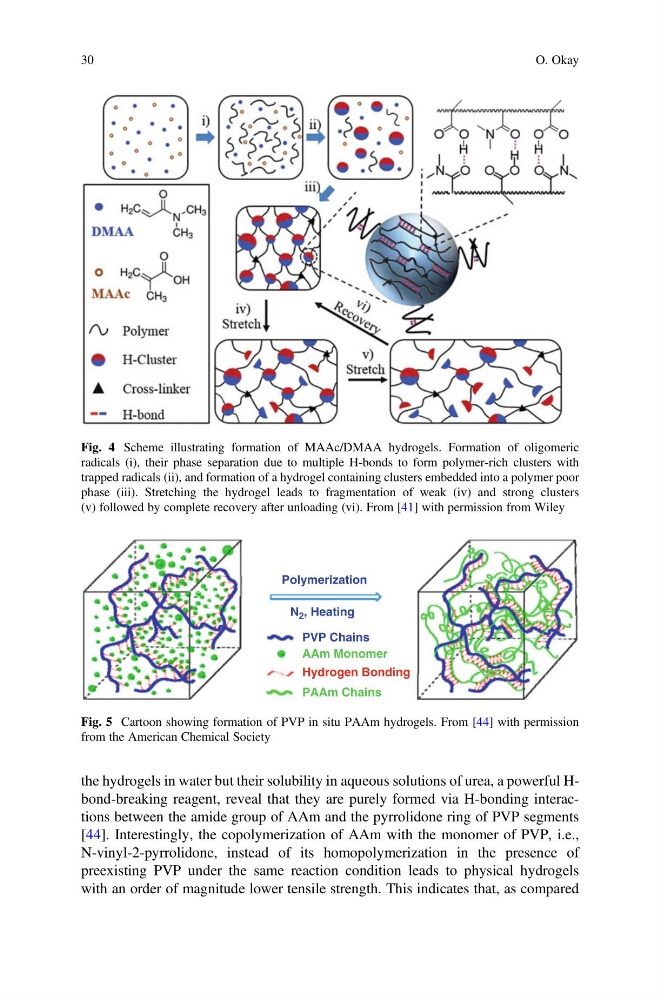
the hydrogels in water but their solubility in aqueous solutions of urea, a powerful Hbond-breaking reagent, reveal that they are purely formed via H-bonding interactions between the amide group of AAm and the pyrrolidone ring of PVP segments
[44]. Interestingly, the copolymerization of AAm with the monomer of PVP, i.e.,
N-vinyl-2-pyrrolidone, instead of its homopolymerization in the presence of
preexisting PVP under the same reaction condition leads to physical hydrogels
with an order of magnitude lower tensile strength. This indicates that, as compared
Fig. 4 Scheme illustrating formation of MAAc/DMAA hydrogels. Formation of oligomeric
radicals (i), their phase separation due to multiple H-bonds to form polymer-rich clusters with
trapped radicals (ii), and formation of a hydrogel containing clusters embedded into a polymer poor
phase (iii). Stretching the hydrogel leads to fragmentation of weak (iv) and strong clusters
(v) followed by complete recovery after unloading (vi). From [41] with permission from Wiley
Polymerization
N 2 , Heating
PVP Chains
AAm Monomer
PAAm Chains
Hydrogen Bonding
Fig. 5 Cartoon showing formation of PVP in situ PAAm hydrogels. From [44] with permission
from the American Chemical Society
30
O. Okay
[44]. Interestingly, the copolymerization of AAm with the monomer of PVP, i.e.,
N-vinyl-2-pyrrolidone, instead of its homopolymerization in the presence of
preexisting PVP under the same reaction condition leads to physical hydrogels
with an order of magnitude lower tensile strength. This indicates that, as compared
Fig. 4 Scheme illustrating formation of MAAc/DMAA hydrogels. Formation of oligomeric
radicals (i), their phase separation due to multiple H-bonds to form polymer-rich clusters with
trapped radicals (ii), and formation of a hydrogel containing clusters embedded into a polymer poor
phase (iii). Stretching the hydrogel leads to fragmentation of weak (iv) and strong clusters
(v) followed by complete recovery after unloading (vi). From [41] with permission from Wiley
Polymerization
N 2 , Heating
PVP Chains
AAm Monomer
PAAm Chains
Hydrogen Bonding
Fig. 5 Cartoon showing formation of PVP in situ PAAm hydrogels. From [44] with permission
from the American Chemical Society
30
O. Okay