

cellular morphology and protein and molecular assays. The adhesive proteincontaining hydrogels induced neuronal cell differentiation of BMSCs without the
use of chemical differentiation factors, presumably due to the low stiffness of the 3D
collagen microenvironment mimicking native brain tissue. The principal fate of
MSCs is self-renewal without amplification and/or differentiation when cultured
on a normal 2D culture dish without a supply of neurogenic medium, such as nerve
growth factor (NGF), and this was also observed in the present study. Immunofluorescence staining, Western blot, and fluorescence-activated cell sorting analyses
demonstrated that a large population of cells was positive for neural nuclear protein
(NeuN) and glial fibrillary acidic protein, which are specific to neuronal cells, when
cultured in the 3D collagen hydrogel. The dependence of the neuronal differentiation
of MSCs on the adhesive proteins containing 3D gel matrices is considered to be
closely related to focal adhesion kinase (FAK) activation through integrin receptor
binding, as exposed by an experiment showing no neuronal outgrowth in the FAK
knockdown cells and stimulation of integrin b1 gene.
In 2012, Swindle-Reilly studied dissociated E9 chick DRG cells in a collagen I
hydrogel modified with LN at concentrations of 0, 1, 10, or 100 μg/mL [34]. This study
revealed that low-concentrated unmodified collagen hydrogels (0.4–1.5 mg/mL)
supported a typical bimodal neurite growth more than the LN-modified variant. Expression of integrin subunits, α1, α3, α6, and β1, was confirmed by polymerase chain
reaction (PCR) and immunolabeling in the 3D scaffolds. As expected, the increase in
collagen concentration increased the stiffness of the gels (Fig. 11). Although confocal
microscopy showed LN following the collagen fibers (Fig. 12), the addition of LN
caused minimal changes on the stiffness of the scaffolds at any concentration of collagen.
In 2013, Koutsopoulos and co-workers compared viability and differentiation of
the mouse adult NSCs in peptide nanofiber hydrogels, Matrigel™, and collagen
[35]. Preliminary studies performed by the same group showed that self-assembling
peptides support neuronal cell attachment and extensive neurite outgrowth and
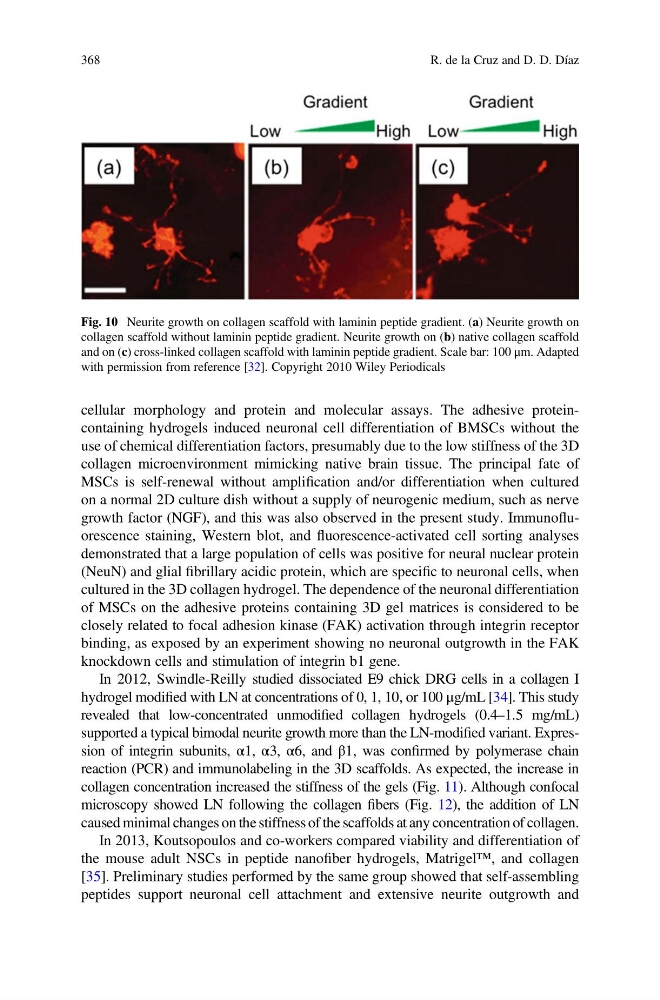
Fig. 10 Neurite growth on collagen scaffold with laminin peptide gradient. (a) Neurite growth on
collagen scaffold without laminin peptide gradient. Neurite growth on (b) native collagen scaffold
and on (c) cross-linked collagen scaffold with laminin peptide gradient. Scale bar: 100 μm. Adapted
with permission from reference [32]. Copyright 2010 Wiley Periodicals
368
R. de la Cruz and D. D. Díaz
use of chemical differentiation factors, presumably due to the low stiffness of the 3D
collagen microenvironment mimicking native brain tissue. The principal fate of
MSCs is self-renewal without amplification and/or differentiation when cultured
on a normal 2D culture dish without a supply of neurogenic medium, such as nerve
growth factor (NGF), and this was also observed in the present study. Immunofluorescence staining, Western blot, and fluorescence-activated cell sorting analyses
demonstrated that a large population of cells was positive for neural nuclear protein
(NeuN) and glial fibrillary acidic protein, which are specific to neuronal cells, when
cultured in the 3D collagen hydrogel. The dependence of the neuronal differentiation
of MSCs on the adhesive proteins containing 3D gel matrices is considered to be
closely related to focal adhesion kinase (FAK) activation through integrin receptor
binding, as exposed by an experiment showing no neuronal outgrowth in the FAK
knockdown cells and stimulation of integrin b1 gene.
In 2012, Swindle-Reilly studied dissociated E9 chick DRG cells in a collagen I
hydrogel modified with LN at concentrations of 0, 1, 10, or 100 μg/mL [34]. This study
revealed that low-concentrated unmodified collagen hydrogels (0.4–1.5 mg/mL)
supported a typical bimodal neurite growth more than the LN-modified variant. Expression of integrin subunits, α1, α3, α6, and β1, was confirmed by polymerase chain
reaction (PCR) and immunolabeling in the 3D scaffolds. As expected, the increase in
collagen concentration increased the stiffness of the gels (Fig. 11). Although confocal
microscopy showed LN following the collagen fibers (Fig. 12), the addition of LN
caused minimal changes on the stiffness of the scaffolds at any concentration of collagen.
In 2013, Koutsopoulos and co-workers compared viability and differentiation of
the mouse adult NSCs in peptide nanofiber hydrogels, Matrigel™, and collagen
[35]. Preliminary studies performed by the same group showed that self-assembling
peptides support neuronal cell attachment and extensive neurite outgrowth and
Fig. 10 Neurite growth on collagen scaffold with laminin peptide gradient. (a) Neurite growth on
collagen scaffold without laminin peptide gradient. Neurite growth on (b) native collagen scaffold
and on (c) cross-linked collagen scaffold with laminin peptide gradient. Scale bar: 100 μm. Adapted
with permission from reference [32]. Copyright 2010 Wiley Periodicals
368
R. de la Cruz and D. D. Díaz