

composites. To verify the importance of the gel matrix, the toughness of PA gel was
systematically tuned by changing the tearing velocity and adding small ions. As the
PA gels exhibit viscoelasticity, the toughness is strongly velocity dependent. Small
ions decrease the bond strength of ionic bonds in PA gels, resulting in decreased
toughness. The composite toughness follows a power law relationship with the
hydrogel matrix toughness over a relatively wide scale, indicating the importance
of the PA gel matrix. This composite concept provides a good guide toward the
universal design of soft composites with extraordinary fracture resistance capacity.
6 Summary
Polyampholyte approach for tough hydrogel is synthetically simple. By changing a
variety of ionic monomer combinations, the specific functions of PA gels can be
tuned as required, such as toughness, stiffness, fatigue resistance, and viscoelastic
behavior, which shows their broad potential applications as structural materials in
various fields. Although initial progress has been achieved in the internal structure,
self-healing behavior, and fracture behavior of PA gels, there is a need to develop
better understanding of fracture toughness and internal structure formation in
these PA hydrogels. Understanding the structure and mechanical behavior of PA
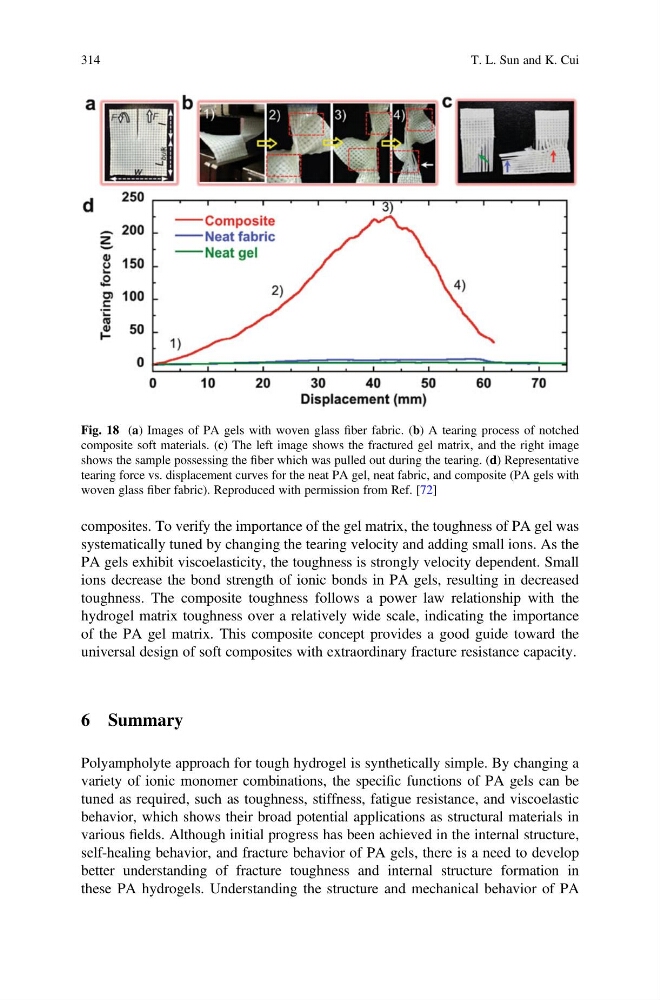
Fig. 18 (a) Images of PA gels with woven glass fiber fabric. (b) A tearing process of notched
composite soft materials. (c) The left image shows the fractured gel matrix, and the right image
shows the sample possessing the fiber which was pulled out during the tearing. (d) Representative
tearing force vs. displacement curves for the neat PA gel, neat fabric, and composite (PA gels with
woven glass fiber fabric). Reproduced with permission from Ref. [72]
314
T. L. Sun and K. Cui
systematically tuned by changing the tearing velocity and adding small ions. As the
PA gels exhibit viscoelasticity, the toughness is strongly velocity dependent. Small
ions decrease the bond strength of ionic bonds in PA gels, resulting in decreased
toughness. The composite toughness follows a power law relationship with the
hydrogel matrix toughness over a relatively wide scale, indicating the importance
of the PA gel matrix. This composite concept provides a good guide toward the
universal design of soft composites with extraordinary fracture resistance capacity.
6 Summary
Polyampholyte approach for tough hydrogel is synthetically simple. By changing a
variety of ionic monomer combinations, the specific functions of PA gels can be
tuned as required, such as toughness, stiffness, fatigue resistance, and viscoelastic
behavior, which shows their broad potential applications as structural materials in
various fields. Although initial progress has been achieved in the internal structure,
self-healing behavior, and fracture behavior of PA gels, there is a need to develop
better understanding of fracture toughness and internal structure formation in
these PA hydrogels. Understanding the structure and mechanical behavior of PA
Fig. 18 (a) Images of PA gels with woven glass fiber fabric. (b) A tearing process of notched
composite soft materials. (c) The left image shows the fractured gel matrix, and the right image
shows the sample possessing the fiber which was pulled out during the tearing. (d) Representative
tearing force vs. displacement curves for the neat PA gel, neat fabric, and composite (PA gels with
woven glass fiber fabric). Reproduced with permission from Ref. [72]
314
T. L. Sun and K. Cui