

5.2 Fiber-Reinforced Soft Composite
In general, producing materials that possess both high strength and toughness is
extremely difficult and has rarely been realized. By combing the tough PA hydrogel
with rigid yet flexible woven glass fiber fabric, a new soft composite material was
fabricated and exhibited extremely high toughness and tensile properties, far superior to those of the neat components (Fig. 18) [72, 73]. During the tearing process,
the notch of the composite materials is largely stretched and blunted at the crack tip,
which effectively diminishes the stress concentration and dissipates energy. The
maximum tearing strength of composite materials reaches 380 N/mm, several orders
of magnitude greater than bother individual neat materials. The highly energydissipative PA gel matrix and its unique interfacial bonding with glass fabric are
the two critical factors for achieving the synergistic effect in toughness of the
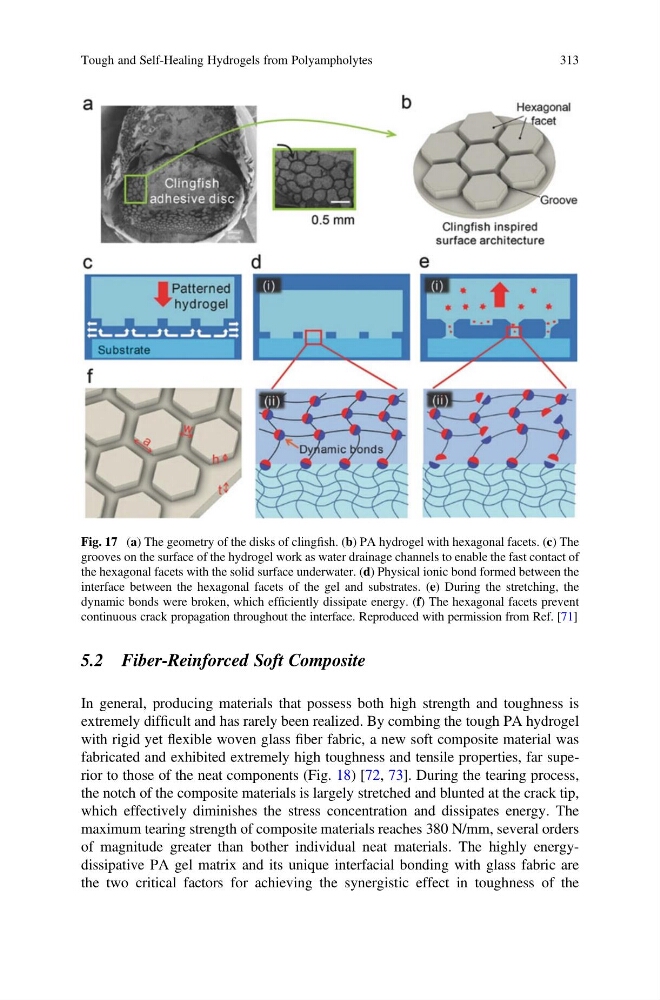
Fig. 17 (a) The geometry of the disks of clingfish. (b) PA hydrogel with hexagonal facets. (c) The
grooves on the surface of the hydrogel work as water drainage channels to enable the fast contact of
the hexagonal facets with the solid surface underwater. (d) Physical ionic bond formed between the
interface between the hexagonal facets of the gel and substrates. (e) During the stretching, the
dynamic bonds were broken, which efficiently dissipate energy. (f) The hexagonal facets prevent
continuous crack propagation throughout the interface. Reproduced with permission from Ref. [71]
Tough and Self-Healing Hydrogels from Polyampholytes
313
In general, producing materials that possess both high strength and toughness is
extremely difficult and has rarely been realized. By combing the tough PA hydrogel
with rigid yet flexible woven glass fiber fabric, a new soft composite material was
fabricated and exhibited extremely high toughness and tensile properties, far superior to those of the neat components (Fig. 18) [72, 73]. During the tearing process,
the notch of the composite materials is largely stretched and blunted at the crack tip,
which effectively diminishes the stress concentration and dissipates energy. The
maximum tearing strength of composite materials reaches 380 N/mm, several orders
of magnitude greater than bother individual neat materials. The highly energydissipative PA gel matrix and its unique interfacial bonding with glass fabric are
the two critical factors for achieving the synergistic effect in toughness of the
Fig. 17 (a) The geometry of the disks of clingfish. (b) PA hydrogel with hexagonal facets. (c) The
grooves on the surface of the hydrogel work as water drainage channels to enable the fast contact of
the hexagonal facets with the solid surface underwater. (d) Physical ionic bond formed between the
interface between the hexagonal facets of the gel and substrates. (e) During the stretching, the
dynamic bonds were broken, which efficiently dissipate energy. (f) The hexagonal facets prevent
continuous crack propagation throughout the interface. Reproduced with permission from Ref. [71]
Tough and Self-Healing Hydrogels from Polyampholytes
313