

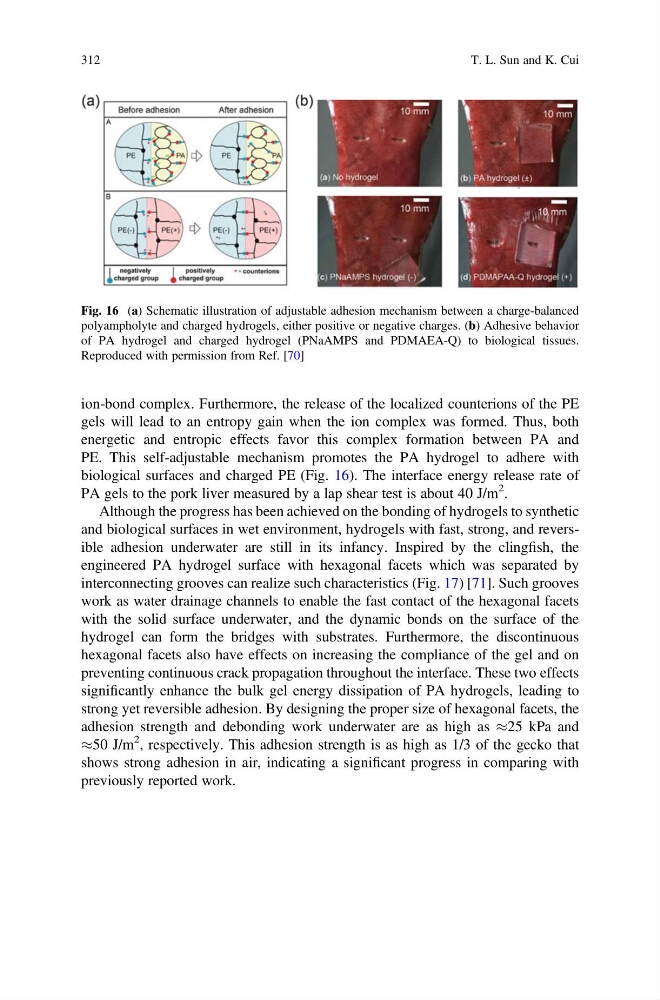
ion-bond complex. Furthermore, the release of the localized counterions of the PE
gels will lead to an entropy gain when the ion complex was formed. Thus, both
energetic and entropic effects favor this complex formation between PA and
PE. This self-adjustable mechanism promotes the PA hydrogel to adhere with
biological surfaces and charged PE (Fig. 16). The interface energy release rate of
PA gels to the pork liver measured by a lap shear test is about 40 J/m
2 .
Although the progress has been achieved on the bonding of hydrogels to synthetic
and biological surfaces in wet environment, hydrogels with fast, strong, and reversible adhesion underwater are still in its infancy. Inspired by the clingfish, the
engineered PA hydrogel surface with hexagonal facets which was separated by
interconnecting grooves can realize such characteristics (Fig. 17) [71]. Such grooves
work as water drainage channels to enable the fast contact of the hexagonal facets
with the solid surface underwater, and the dynamic bonds on the surface of the
hydrogel can form the bridges with substrates. Furthermore, the discontinuous
hexagonal facets also have effects on increasing the compliance of the gel and on
preventing continuous crack propagation throughout the interface. These two effects
significantly enhance the bulk gel energy dissipation of PA hydrogels, leading to
strong yet reversible adhesion. By designing the proper size of hexagonal facets, the
adhesion strength and debonding work underwater are as high as %25 kPa and
%50 J/m
2 , respectively. This adhesion strength is as high as 1/3 of the gecko that
shows strong adhesion in air, indicating a significant progress in comparing with
previously reported work.
Fig. 16 (a) Schematic illustration of adjustable adhesion mechanism between a charge-balanced
polyampholyte and charged hydrogels, either positive or negative charges. (b) Adhesive behavior
of PA hydrogel and charged hydrogel (PNaAMPS and PDMAEA-Q) to biological tissues.
Reproduced with permission from Ref. [70]
312
T. L. Sun and K. Cui
gels will lead to an entropy gain when the ion complex was formed. Thus, both
energetic and entropic effects favor this complex formation between PA and
PE. This self-adjustable mechanism promotes the PA hydrogel to adhere with
biological surfaces and charged PE (Fig. 16). The interface energy release rate of
PA gels to the pork liver measured by a lap shear test is about 40 J/m
2 .
Although the progress has been achieved on the bonding of hydrogels to synthetic
and biological surfaces in wet environment, hydrogels with fast, strong, and reversible adhesion underwater are still in its infancy. Inspired by the clingfish, the
engineered PA hydrogel surface with hexagonal facets which was separated by
interconnecting grooves can realize such characteristics (Fig. 17) [71]. Such grooves
work as water drainage channels to enable the fast contact of the hexagonal facets
with the solid surface underwater, and the dynamic bonds on the surface of the
hydrogel can form the bridges with substrates. Furthermore, the discontinuous
hexagonal facets also have effects on increasing the compliance of the gel and on
preventing continuous crack propagation throughout the interface. These two effects
significantly enhance the bulk gel energy dissipation of PA hydrogels, leading to
strong yet reversible adhesion. By designing the proper size of hexagonal facets, the
adhesion strength and debonding work underwater are as high as %25 kPa and
%50 J/m
2 , respectively. This adhesion strength is as high as 1/3 of the gecko that
shows strong adhesion in air, indicating a significant progress in comparing with
previously reported work.
Fig. 16 (a) Schematic illustration of adjustable adhesion mechanism between a charge-balanced
polyampholyte and charged hydrogels, either positive or negative charges. (b) Adhesive behavior
of PA hydrogel and charged hydrogel (PNaAMPS and PDMAEA-Q) to biological tissues.
Reproduced with permission from Ref. [70]
312
T. L. Sun and K. Cui