

can be written and erased by changing the ionic strength and pH value of solution,
which give the application of PA hydrogel as a shape memory material [39, 67]. PA
hydrogel also can be used as the supercapacitors for flexible electronics used in
low-temperature environments due to the non-freezable water in low temperature
[68, 69]. Furthermore, due to the dynamic features of ionic bonds, PA hydrogels
show strong adhesion on bio-tissues and solid substrates. Two typical applications
are listed here.
5.1 Adhesion
Conventional hydrogels usually show poor adhesion to biological surfaces, which
limits them as structure materials in biomedical applications. Usually, adhesion in
wet environment is based on the Coulombic interaction, while many biological
surfaces and hydrogels have net negative surface charge, and they are repulsive in
water (Fig. 16) [70]. For example, the negatively charged PNaAMPS hydrogel
synthesized from 2-acrylamido-2-methylpropanesulphonic sodium (NaAMPS) was
nonadhesive and slipped down the surface of a pork liver. The positively charged
PDMAPAA-Q hydrogel synthesized from N-[3-(N,N-dimethylamino)propyl] acrylamide methyl chloride quaternary (DMAPAA-Q) adhered to the tissue first, but
adhesive stress is very weak, and the positive gel also slipped down from the tissue
surface after several seconds. However, a neutral PA hydrogel can adhere strongly to
the pork tissue and sustain for a very long time without slipping down through the
self-adjustable adhesion mechanism. The mechanism is depicted as follows: when a
PA hydrogel approaches a positive or negative polyelectrolyte (PE) hydrogel or
biological surfaces, the PA gel is polarized by the electric field of the polar species of
countersurfaces, inducing the charge redistribution of the PA. That is, opposite
charges to that of polar species head to polar species and vice versa (Fig. 16a).
Therefore, the charges of PA hydrogels on their surface can interact with charged or
polar species of countersurfaces through the formation of polarization-induced
10
-3
10
-2
10
-1
10
0
10
1
10
2
10
-1
10
1
10
3
10
5
Soft tissues
Rubbers
Polyampholyte
DN
Conventional gels
,
y
g
r
e
n
e
g
n
i
r
a
e
T
T (J/m
2
)
Young's modulus, E (MPa)
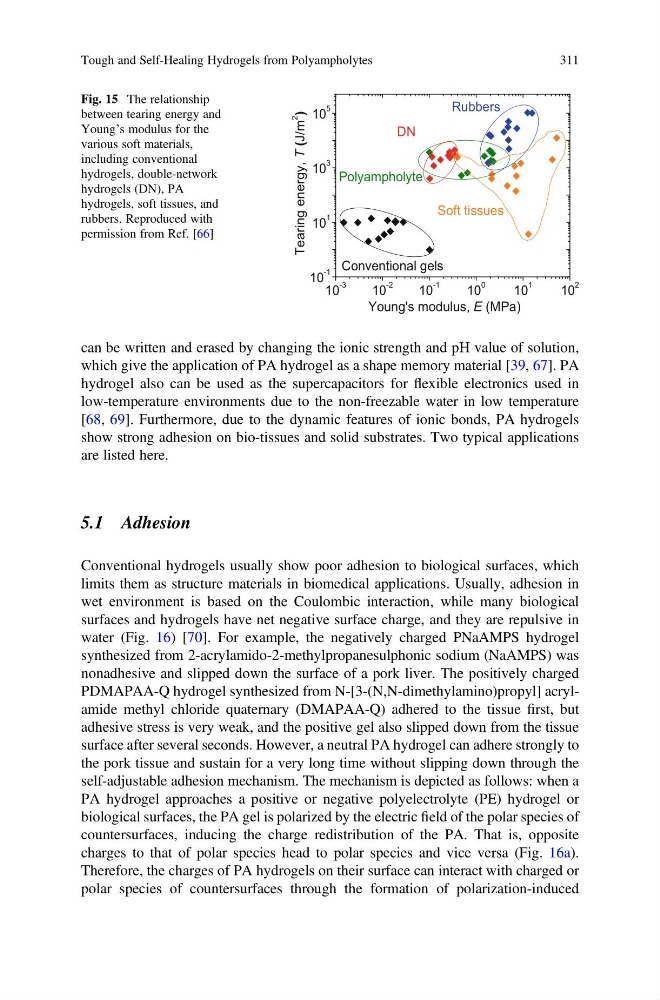
Fig. 15 The relationship
between tearing energy and
Young’s modulus for the
various soft materials,
including conventional
hydrogels, double-network
hydrogels (DN), PA
hydrogels, soft tissues, and
rubbers. Reproduced with
permission from Ref. [66]
Tough and Self-Healing Hydrogels from Polyampholytes
311
which give the application of PA hydrogel as a shape memory material [39, 67]. PA
hydrogel also can be used as the supercapacitors for flexible electronics used in
low-temperature environments due to the non-freezable water in low temperature
[68, 69]. Furthermore, due to the dynamic features of ionic bonds, PA hydrogels
show strong adhesion on bio-tissues and solid substrates. Two typical applications
are listed here.
5.1 Adhesion
Conventional hydrogels usually show poor adhesion to biological surfaces, which
limits them as structure materials in biomedical applications. Usually, adhesion in
wet environment is based on the Coulombic interaction, while many biological
surfaces and hydrogels have net negative surface charge, and they are repulsive in
water (Fig. 16) [70]. For example, the negatively charged PNaAMPS hydrogel
synthesized from 2-acrylamido-2-methylpropanesulphonic sodium (NaAMPS) was
nonadhesive and slipped down the surface of a pork liver. The positively charged
PDMAPAA-Q hydrogel synthesized from N-[3-(N,N-dimethylamino)propyl] acrylamide methyl chloride quaternary (DMAPAA-Q) adhered to the tissue first, but
adhesive stress is very weak, and the positive gel also slipped down from the tissue
surface after several seconds. However, a neutral PA hydrogel can adhere strongly to
the pork tissue and sustain for a very long time without slipping down through the
self-adjustable adhesion mechanism. The mechanism is depicted as follows: when a
PA hydrogel approaches a positive or negative polyelectrolyte (PE) hydrogel or
biological surfaces, the PA gel is polarized by the electric field of the polar species of
countersurfaces, inducing the charge redistribution of the PA. That is, opposite
charges to that of polar species head to polar species and vice versa (Fig. 16a).
Therefore, the charges of PA hydrogels on their surface can interact with charged or
polar species of countersurfaces through the formation of polarization-induced
10
-3
10
-2
10
-1
10
0
10
1
10
2
10
-1
10
1
10
3
10
5
Soft tissues
Rubbers
Polyampholyte
DN
Conventional gels
,
y
g
r
e
n
e
g
n
i
r
a
e
T
T (J/m
2
)
Young's modulus, E (MPa)
Fig. 15 The relationship
between tearing energy and
Young’s modulus for the
various soft materials,
including conventional
hydrogels, double-network
hydrogels (DN), PA
hydrogels, soft tissues, and
rubbers. Reproduced with
permission from Ref. [66]
Tough and Self-Healing Hydrogels from Polyampholytes
311