

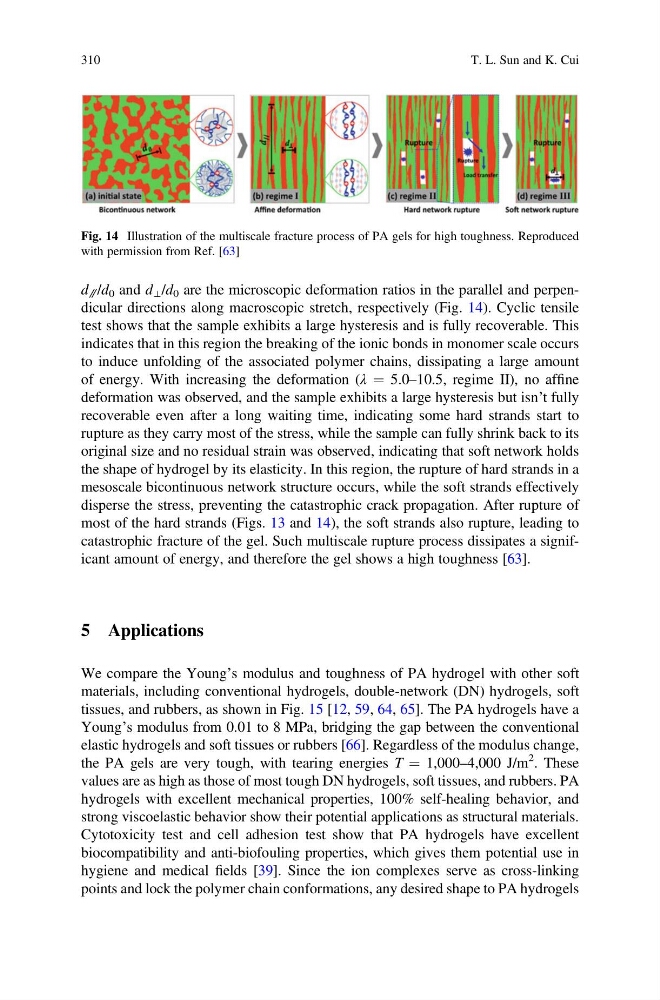
d ⫽ /d 0 and d ⊥ /d 0 are the microscopic deformation ratios in the parallel and perpendicular directions along macroscopic stretch, respectively (Fig. 14). Cyclic tensile
test shows that the sample exhibits a large hysteresis and is fully recoverable. This
indicates that in this region the breaking of the ionic bonds in monomer scale occurs
to induce unfolding of the associated polymer chains, dissipating a large amount
of energy. With increasing the deformation (λ ¼ 5.0–10.5, regime II), no affine
deformation was observed, and the sample exhibits a large hysteresis but isn’t fully
recoverable even after a long waiting time, indicating some hard strands start to
rupture as they carry most of the stress, while the sample can fully shrink back to its
original size and no residual strain was observed, indicating that soft network holds
the shape of hydrogel by its elasticity. In this region, the rupture of hard strands in a
mesoscale bicontinuous network structure occurs, while the soft strands effectively
disperse the stress, preventing the catastrophic crack propagation. After rupture of
most of the hard strands (Figs. 13 and 14), the soft strands also rupture, leading to
catastrophic fracture of the gel. Such multiscale rupture process dissipates a significant amount of energy, and therefore the gel shows a high toughness [63].
5 Applications
We compare the Young’s modulus and toughness of PA hydrogel with other soft
materials, including conventional hydrogels, double-network (DN) hydrogels, soft
tissues, and rubbers, as shown in Fig. 15 [12, 59, 64, 65]. The PA hydrogels have a
Young’s modulus from 0.01 to 8 MPa, bridging the gap between the conventional
elastic hydrogels and soft tissues or rubbers [66]. Regardless of the modulus change,
the PA gels are very tough, with tearing energies T ¼ 1,000–4,000 J/m
2 . These
values are as high as those of most tough DN hydrogels, soft tissues, and rubbers. PA
hydrogels with excellent mechanical properties, 100% self-healing behavior, and
strong viscoelastic behavior show their potential applications as structural materials.
Cytotoxicity test and cell adhesion test show that PA hydrogels have excellent
biocompatibility and anti-biofouling properties, which gives them potential use in
hygiene and medical fields [39]. Since the ion complexes serve as cross-linking
points and lock the polymer chain conformations, any desired shape to PA hydrogels
Fig. 14 Illustration of the multiscale fracture process of PA gels for high toughness. Reproduced
with permission from Ref. [63]
310
T. L. Sun and K. Cui
test shows that the sample exhibits a large hysteresis and is fully recoverable. This
indicates that in this region the breaking of the ionic bonds in monomer scale occurs
to induce unfolding of the associated polymer chains, dissipating a large amount
of energy. With increasing the deformation (λ ¼ 5.0–10.5, regime II), no affine
deformation was observed, and the sample exhibits a large hysteresis but isn’t fully
recoverable even after a long waiting time, indicating some hard strands start to
rupture as they carry most of the stress, while the sample can fully shrink back to its
original size and no residual strain was observed, indicating that soft network holds
the shape of hydrogel by its elasticity. In this region, the rupture of hard strands in a
mesoscale bicontinuous network structure occurs, while the soft strands effectively
disperse the stress, preventing the catastrophic crack propagation. After rupture of
most of the hard strands (Figs. 13 and 14), the soft strands also rupture, leading to
catastrophic fracture of the gel. Such multiscale rupture process dissipates a significant amount of energy, and therefore the gel shows a high toughness [63].
5 Applications
We compare the Young’s modulus and toughness of PA hydrogel with other soft
materials, including conventional hydrogels, double-network (DN) hydrogels, soft
tissues, and rubbers, as shown in Fig. 15 [12, 59, 64, 65]. The PA hydrogels have a
Young’s modulus from 0.01 to 8 MPa, bridging the gap between the conventional
elastic hydrogels and soft tissues or rubbers [66]. Regardless of the modulus change,
the PA gels are very tough, with tearing energies T ¼ 1,000–4,000 J/m
2 . These
values are as high as those of most tough DN hydrogels, soft tissues, and rubbers. PA
hydrogels with excellent mechanical properties, 100% self-healing behavior, and
strong viscoelastic behavior show their potential applications as structural materials.
Cytotoxicity test and cell adhesion test show that PA hydrogels have excellent
biocompatibility and anti-biofouling properties, which gives them potential use in
hygiene and medical fields [39]. Since the ion complexes serve as cross-linking
points and lock the polymer chain conformations, any desired shape to PA hydrogels
Fig. 14 Illustration of the multiscale fracture process of PA gels for high toughness. Reproduced
with permission from Ref. [63]
310
T. L. Sun and K. Cui