

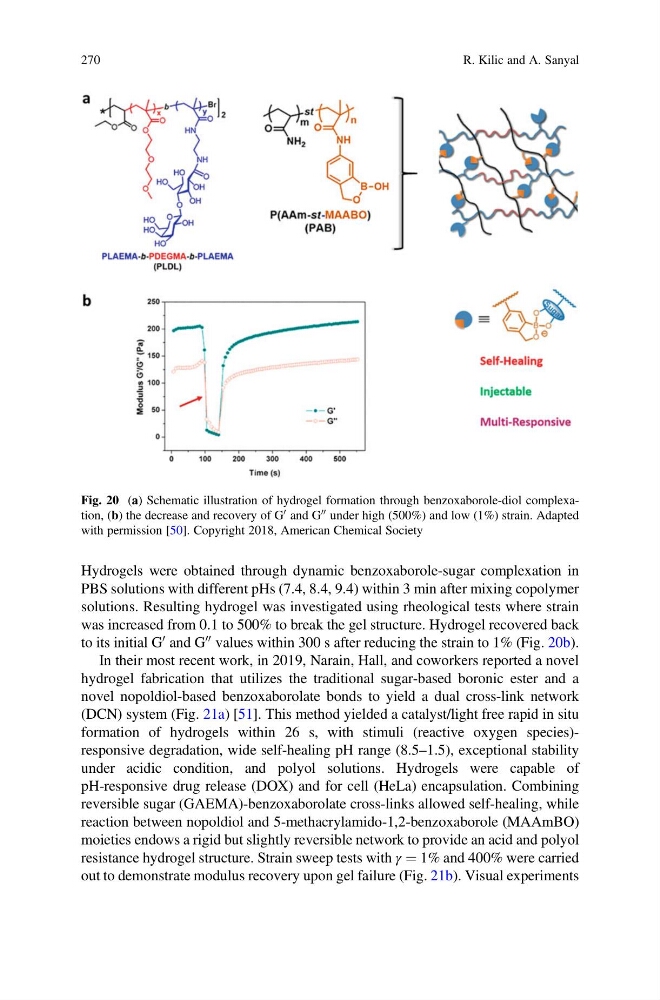
Hydrogels were obtained through dynamic benzoxaborole-sugar complexation in
PBS solutions with different pHs (7.4, 8.4, 9.4) within 3 min after mixing copolymer
solutions. Resulting hydrogel was investigated using rheological tests where strain
was increased from 0.1 to 500% to break the gel structure. Hydrogel recovered back
to its initial G
0 and G
00 values within 300 s after reducing the strain to 1% (Fig. 20b).
In their most recent work, in 2019, Narain, Hall, and coworkers reported a novel
hydrogel fabrication that utilizes the traditional sugar-based boronic ester and a
novel nopoldiol-based benzoxaborolate bonds to yield a dual cross-link network
(DCN) system (Fig. 21a) [51]. This method yielded a catalyst/light free rapid in situ
formation of hydrogels within 26 s, with stimuli (reactive oxygen species)responsive degradation, wide self-healing pH range (8.5–1.5), exceptional stability
under acidic condition, and polyol solutions. Hydrogels were capable of
pH-responsive drug release (DOX) and for cell (HeLa) encapsulation. Combining
reversible sugar (GAEMA)-benzoxaborolate cross-links allowed self-healing, while
reaction between nopoldiol and 5-methacrylamido-1,2-benzoxaborole (MAAmBO)
moieties endows a rigid but slightly reversible network to provide an acid and polyol
resistance hydrogel structure. Strain sweep tests with γ ¼ 1% and 400% were carried
out to demonstrate modulus recovery upon gel failure (Fig. 21b). Visual experiments
Fig. 20 (a) Schematic illustration of hydrogel formation through benzoxaborole-diol complexation, (b) the decrease and recovery of G
0 and G
00 under high (500%) and low (1%) strain. Adapted
with permission [50]. Copyright 2018, American Chemical Society
270
R. Kilic and A. Sanyal
PBS solutions with different pHs (7.4, 8.4, 9.4) within 3 min after mixing copolymer
solutions. Resulting hydrogel was investigated using rheological tests where strain
was increased from 0.1 to 500% to break the gel structure. Hydrogel recovered back
to its initial G
0 and G
00 values within 300 s after reducing the strain to 1% (Fig. 20b).
In their most recent work, in 2019, Narain, Hall, and coworkers reported a novel
hydrogel fabrication that utilizes the traditional sugar-based boronic ester and a
novel nopoldiol-based benzoxaborolate bonds to yield a dual cross-link network
(DCN) system (Fig. 21a) [51]. This method yielded a catalyst/light free rapid in situ
formation of hydrogels within 26 s, with stimuli (reactive oxygen species)responsive degradation, wide self-healing pH range (8.5–1.5), exceptional stability
under acidic condition, and polyol solutions. Hydrogels were capable of
pH-responsive drug release (DOX) and for cell (HeLa) encapsulation. Combining
reversible sugar (GAEMA)-benzoxaborolate cross-links allowed self-healing, while
reaction between nopoldiol and 5-methacrylamido-1,2-benzoxaborole (MAAmBO)
moieties endows a rigid but slightly reversible network to provide an acid and polyol
resistance hydrogel structure. Strain sweep tests with γ ¼ 1% and 400% were carried
out to demonstrate modulus recovery upon gel failure (Fig. 21b). Visual experiments
Fig. 20 (a) Schematic illustration of hydrogel formation through benzoxaborole-diol complexation, (b) the decrease and recovery of G
0 and G
00 under high (500%) and low (1%) strain. Adapted
with permission [50]. Copyright 2018, American Chemical Society
270
R. Kilic and A. Sanyal