

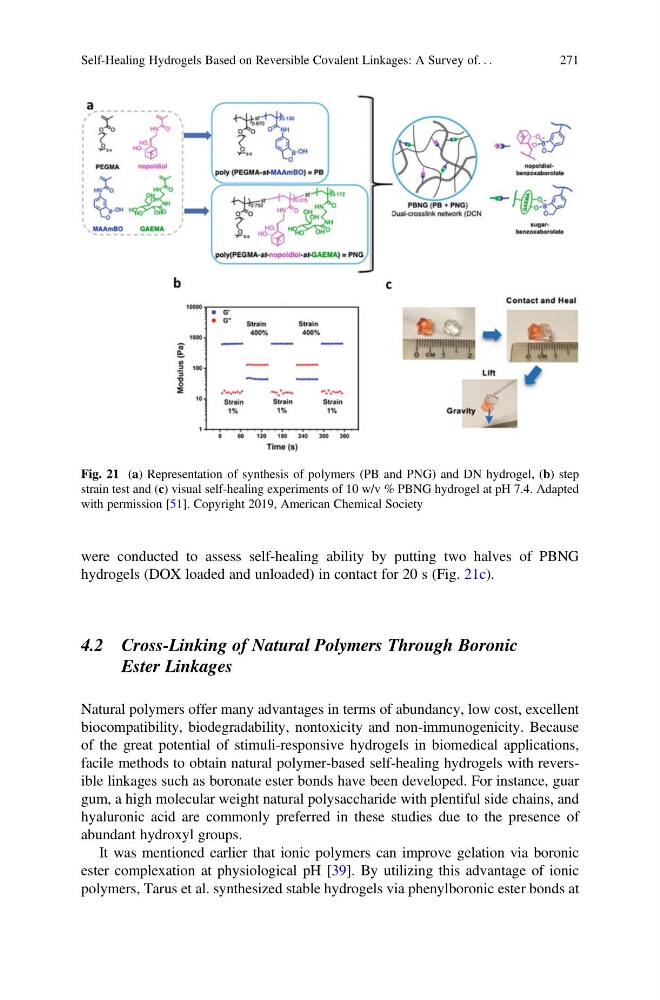
were conducted to assess self-healing ability by putting two halves of PBNG
hydrogels (DOX loaded and unloaded) in contact for 20 s (Fig. 21c).
4.2 Cross-Linking of Natural Polymers Through Boronic
Ester Linkages
Natural polymers offer many advantages in terms of abundancy, low cost, excellent
biocompatibility, biodegradability, nontoxicity and non-immunogenicity. Because
of the great potential of stimuli-responsive hydrogels in biomedical applications,
facile methods to obtain natural polymer-based self-healing hydrogels with reversible linkages such as boronate ester bonds have been developed. For instance, guar
gum, a high molecular weight natural polysaccharide with plentiful side chains, and
hyaluronic acid are commonly preferred in these studies due to the presence of
abundant hydroxyl groups.
It was mentioned earlier that ionic polymers can improve gelation via boronic
ester complexation at physiological pH [39]. By utilizing this advantage of ionic
polymers, Tarus et al. synthesized stable hydrogels via phenylboronic ester bonds at
Fig. 21 (a) Representation of synthesis of polymers (PB and PNG) and DN hydrogel, (b) step
strain test and (c) visual self-healing experiments of 10 w/v % PBNG hydrogel at pH 7.4. Adapted
with permission [51]. Copyright 2019, American Chemical Society
Self-Healing Hydrogels Based on Reversible Covalent Linkages: A Survey of. . .
271
hydrogels (DOX loaded and unloaded) in contact for 20 s (Fig. 21c).
4.2 Cross-Linking of Natural Polymers Through Boronic
Ester Linkages
Natural polymers offer many advantages in terms of abundancy, low cost, excellent
biocompatibility, biodegradability, nontoxicity and non-immunogenicity. Because
of the great potential of stimuli-responsive hydrogels in biomedical applications,
facile methods to obtain natural polymer-based self-healing hydrogels with reversible linkages such as boronate ester bonds have been developed. For instance, guar
gum, a high molecular weight natural polysaccharide with plentiful side chains, and
hyaluronic acid are commonly preferred in these studies due to the presence of
abundant hydroxyl groups.
It was mentioned earlier that ionic polymers can improve gelation via boronic
ester complexation at physiological pH [39]. By utilizing this advantage of ionic
polymers, Tarus et al. synthesized stable hydrogels via phenylboronic ester bonds at
Fig. 21 (a) Representation of synthesis of polymers (PB and PNG) and DN hydrogel, (b) step
strain test and (c) visual self-healing experiments of 10 w/v % PBNG hydrogel at pH 7.4. Adapted
with permission [51]. Copyright 2019, American Chemical Society
Self-Healing Hydrogels Based on Reversible Covalent Linkages: A Survey of. . .
271