

Recently, Li and coworkers synthesized poly(vinyl alcohol)/poly(dopamine)/
graphene (PVA/PDA/GO)-based hydrogels by partially reducing graphene oxide
under the oxidative self-polymerization of dopamine and mixing with prepared PVA
aqueous solution and sodium tetraborate aqueous solution [46]. Hydrogels possessed conducting ability due to the presence of partially reduced graphene oxide
and rapid self-healing ability due to boronic ester bonds. Alternate step strain sweeps
were conducted to show self-healing performance of hydrogel. Strain was changed
between 1 and 300%. Under high strain, gel structure collapsed into quasi-liquid
state and exhibited rapid restoration of G
0 and G
00 even after four cycles. Tensile tests
of self-healing hydrogels were carried out to calculate the effectiveness of mechanical property and revealed that hydrogels recover 92.89% of the original tensile
strength within 1 min, because of the dynamic breakage and reformation of the diolborate ester bonds in the hydrogel network.
Narain and coworkers have reported a series of hydrogels by utilizing
benzoxaborole-diol complexation for several biomedical applications [47–49]. By
using the same chemistry, a self-healing and injectable hydrogel based on triblock
hydrophilic glycopolymer (PLAEMA-b-PDEGMA-b-PLAEMA abbreviated as
PLDL) and benzoxaborole-containing copolymer (P(AAm-st-MAABO) abbreviated
as PAB) was reported in 2019 (Fig. 20a) [50]. PLDL was a diol containing robust
polymer that can avoid undesired oxidation and synthesized via a two-step atom
transfer radical polymerization (ATRP) with varied ratios of sugar groups.
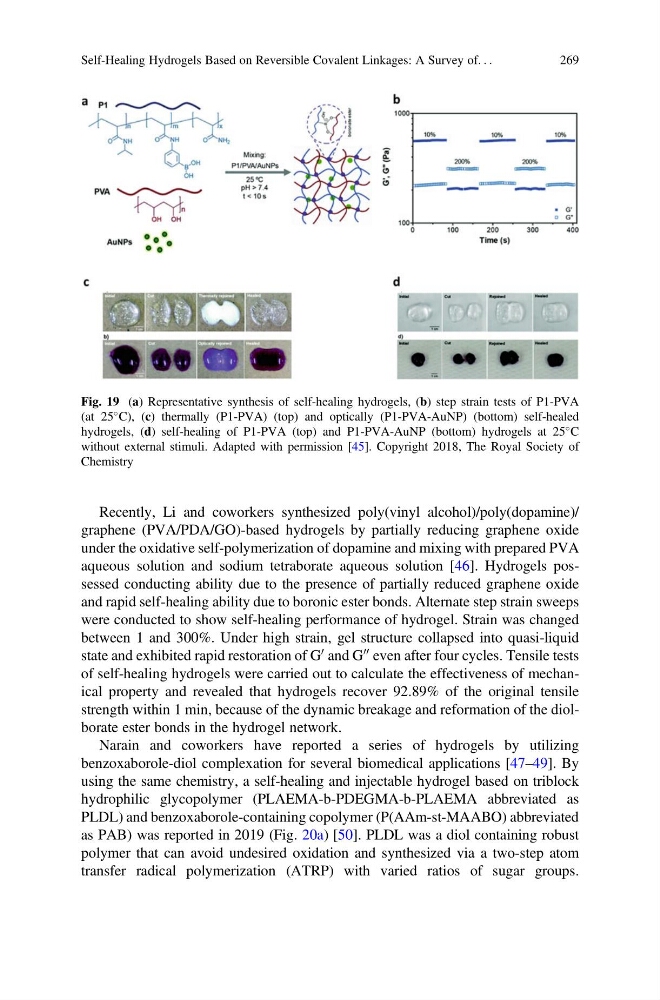
Fig. 19 (a) Representative synthesis of self-healing hydrogels, (b) step strain tests of P1-PVA
(at 25
C), (c) thermally (P1-PVA) (top) and optically (P1-PVA-AuNP) (bottom) self-healed
hydrogels, (d) self-healing of P1-PVA (top) and P1-PVA-AuNP (bottom) hydrogels at 25
C
without external stimuli. Adapted with permission [45]. Copyright 2018, The Royal Society of
Chemistry
Self-Healing Hydrogels Based on Reversible Covalent Linkages: A Survey of. . .
269
graphene (PVA/PDA/GO)-based hydrogels by partially reducing graphene oxide
under the oxidative self-polymerization of dopamine and mixing with prepared PVA
aqueous solution and sodium tetraborate aqueous solution [46]. Hydrogels possessed conducting ability due to the presence of partially reduced graphene oxide
and rapid self-healing ability due to boronic ester bonds. Alternate step strain sweeps
were conducted to show self-healing performance of hydrogel. Strain was changed
between 1 and 300%. Under high strain, gel structure collapsed into quasi-liquid
state and exhibited rapid restoration of G
0 and G
00 even after four cycles. Tensile tests
of self-healing hydrogels were carried out to calculate the effectiveness of mechanical property and revealed that hydrogels recover 92.89% of the original tensile
strength within 1 min, because of the dynamic breakage and reformation of the diolborate ester bonds in the hydrogel network.
Narain and coworkers have reported a series of hydrogels by utilizing
benzoxaborole-diol complexation for several biomedical applications [47–49]. By
using the same chemistry, a self-healing and injectable hydrogel based on triblock
hydrophilic glycopolymer (PLAEMA-b-PDEGMA-b-PLAEMA abbreviated as
PLDL) and benzoxaborole-containing copolymer (P(AAm-st-MAABO) abbreviated
as PAB) was reported in 2019 (Fig. 20a) [50]. PLDL was a diol containing robust
polymer that can avoid undesired oxidation and synthesized via a two-step atom
transfer radical polymerization (ATRP) with varied ratios of sugar groups.
Fig. 19 (a) Representative synthesis of self-healing hydrogels, (b) step strain tests of P1-PVA
(at 25
C), (c) thermally (P1-PVA) (top) and optically (P1-PVA-AuNP) (bottom) self-healed
hydrogels, (d) self-healing of P1-PVA (top) and P1-PVA-AuNP (bottom) hydrogels at 25
C
without external stimuli. Adapted with permission [45]. Copyright 2018, The Royal Society of
Chemistry
Self-Healing Hydrogels Based on Reversible Covalent Linkages: A Survey of. . .
269