

Another study utilizing borax-based cross-linking was reported in 2018 by Chen
et al., who showed shapeable and recyclable agarose/PVA-based double network
hydrogels which exhibit excellent self-healing property both in air and underwater
[44]. Hydrogels were obtained by mixing agarose/PVA solution in hot water with
borax solution. Dynamic PVA-borate network provided self-healing to hydrogel,
while H-bonding interactions in agarose supported mechanical strength. Healed
hydrogel at room temperature for 10 s was stretched to test the tensile strength and
showed almost the same stress-strain behavior with the original one. The tensile
stress of hydrogel healed under water for 60 s revealed 70% recovery, indicating
agarose/PVA hydrogels exhibit a fast self-healing property underwater as well.
Visual experiments were conducted to demonstrate self-healing of PVA-boraxbased hydrogel containing 1 wt % of agarose.
In 2018, Pasparakis and coworkers reported multi-responsive, self-healing, and
cytocompatible hydrogels by cross-linking a copolymer (P1) of NIPAAm and
3-(acrylamido)phenylboronic acid (APBA) with PVA via boronate ester bonds in
PBS (pH 7.4) at 25
C in less than 10 min (Fig. 19a) [45]. Furthermore, optically
active gel nanocomposites were prepared by mixing P1 with colloidally stable poly
(vinylpyrrolidone)-coated gold nanoparticles. Hydrogels undergo gel-sol transition
owing to the disruption of the boronate ester thermally (heating above 37
C) or
optically (irradiation with green light). Alternate step strain measurements (between
10 and 200%) demonstrated self-healing behavior of P1-PVA hydrogel and repeatability of this process for several times without significant loss of the mechanical
properties (Fig. 19b). Visual self-healing experiments were carried out under heat
(39
C) and light and without any external stimuli. Images showed that the hydrogels
can fully recover their mechanical properties within minutes (Fig. 19c, d).
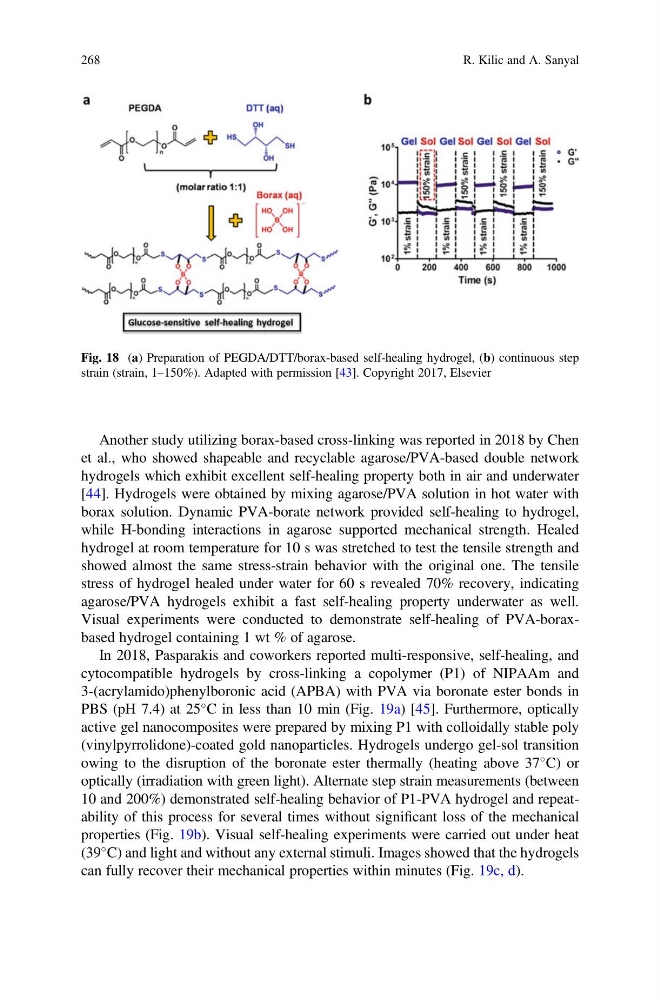
Fig. 18 (a) Preparation of PEGDA/DTT/borax-based self-healing hydrogel, (b) continuous step
strain (strain, 1–150%). Adapted with permission [43]. Copyright 2017, Elsevier
268
R. Kilic and A. Sanyal
et al., who showed shapeable and recyclable agarose/PVA-based double network
hydrogels which exhibit excellent self-healing property both in air and underwater
[44]. Hydrogels were obtained by mixing agarose/PVA solution in hot water with
borax solution. Dynamic PVA-borate network provided self-healing to hydrogel,
while H-bonding interactions in agarose supported mechanical strength. Healed
hydrogel at room temperature for 10 s was stretched to test the tensile strength and
showed almost the same stress-strain behavior with the original one. The tensile
stress of hydrogel healed under water for 60 s revealed 70% recovery, indicating
agarose/PVA hydrogels exhibit a fast self-healing property underwater as well.
Visual experiments were conducted to demonstrate self-healing of PVA-boraxbased hydrogel containing 1 wt % of agarose.
In 2018, Pasparakis and coworkers reported multi-responsive, self-healing, and
cytocompatible hydrogels by cross-linking a copolymer (P1) of NIPAAm and
3-(acrylamido)phenylboronic acid (APBA) with PVA via boronate ester bonds in
PBS (pH 7.4) at 25
C in less than 10 min (Fig. 19a) [45]. Furthermore, optically
active gel nanocomposites were prepared by mixing P1 with colloidally stable poly
(vinylpyrrolidone)-coated gold nanoparticles. Hydrogels undergo gel-sol transition
owing to the disruption of the boronate ester thermally (heating above 37
C) or
optically (irradiation with green light). Alternate step strain measurements (between
10 and 200%) demonstrated self-healing behavior of P1-PVA hydrogel and repeatability of this process for several times without significant loss of the mechanical
properties (Fig. 19b). Visual self-healing experiments were carried out under heat
(39
C) and light and without any external stimuli. Images showed that the hydrogels
can fully recover their mechanical properties within minutes (Fig. 19c, d).
Fig. 18 (a) Preparation of PEGDA/DTT/borax-based self-healing hydrogel, (b) continuous step
strain (strain, 1–150%). Adapted with permission [43]. Copyright 2017, Elsevier
268
R. Kilic and A. Sanyal