

buffer (pH 9.0) at 37
C within 10 s [42]. Self-healing property of triple responsive
(toward pH, glucose, and dopamine), degradable hydrogels was demonstrated by
visual experiments. Simply, two pieces of cut hydrogels kept in contact, and they
formed a uniform single piece gel within 30 s.
Using a somewhat different synthetic approach, Tseng et al. synthesized a
hydrogel system utilizing reversible nature of boronate ester linkages [43]. A
glucose-sensitive self-healing hydrogel was formed through cross-linking poly(ethylene glycol)-diacrylate (PEGDA) and dithiothreitol (DTT) with borax via boronate
ester linkages in PBS (Fig. 18a) as a sacrificial layer of branched tubular channels
inside another non-sacrificial hydrogel (e.g., fibrin gel or chitosan gel) containing
neural stem cells (NSCs). Self-healing ability was tested by continuous step strain;
hydrogel did not lose its mechanical strength over repeated cycles (Fig. 18b). The
boric acid in the structure of self-healing hydrogel is known to form complex with
glucose, hence leading disintegration of gel to form complicated and interconnected
hallow channels in bulk gel allowing endothelial cells to grow and form lumens
while NSCs embedded in non-sacrificial construct form neurosphere-like structure.
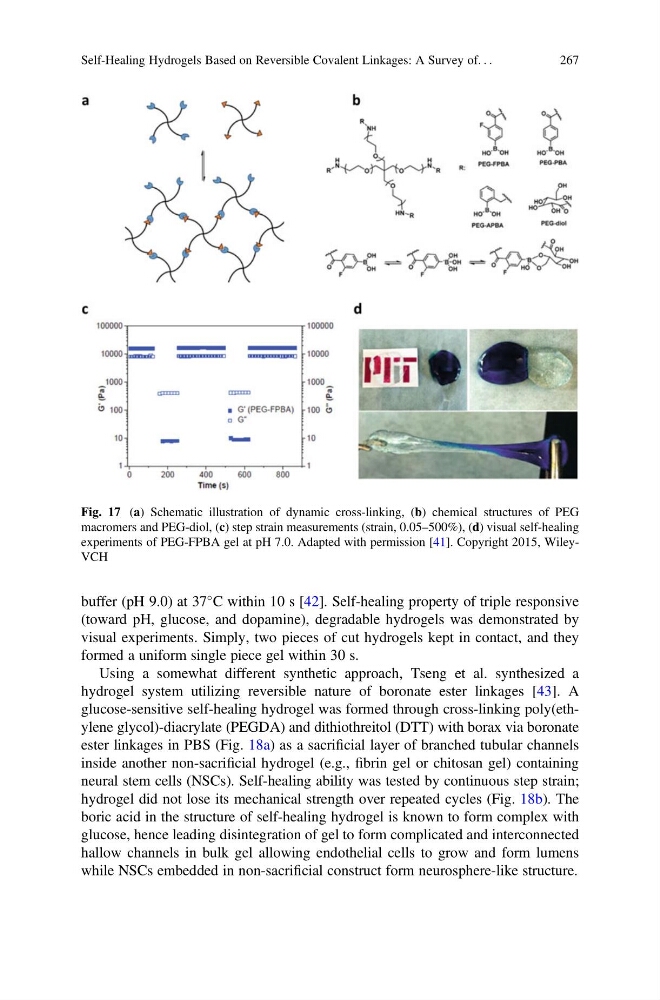
Fig. 17 (a) Schematic illustration of dynamic cross-linking, (b) chemical structures of PEG
macromers and PEG-diol, (c) step strain measurements (strain, 0.05–500%), (d) visual self-healing
experiments of PEG-FPBA gel at pH 7.0. Adapted with permission [41]. Copyright 2015, WileyVCH
Self-Healing Hydrogels Based on Reversible Covalent Linkages: A Survey of. . .
267
C within 10 s [42]. Self-healing property of triple responsive
(toward pH, glucose, and dopamine), degradable hydrogels was demonstrated by
visual experiments. Simply, two pieces of cut hydrogels kept in contact, and they
formed a uniform single piece gel within 30 s.
Using a somewhat different synthetic approach, Tseng et al. synthesized a
hydrogel system utilizing reversible nature of boronate ester linkages [43]. A
glucose-sensitive self-healing hydrogel was formed through cross-linking poly(ethylene glycol)-diacrylate (PEGDA) and dithiothreitol (DTT) with borax via boronate
ester linkages in PBS (Fig. 18a) as a sacrificial layer of branched tubular channels
inside another non-sacrificial hydrogel (e.g., fibrin gel or chitosan gel) containing
neural stem cells (NSCs). Self-healing ability was tested by continuous step strain;
hydrogel did not lose its mechanical strength over repeated cycles (Fig. 18b). The
boric acid in the structure of self-healing hydrogel is known to form complex with
glucose, hence leading disintegration of gel to form complicated and interconnected
hallow channels in bulk gel allowing endothelial cells to grow and form lumens
while NSCs embedded in non-sacrificial construct form neurosphere-like structure.
Fig. 17 (a) Schematic illustration of dynamic cross-linking, (b) chemical structures of PEG
macromers and PEG-diol, (c) step strain measurements (strain, 0.05–500%), (d) visual self-healing
experiments of PEG-FPBA gel at pH 7.0. Adapted with permission [41]. Copyright 2015, WileyVCH
Self-Healing Hydrogels Based on Reversible Covalent Linkages: A Survey of. . .
267