

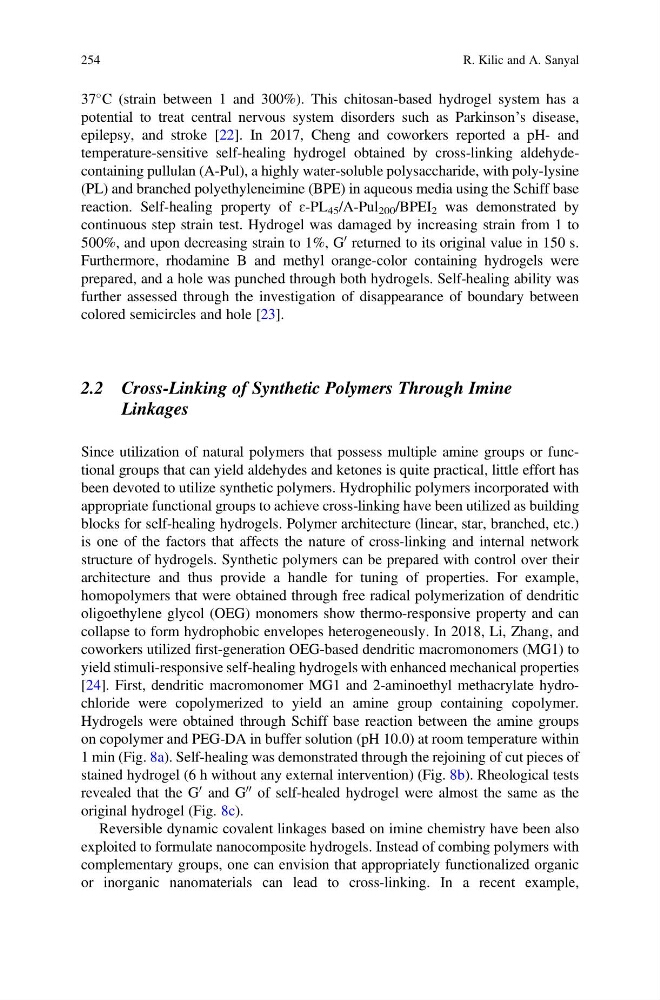
37
C (strain between 1 and 300%). This chitosan-based hydrogel system has a
potential to treat central nervous system disorders such as Parkinson’s disease,
epilepsy, and stroke [22]. In 2017, Cheng and coworkers reported a pH- and
temperature-sensitive self-healing hydrogel obtained by cross-linking aldehydecontaining pullulan (A-Pul), a highly water-soluble polysaccharide, with poly-lysine
(PL) and branched polyethyleneimine (BPE) in aqueous media using the Schiff base
reaction. Self-healing property of ɛ-PL 45 /A-Pul 200 /BPEI 2 was demonstrated by
continuous step strain test. Hydrogel was damaged by increasing strain from 1 to
500%, and upon decreasing strain to 1%, G
0 returned to its original value in 150 s.
Furthermore, rhodamine B and methyl orange-color containing hydrogels were
prepared, and a hole was punched through both hydrogels. Self-healing ability was
further assessed through the investigation of disappearance of boundary between
colored semicircles and hole [23].
2.2 Cross-Linking of Synthetic Polymers Through Imine
Linkages
Since utilization of natural polymers that possess multiple amine groups or functional groups that can yield aldehydes and ketones is quite practical, little effort has
been devoted to utilize synthetic polymers. Hydrophilic polymers incorporated with
appropriate functional groups to achieve cross-linking have been utilized as building
blocks for self-healing hydrogels. Polymer architecture (linear, star, branched, etc.)
is one of the factors that affects the nature of cross-linking and internal network
structure of hydrogels. Synthetic polymers can be prepared with control over their
architecture and thus provide a handle for tuning of properties. For example,
homopolymers that were obtained through free radical polymerization of dendritic
oligoethylene glycol (OEG) monomers show thermo-responsive property and can
collapse to form hydrophobic envelopes heterogeneously. In 2018, Li, Zhang, and
coworkers utilized first-generation OEG-based dendritic macromonomers (MG1) to
yield stimuli-responsive self-healing hydrogels with enhanced mechanical properties
[24]. First, dendritic macromonomer MG1 and 2-aminoethyl methacrylate hydrochloride were copolymerized to yield an amine group containing copolymer.
Hydrogels were obtained through Schiff base reaction between the amine groups
on copolymer and PEG-DA in buffer solution (pH 10.0) at room temperature within
1 min (Fig. 8a). Self-healing was demonstrated through the rejoining of cut pieces of
stained hydrogel (6 h without any external intervention) (Fig. 8b). Rheological tests
revealed that the G
0 and G
00 of self-healed hydrogel were almost the same as the
original hydrogel (Fig. 8c).
Reversible dynamic covalent linkages based on imine chemistry have been also
exploited to formulate nanocomposite hydrogels. Instead of combing polymers with
complementary groups, one can envision that appropriately functionalized organic
or inorganic nanomaterials can lead to cross-linking. In a recent example,
254
R. Kilic and A. Sanyal
C (strain between 1 and 300%). This chitosan-based hydrogel system has a
potential to treat central nervous system disorders such as Parkinson’s disease,
epilepsy, and stroke [22]. In 2017, Cheng and coworkers reported a pH- and
temperature-sensitive self-healing hydrogel obtained by cross-linking aldehydecontaining pullulan (A-Pul), a highly water-soluble polysaccharide, with poly-lysine
(PL) and branched polyethyleneimine (BPE) in aqueous media using the Schiff base
reaction. Self-healing property of ɛ-PL 45 /A-Pul 200 /BPEI 2 was demonstrated by
continuous step strain test. Hydrogel was damaged by increasing strain from 1 to
500%, and upon decreasing strain to 1%, G
0 returned to its original value in 150 s.
Furthermore, rhodamine B and methyl orange-color containing hydrogels were
prepared, and a hole was punched through both hydrogels. Self-healing ability was
further assessed through the investigation of disappearance of boundary between
colored semicircles and hole [23].
2.2 Cross-Linking of Synthetic Polymers Through Imine
Linkages
Since utilization of natural polymers that possess multiple amine groups or functional groups that can yield aldehydes and ketones is quite practical, little effort has
been devoted to utilize synthetic polymers. Hydrophilic polymers incorporated with
appropriate functional groups to achieve cross-linking have been utilized as building
blocks for self-healing hydrogels. Polymer architecture (linear, star, branched, etc.)
is one of the factors that affects the nature of cross-linking and internal network
structure of hydrogels. Synthetic polymers can be prepared with control over their
architecture and thus provide a handle for tuning of properties. For example,
homopolymers that were obtained through free radical polymerization of dendritic
oligoethylene glycol (OEG) monomers show thermo-responsive property and can
collapse to form hydrophobic envelopes heterogeneously. In 2018, Li, Zhang, and
coworkers utilized first-generation OEG-based dendritic macromonomers (MG1) to
yield stimuli-responsive self-healing hydrogels with enhanced mechanical properties
[24]. First, dendritic macromonomer MG1 and 2-aminoethyl methacrylate hydrochloride were copolymerized to yield an amine group containing copolymer.
Hydrogels were obtained through Schiff base reaction between the amine groups
on copolymer and PEG-DA in buffer solution (pH 10.0) at room temperature within
1 min (Fig. 8a). Self-healing was demonstrated through the rejoining of cut pieces of
stained hydrogel (6 h without any external intervention) (Fig. 8b). Rheological tests
revealed that the G
0 and G
00 of self-healed hydrogel were almost the same as the
original hydrogel (Fig. 8c).
Reversible dynamic covalent linkages based on imine chemistry have been also
exploited to formulate nanocomposite hydrogels. Instead of combing polymers with
complementary groups, one can envision that appropriately functionalized organic
or inorganic nanomaterials can lead to cross-linking. In a recent example,
254
R. Kilic and A. Sanyal