

Bhattacharya et al. reported fluorescent self-healing gels that are comprised of
carbon dots (C-dots) and polyethyleneimine (PEI) (Fig. 9a) [25]. This seminal report
uses C-dots as a hydrogel gel building block, as well as a fluorophore. The C-dots
were synthesized from different carbonaceous precursors like glutaraldehyde, benzaldehyde, etc. Strain alternation experiment was conducted to demonstrate viscoelastic recovery of the C-dots/PEI gel. Upon reducing strain from 300 to 1%, the gel
rapidly healed and returned to almost its original G
0 value within 10 s. This process
was repeated four times without resulting in any unrecoverable damage (Fig. 9b).
As an interesting approach, Chen and coworkers employed Schiff base reaction to
obtain a self-healing hydrogel that can be used to collect digital information for
identification [26]. This system aims to print 3D finger friction ridges on a soft
hydrogel surface and allow its disappearance after a certain time. For this purpose,
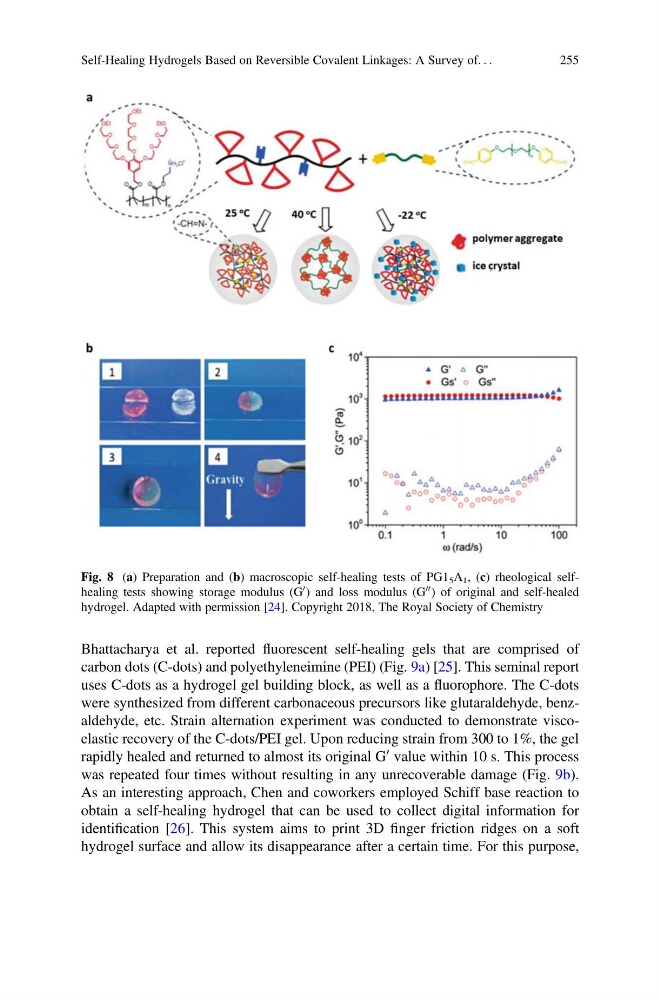
Fig. 8 (a) Preparation and (b) macroscopic self-healing tests of PG1 5 A 1 , (c) rheological selfhealing tests showing storage modulus (G
0 ) and loss modulus (G
00 ) of original and self-healed
hydrogel. Adapted with permission [24]. Copyright 2018, The Royal Society of Chemistry
Self-Healing Hydrogels Based on Reversible Covalent Linkages: A Survey of. . .
255
carbon dots (C-dots) and polyethyleneimine (PEI) (Fig. 9a) [25]. This seminal report
uses C-dots as a hydrogel gel building block, as well as a fluorophore. The C-dots
were synthesized from different carbonaceous precursors like glutaraldehyde, benzaldehyde, etc. Strain alternation experiment was conducted to demonstrate viscoelastic recovery of the C-dots/PEI gel. Upon reducing strain from 300 to 1%, the gel
rapidly healed and returned to almost its original G
0 value within 10 s. This process
was repeated four times without resulting in any unrecoverable damage (Fig. 9b).
As an interesting approach, Chen and coworkers employed Schiff base reaction to
obtain a self-healing hydrogel that can be used to collect digital information for
identification [26]. This system aims to print 3D finger friction ridges on a soft
hydrogel surface and allow its disappearance after a certain time. For this purpose,
Fig. 8 (a) Preparation and (b) macroscopic self-healing tests of PG1 5 A 1 , (c) rheological selfhealing tests showing storage modulus (G
0 ) and loss modulus (G
00 ) of original and self-healed
hydrogel. Adapted with permission [24]. Copyright 2018, The Royal Society of Chemistry
Self-Healing Hydrogels Based on Reversible Covalent Linkages: A Survey of. . .
255